Last Updated: August 9, 2026
Introduction
Seoul heavy rain can change a normal travel day quickly. A short walk may become difficult, an outdoor plan may need to change, and your usual route may no longer be the right choice.
The first step is not to keep following your original plan. Check the current weather and safety alerts, check your route, and look for any closures, flooding, or transportation changes before you move.
This guide explains what to check during heavy rain in Seoul, how to adjust your transportation or walking route, and what to do next if conditions change while you are already outside.
Heavy rain in Seoul? Check the current situation before you keep following your original route.
If you found this image while searching for Seoul heavy rain travel information, the most important question is not simply how much rain is falling. You need to know whether your current route, transportation, and destination are still practical to use.
Heavy rain in Seoul can affect walking routes, outdoor attractions, roads, station access, and transportation conditions. A route that looked simple when you planned your trip may need to change when current warnings, closures, or flooding affect the area.
Start here: Check current alerts → check your route → avoid flooded or restricted areas → change your plan if needed.
The next section shows what to check first, so you can make the next decision based on current conditions instead of continuing with an outdated travel plan.
Seoul heavy rain can change more than an outdoor sightseeing plan. Walking routes, road access, station entrances, transportation services, and destination access may also change as conditions develop.
This guide is not simply a list of rainy-day places to visit in Seoul. It is designed to help you decide what to check first and what to do next when heavy rain affects your trip.
Heavy rain starts
↓ Check current weather and safety information
↓ Check your route and current restrictions
↓ Decide what to do next
A place or route should not be treated as permanently safe or dangerous just because an older map or travel guide describes it that way. Heavy rain conditions, flooding, closures, and transportation disruptions can change. Current official information, on-site restrictions, and local instructions should guide your decision.
If you are traveling with a large suitcase, using a wheelchair or stroller, or have limited mobility, check more than the transportation method itself. Consider station access, elevators, outdoor walking distance, crossings, slopes, and the final route to your destination.
The next step is simple: check the current situation before you move. The following section shows exactly what to check first when heavy rain begins in Seoul.
Table of Contents
Quick Answer: What Should You Do First?
Seoul heavy rain starts. What should you check first? Check the current alerts, check your route, and decide whether your original travel plan still makes sense.
Not sure what to do first? Use this quick decision flow before you continue with your original route during Seoul heavy rain.
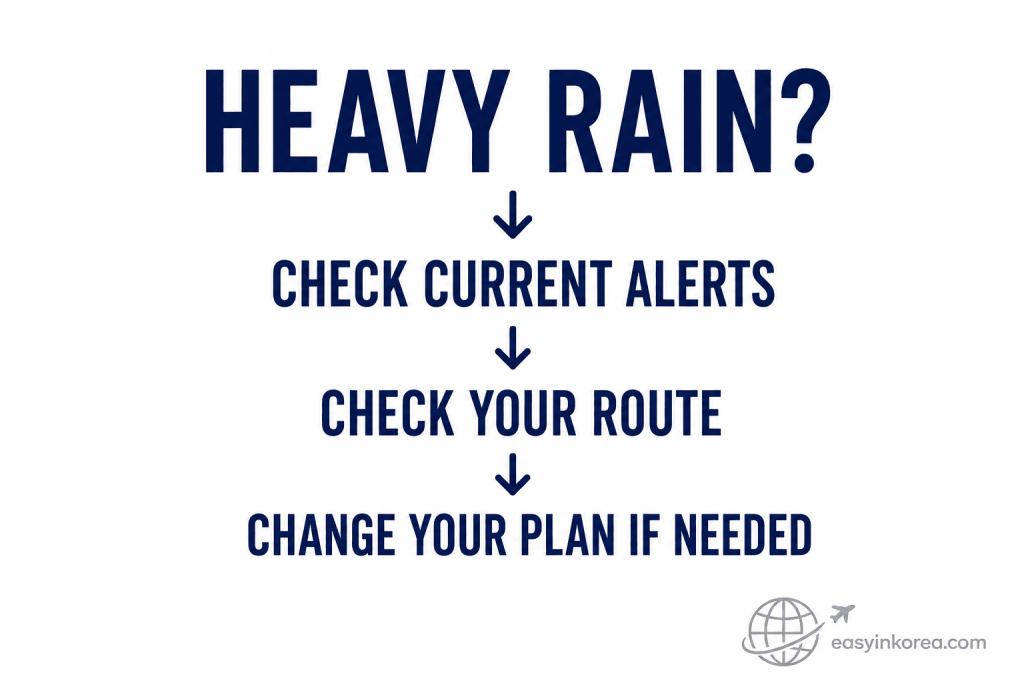
If you found this image while searching for Seoul heavy rain advice, start with the order shown above. Do not choose a transportation method or keep walking before you know what is happening on your actual route.
First, check current weather and emergency alerts. Then check whether your route is affected by flooding, closures, transportation changes, or other current restrictions. Only after those checks should you decide whether to continue, wait, or change the plan.
Quick rule: Current alerts → route conditions → next action.
The same rule matters if you are carrying luggage, using a wheelchair or stroller, or have limited mobility. A route may require more outdoor walking, different station access, or a different final entrance when conditions change.
Next, check the current warning before you leave. That will help you decide whether your planned route still makes sense today.
During Seoul heavy rain, check current weather and emergency alerts first. Then check your actual route for flooding, closures, transportation changes, or other restrictions before deciding whether to continue your trip.
What should you check first during heavy rain in Seoul?
Check current alerts first, then check your actual route. If you find flooding, closures, or other restrictions, do not keep following the original plan. Choose the next practical action based on current conditions.
This order matters because a transportation option can still be operating while part of your full trip is affected. A subway may be running, for example, while the station exit or final outdoor walking route needs to be checked separately.
If you use a wheelchair or stroller, have limited mobility, or are carrying heavy luggage, check the full route before moving. Look at elevator access, station or boarding access, outdoor walking distance, crossings, slopes, and the final entrance. An available elevator alone does not confirm that the entire route works for your needs.
Use these four checks as the starting point for every decision in this guide: current information → actual route → current restrictions → next action.
Check the Current Warning Before You Leave
The rain outside your window does not tell you the whole situation. During Seoul heavy rain, check current warnings and travel conditions before you decide to leave.
A weather app may show rain, but that alone does not tell you whether there is a heavy rain warning, a local safety alert, a transportation disruption, or a temporary closure affecting your route. Check the most current information before you move.
What should you check before leaving during heavy rain in Seoul?
Check the current weather warning first, then check safety alerts and the latest conditions for the transportation route you plan to use. If current signs or official information show a closure or restriction, adjust your route or delay the trip.
Do not rely only on a rain icon, a screenshot, or an older travel guide. Heavy rain warnings, road access, station entrances, closures, and transportation conditions can change during the day.
If you use a wheelchair or stroller, have limited mobility, or are carrying heavy luggage, current route information matters even more. Check elevator access, station or boarding access, outdoor walking sections, crossings, slopes, and the final entrance before leaving.
Use this order when information differs: current official warning → current transportation information → current on-site signs and staff guidance.
Should You Go Out or Wait?
Do you really need to leave now? During Seoul heavy rain, check the current alerts and your route before deciding whether to go out, wait, or change your plan.
Do you need to leave right now? Use this quick decision before going out during Seoul heavy rain.
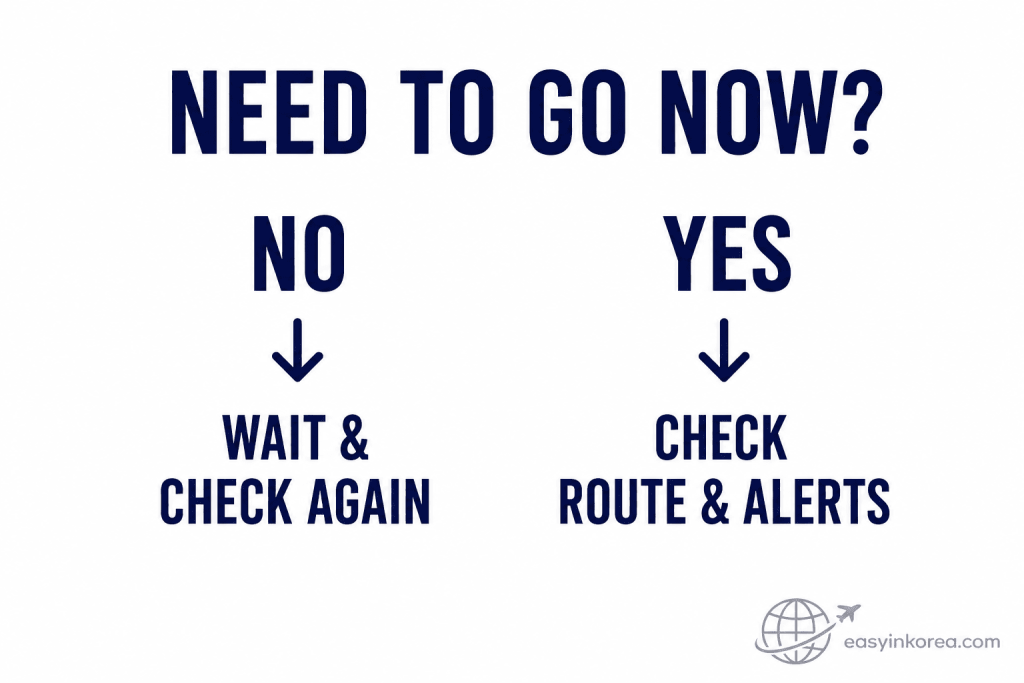
If you found this image while searching for Seoul heavy rain travel advice, start by asking whether the trip really needs to happen now. A flexible sightseeing plan and a time-sensitive airport or hotel transfer may require different decisions.
If you do not need to leave immediately, waiting and checking the situation again may reduce unnecessary travel. If you do need to go, check current alerts, transportation conditions, road or station restrictions, and the outdoor sections of your actual route before leaving.
Quick decision: No urgent trip → wait and check again. Need to go now → check route and alerts first.
This decision also matters if you use a wheelchair or stroller, have limited mobility, or are carrying heavy luggage. Check the full route, including station access, elevators, outdoor walking, crossings, slopes, and the final entrance rather than looking only at the transportation method.
The next question is whether the route itself is still usable. If you find flooding or a current restriction, the safest next action is not to force the original route.
Seoul heavy rain does not automatically mean that every trip must stop. The better question is whether you need to travel now and whether your full route still works under current conditions.
Should you go out during heavy rain in Seoul?
Go only after checking current alerts, the reason for your trip, your actual route, transportation conditions, outdoor walking, and current restrictions. If the trip can wait, checking the situation again before leaving may be the more practical choice.
If the trip can wait
Wait and check current conditions again before leaving. An outdoor attraction, shopping stop, neighborhood walk, or other flexible activity can be moved without forcing an unnecessary trip through worsening conditions.
If you need to go now
Check the route and current alerts first. Reduce unnecessary outdoor walking when practical, but do not assume that one transportation method is automatically safe or suitable in every heavy-rain situation.
If you are carrying heavy luggage, a short outdoor section may require more effort than usual. Check elevator access, walking distance, the pickup or drop-off point, and the final street route rather than choosing transportation from travel time alone.
If you use a wheelchair or stroller or have limited mobility, check the full step-free route separately. Confirm station or boarding access, elevators, street-level access, curbs, crossings, slopes, current restrictions, and the final entrance. An available elevator does not confirm that every part of the route is usable.
The decision is therefore not simply go out or stay inside. It is check the current situation → decide whether the trip is necessary now → check the full route → go, wait, or change the plan.
Avoid Flooded and Restricted Areas
A familiar route can become a different route during Seoul heavy rain. If you see flooding, a closure, or a restricted area, do not keep following the route simply because you normally use it.
Water on your route? Do not test the depth or keep moving forward. Use this quick safety decision during Seoul heavy rain.
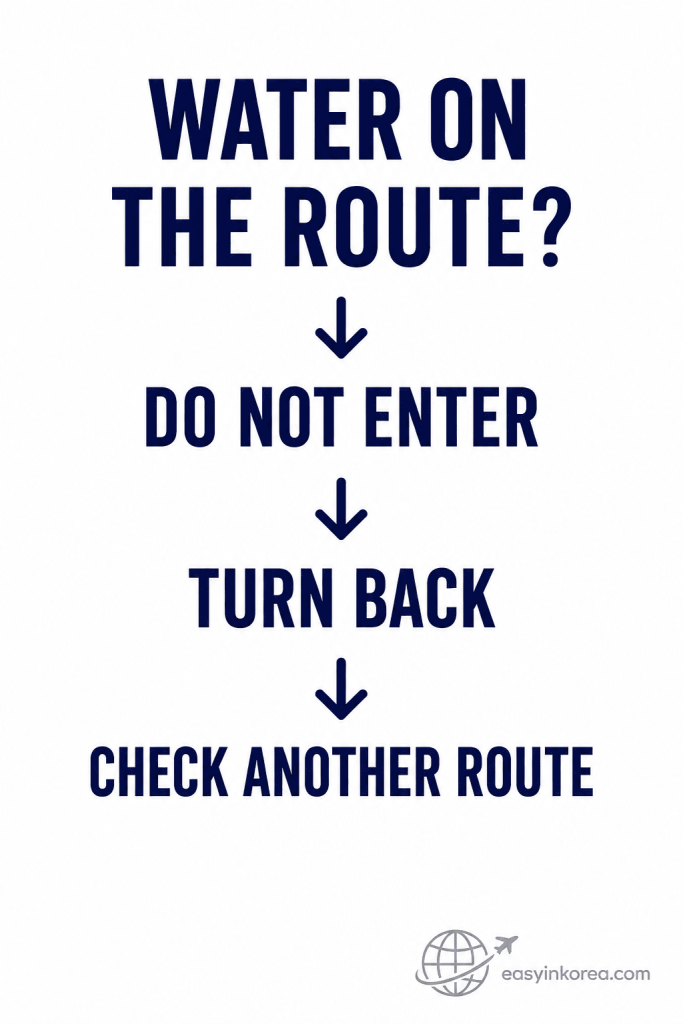
If you found this image while searching for Seoul heavy rain or flood safety information, the key rule is simple: do not enter a route that is flooded, closed, or currently restricted.
Do not rely on how shallow the water looks or how familiar the route normally feels. Heavy rain can change road access, underpasses, riverside paths, station entrances, and pedestrian routes quickly.
Quick rule: Water or restriction ahead → do not enter → turn back → check another route.
If you use a wheelchair or stroller, have limited mobility, or are carrying heavy luggage, do not assume that a short detour will work for the full trip. Check step-free access, crossings, slopes, outdoor walking distance, and the final entrance before choosing the alternate route.
The next step is to understand which environments need extra caution during heavy rain, especially streams, riversides, low-lying routes, and places where current access may change.
During Seoul heavy rain, do not judge a flooded or restricted route by appearance alone. Water depth, current flow, road conditions, access restrictions, and nearby drainage conditions may be difficult to assess from where you are standing.
What should you avoid during heavy rain in Seoul?
Avoid flooded roads, underpasses, streams and riverbanks, low-lying areas, restricted routes, and underground spaces affected by flooding. If access is blocked or water is on the route, do not enter. Turn back and check another route.
Do not try to estimate whether the water is shallow enough, moving slowly enough, or safe enough to cross. A traveler cannot reliably judge every local condition from appearance alone.
Use this priority: current official safety information → current closures and barriers → on-site signs and staff instructions → alternate route.
If you use a wheelchair or stroller, have limited mobility, or are carrying heavy luggage, a detour also needs a full-route check. Confirm step-free access, crossings, slopes, outdoor walking distance, station access, and the final entrance before choosing the alternate path.
The practical rule is simple: do not test a flooded or restricted route yourself. Stop, turn back, and use current information to choose another route.
Be Extra Careful Near Streams and Rivers
Rain can change a waterside walking route quickly. During Seoul heavy rain, check current access and closure information before entering a streamside or riverside path.
Streams and riverside areas should not be treated as permanently open or permanently unsafe. Conditions can change with the weather, so make the decision from current access information rather than from an old itinerary, photo, map, or previous visit.
Should you enter a streamside or riverside path during heavy rain in Seoul?
Check the current access status first. If the path is closed, restricted, or blocked by an official barrier, do not enter. Follow the current closure and choose another route or activity.
Example: Cheonggyecheon Stream
Cheonggyecheon is a useful example of why current conditions matter. It is a well-known walking area in central Seoul, but travelers should not assume that normal access conditions apply during every period of heavy rain.
If access is currently restricted or closed, change the walking plan instead of trying to complete the original itinerary. The same decision rule applies to other streamside and riverside routes.
Decision rule: Current closure or on-site safety guidance → follow it first → change the original itinerary if necessary.
This does not mean that Cheonggyecheon, riversides, or other waterside areas should be labeled as permanent “flood zones.” The useful question for a traveler is whether the specific route is open and usable under current conditions.
If you use a wheelchair or stroller, have limited mobility, or are carrying heavy luggage, do not assume that an alternate entrance or detour will provide the same access. Check step-free access, slopes, crossings, outdoor walking distance, and the full route to your next destination before changing paths.
Keep the priority simple: current closure > original itinerary. If current access control or on-site safety guidance changes your plan, follow the current information first.
Taking the Subway During Heavy Rain
The subway may reduce outdoor walking, but it does not remove every travel risk during Seoul heavy rain. Check the full trip from station access to the final outdoor walk.
Do not use a simple rule such as “subway = safe.” The subway may reduce time outside, but you still need to check whether you can enter the station, whether the service is operating normally, whether the exit you need is usable, and what happens after you reach street level.
Is the subway a good option during heavy rain in Seoul?
It can be useful when it reduces outdoor walking, but only if the full route still works. Check station access, current service, exit conditions, and the final outdoor walk before you decide.
Full-trip check: station access → current service → exit condition → final outdoor walk.
This is why arriving at the correct subway station and arriving at your final destination are two different decisions. The rail portion may work normally while the last part of the trip still needs to be changed.
If you are carrying heavy luggage, check elevators, transfer distance, station exits, and the final street route. Reducing outdoor walking can help, but a transfer with stairs or a long final walk may still create a difficult trip.
If you use a wheelchair or stroller or have limited mobility, check the full step-free route separately. Confirm elevator access, concourse and platform access, street-level access, curbs, crossings, slopes, current restrictions, and the final entrance. An elevator inside one part of the station does not confirm that the full route is usable.
Use the subway when it still works for the full trip, not simply because it keeps part of the journey underground.
Taking a Bus or Taxi During Heavy Rain
Less outdoor walking can help, but road conditions still matter during Seoul heavy rain. Check traffic, road access, pickup and drop-off points, and the final walk before choosing a bus or taxi.
A bus or taxi may reduce outdoor walking, especially when you have luggage or need to avoid a long walk between stations. However, neither option is automatically the safest or fastest choice during heavy rain. The full road trip still depends on current conditions.
Is a bus or taxi better during heavy rain in Seoul?
It depends on current road conditions, traffic, pickup and drop-off access, service availability, and how much outdoor walking remains at both ends of the trip. Check those conditions before you choose.
Full-trip check: traffic → road restrictions → pickup point → drop-off point → final walking distance → current availability.
If you are carrying heavy luggage, a taxi or direct bus may reduce transfers and outdoor walking, but check where the vehicle can actually stop and how far you must walk to the final entrance. A short vehicle trip does not always mean a short full trip.
If you use a wheelchair or stroller or have limited mobility, check curb access, boarding access, vehicle accessibility when relevant, the drop-off location, crossings, slopes, and the final entrance. A nearby pickup or drop-off point does not by itself confirm that the full route is step-free.
Choose a bus or taxi when it fits the full route under current conditions, not because one option is assumed to be the safest or fastest during heavy rain.
Traveling With Heavy Luggage?
A short walk feels very different with a suitcase during Seoul heavy rain. Check the outdoor walking distance and the final route before choosing how to travel.
Got a heavy suitcase? Reduce unnecessary outdoor walking, but check the full route before choosing how to travel during Seoul heavy rain.
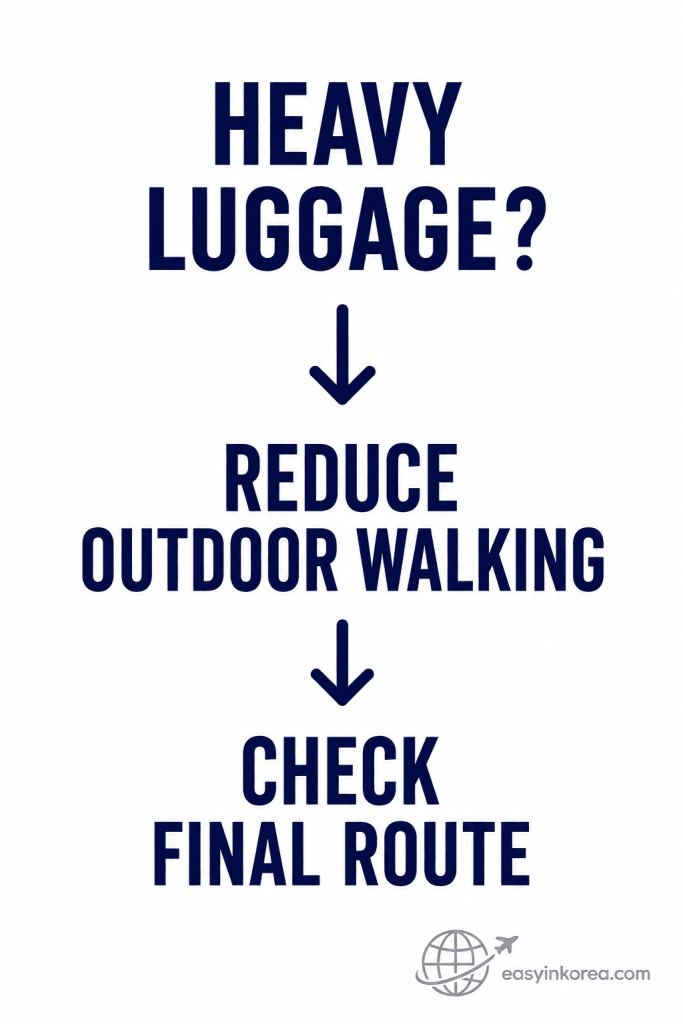
If you found this image while searching for Seoul heavy rain advice with luggage, do not choose transportation from travel time alone. A route that looks short can still include stairs, transfers, exposed walking, or a long final street section.
Start by reducing unnecessary outdoor walking. Then check elevator access, transfer distance, the walk to the boarding point, the drop-off location, and the route from your final stop to the actual entrance you need.
Luggage rule: Reduce outdoor walking → check elevator and transfer access → check the final street route.
A taxi or direct bus may reduce transfers in some situations, while a subway route may reduce road travel in others. There is no single transport option that is automatically right for every traveler with luggage during heavy rain.
If you use a wheelchair or stroller or have limited mobility, treat accessibility as a separate check. Confirm step-free access, platform or boarding access, street level, crossings, slopes, and the final entrance rather than assuming that a luggage-friendly route is also fully accessible.
Next, compare the full route from where you are now to the final entrance. That is the part of the trip that matters most when rain and luggage combine.
During Seoul heavy rain, traveling with a large suitcase can change which route is practical. Do not compare transportation by travel time alone. Check the parts of the trip where you will actually need to carry, pull, or move your luggage.
What should you check first when traveling with heavy luggage in the rain?
Check elevator access first, then check the total walking distance, and finally check the outdoor street route from your last stop to the entrance you actually need.
Luggage check: CHECK ELEVATOR → CHECK WALKING DISTANCE → CHECK FINAL STREET ROUTE
The difference becomes more noticeable when you are holding an umbrella with one hand and pulling a suitcase with the other. Stairs, wet pavement, curb edges, crowded entrances, and water collecting along the walking route can make a normally simple transfer more difficult.
This does not mean that a taxi is automatically the right answer. A taxi may reduce transfers and walking in some situations, but you still need to check traffic, pickup access, the drop-off point, current road conditions, and the final walk to the entrance.
A subway or direct bus may also work when elevators, boarding access, and the final route fit your trip. Compare the full journey with luggage rather than choosing a transport method from one feature alone.
Is a luggage-friendly route the same as an accessible route?
No. Luggage and accessibility should be checked separately. A traveler may be able to carry a suitcase over a curb or use a short flight of stairs, while a wheelchair or stroller route may require continuous step-free access.
If you use a wheelchair or stroller or have limited mobility, check elevator continuity, platform or boarding access, street-level access, curbs, crossings, slopes, current closures, and the final entrance. Do not assume that a route suitable for luggage is automatically suitable for mobility needs.
The practical rule is simple: reduce unnecessary outdoor walking, but check the full route before you move.
Wheelchair, Stroller, or Limited Mobility?
Step-free access matters even more when the route changes during Seoul heavy rain. Check the full path from station or boarding access to the final entrance, not just whether an elevator exists.
Accessibility should be checked separately from heavy luggage. A route that works for someone pulling a suitcase may still include a curb, stairs, a steep slope, or a street crossing that changes whether the full trip works for a wheelchair, stroller, or traveler with limited mobility.
What should you check for a step-free route during heavy rain in Seoul?
Check elevator continuity, platform or concourse access, street-level access, curbs, crossings, slopes, the final entrance, and any current flooding or closure that affects the route.
Step-free route check: elevator → platform/concourse → street level → curb → crossing → slope → final entrance → current flooding or closure.
Does an elevator mean the whole route is accessible?
No. An elevator only confirms one part of the trip. The full route may still include an inaccessible transfer, curb, crossing, slope, closed exit, flooded section, or entrance with steps.
If you are traveling with both heavy luggage and limited mobility, check the two problems separately. Reducing walking can help with luggage, while accessibility requires continuous step-free access from the starting point to the final entrance.
Current information matters more during heavy rain. If an elevator, entrance, crossing, or normal path is unavailable, do not assume the shortest detour is usable. Check the complete alternate route before moving.
The practical rule is: check the entire step-free journey, not one accessible feature.
Change Your Outdoor Plan If Needed
Your plan can change when the weather changes. During Seoul heavy rain, you do not need to complete an outdoor itinerary just because you planned it in advance.
If an outdoor activity is flexible, changing the plan can be more practical than trying to complete the original itinerary in worsening conditions. Check current alerts, access conditions, and transportation before deciding what to do next.
What can you do instead of an outdoor activity during heavy rain in Seoul?
Consider an indoor attraction, museum, shopping complex, café or rest stop, hotel rest time, or move the outdoor activity to another day. Check current access and operating information before you go.
Simple rule: You do not need to complete the original itinerary today.
An indoor location should not automatically be treated as “100% safe.” Access conditions, underground areas, building operations, nearby streets, and transportation can still be affected by heavy rain. Follow current official information and on-site instructions.
If you use a wheelchair or stroller or have limited mobility, check the alternate plan as a new full route. Confirm step-free access, elevators, crossings, slopes, outdoor walking distance, current closures, and the final entrance before changing destinations.
A changed plan is still a valid travel day. Check current conditions, choose a practical alternative, and return to the outdoor activity when conditions allow.
What If Transportation Is Disrupted?
Your normal route may no longer be the useful route during Seoul heavy rain. If service, station access, exits, or roads change, stop and check the current situation before continuing.
Transportation disruptions can affect more than one part of a trip. A train may still be running while a station entrance is closed, an exit may change, or a road restriction may affect the final section of the route.
What should you do if transportation is disrupted during heavy rain in Seoul?
Stop following the old route, check current transportation and access information, look for another usable route, and ask staff if the situation is unclear.
Recovery rule: STOP → CHECK CURRENT INFORMATION → CHECK ANOTHER ROUTE → ASK STAFF IF NEEDED
Do not assume that a route saved earlier in the day is still the most practical route now. Check current service information, station notices, road restrictions, on-site signs, and staff guidance before you continue.
If you are carrying heavy luggage, compare the replacement route by elevator access, transfer distance, outdoor walking, and the final street route. A detour that looks short on a map may require more walking or stairs.
If you use a wheelchair or stroller or have limited mobility, check the alternate route as a complete step-free journey. Confirm elevators, platform or boarding access, street-level access, curbs, crossings, slopes, current closures, and the final entrance before changing routes.
The goal is not to force the original plan to work. Use the most current information to choose the next usable route from where you are now.
What If You Are Already Outside?
The rain suddenly becomes much heavier while you are walking. During Seoul heavy rain, stop and check your current location, alerts, and nearby conditions before deciding where to go next.
Already outside and the rain is getting worse? Stop first and use this recovery check before continuing during Seoul heavy rain.
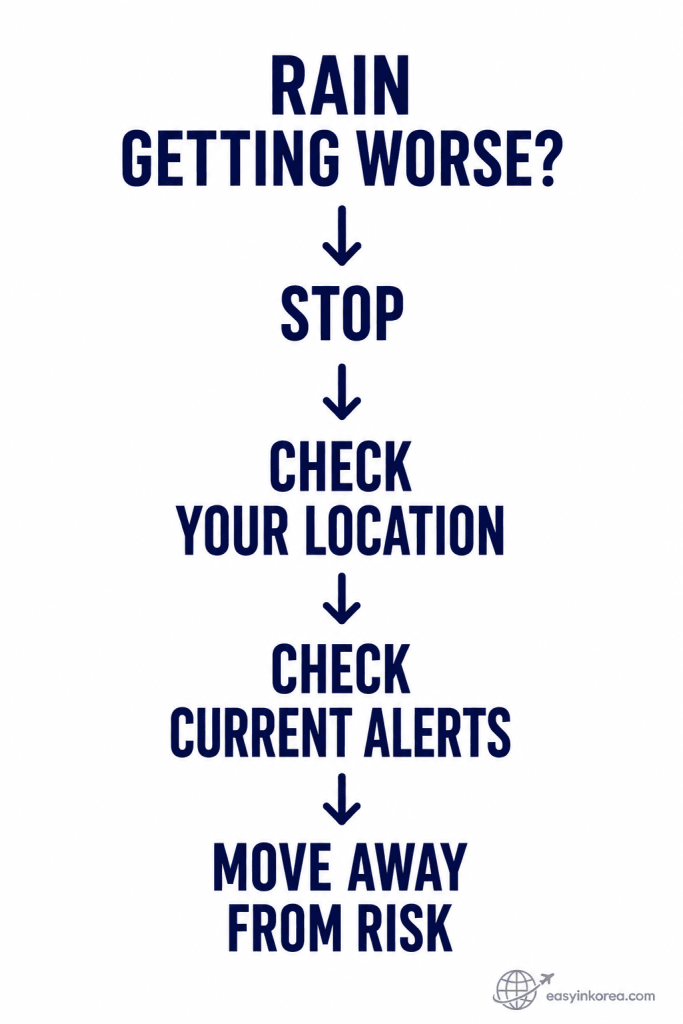
If you found this image while searching for Seoul heavy rain safety advice, the first step is to stop following the original route automatically. Check where you are and what is happening around you before deciding where to move next.
Check current weather and emergency alerts, nearby closures, barriers, road or station restrictions, and any visible flooding affecting your route. If the area ahead is restricted or conditions are worsening, move away from the affected area and follow current official or on-site instructions.
Recovery rule: STOP → CHECK YOUR LOCATION → CHECK CURRENT ALERTS → MOVE AWAY FROM RISK
Do not use one automatic rule such as “go underground” or “take the subway.” The useful next action depends on your current location, nearby access conditions, flooding, closures, and official guidance.
If you are carrying heavy luggage, check whether the new route adds stairs, transfers, or exposed walking. If you use a wheelchair or stroller or have limited mobility, confirm continuous step-free access, crossings, slopes, street-level access, and the final entrance before using an alternate route.
Once you are away from the immediate problem, check the situation again and rebuild the trip from your current location instead of trying to return automatically to the original plan.
If the rain suddenly gets worse while you are already outside during Seoul heavy rain, stop following the original route automatically. Check your current location and the conditions around you before deciding where to move next.
What should you do if heavy rain gets worse while you are already outside in Seoul?
Stop, check your location, review current weather and emergency alerts, move away from flooded or restricted areas, and follow current official or on-site instructions before rebuilding your route.
Recovery check: STOP → CHECK YOUR LOCATION → CHECK CURRENT ALERTS → MOVE AWAY FROM RISK → REBUILD YOUR ROUTE
Should you always go underground when heavy rain gets worse?
No. Do not use “go underground” as an automatic rule. Underground spaces, station entrances, underpasses, and other low areas can also be affected by flooding or access restrictions. Check your current location and official guidance before choosing where to move.
If you need time to check the situation again, use an appropriate nearby location only when it is currently open and accessible and does not require you to cross a flooded or restricted route. Continue to follow current official and on-site instructions.
If you are carrying heavy luggage, check whether the new route adds stairs, long transfers, or exposed outdoor walking. Reducing distance can help, but do not choose a route that requires crossing water or ignoring a current restriction.
If you use a wheelchair or stroller or have limited mobility, check the replacement route as a complete step-free journey. Confirm elevator continuity, street-level access, curbs, crossings, slopes, current closures, and the final entrance before moving.
The practical rule is: do not force the old route to work when the conditions have changed. Stop, check what is happening now, move away from the affected area when needed, and choose the next route from your current location.
What Travelers Wish They Knew During Heavy Rain
During Seoul heavy rain, a route that looked simple on a map can feel very different once you are outside with luggage, wet streets, and changing access conditions.
You leave the subway with your suitcase.
The rain is much heavier than it was before.
Your hotel looks close on the map.
But water is collecting along the street you planned to use.
This is the moment to check the situation again, not simply keep walking because the route looked short on the map. The useful decision now comes from what is happening in front of you, not from the plan you made earlier.
What do travelers often realize too late during heavy rain in Seoul?
A short route on the map does not always mean a simple route in current conditions. Outdoor walking, stairs, wet pavement, water on the street, station exits, luggage, and temporary closures can change the final part of the trip.
Traveler lesson: Check what is happening now, not only what the map said before you left.
With heavy luggage, this matters even more. Holding an umbrella while pulling a suitcase can make stairs, wet pavement, curb edges, crossings, and a short detour feel very different from a normal dry-weather walk.
If you use a wheelchair or stroller or have limited mobility, check the complete replacement route rather than assuming that a nearby detour is usable. Confirm step-free access, elevators, street-level access, curbs, crossings, slopes, current closures, and the final entrance.
The useful habit is simple: look at the situation in front of you, check current information, and change the route when the real conditions no longer match the original plan.
Useful Korean Phrases During Heavy Rain
A short question can help when the normal route changes during Seoul heavy rain. Keep these Korean phrases ready to say or show when you need directions or current access information.
You do not need a long Korean sentence to ask for help. These short phrases are useful when a street, station exit, walking route, or other access point has changed because of current conditions.
What Korean phrases are useful when heavy rain changes your route?
Ask whether you can continue, whether the route is closed, whether another route is available, or where you should go next. You can say the phrase or show the Korean text to staff.
Quick tip: If speaking is difficult, show the Korean phrase on your phone and point to your current route or destination.
Use these questions to confirm the situation rather than trying to interpret a barrier or closure yourself. If staff or authorities give you a different route, follow the current instruction instead of the original itinerary.
If you use a wheelchair or stroller or have limited mobility, showing the route on your phone can also help you confirm whether the suggested alternative includes an elevator or another step-free path.
Keep the goal simple: ask what is usable now, understand the next direction, and follow current on-site guidance.
FAQ: Seoul Heavy Rain
These quick answers cover common decisions travelers may face during Seoul heavy rain, from transportation and flooded routes to current warnings and changing outdoor plans.
Heavy rain conditions can change during the day. Use these answers as a decision guide, then check current official warnings, transportation information, closures, and on-site instructions before you move.
1. Is it safe to travel around Seoul during heavy rain?
There is no single yes-or-no answer for every trip. Travel conditions depend on current weather warnings, flooding, closures, transportation conditions, and the route you need to use.
Next action: Check current alerts and your full route. Avoid flooded or restricted areas and change or delay the trip when current conditions require it.
2. Should I use the subway during heavy rain in Seoul?
The subway can reduce outdoor walking, but it is not automatically the right option in every situation. Station access, current service, exit conditions, and the final outdoor walk still matter.
Next action: Check station access → current service → exit condition → final outdoor walk before choosing the subway.
3. Should I take a taxi instead?
A taxi may reduce transfers and outdoor walking, but it is not automatically the safest or fastest option during heavy rain. Traffic, road restrictions, pickup access, drop-off access, and availability can all change.
Next action: Compare the full trip, including the walk to the pickup point and the walk from the drop-off point to your final entrance.
4. What should I do if a road is flooded?
Do not enter or try to judge the water depth yourself. A flooded route can be difficult to assess from appearance alone.
Next action: Turn back, check current restrictions and official information, and choose another route.
5. Is it safe to walk near Cheonggyecheon during heavy rain?
Do not treat Cheonggyecheon as permanently open or permanently unsafe. Access can change according to current weather and safety conditions.
Next action: Check current access information, barriers, warnings, and on-site guidance. If access is closed or restricted, do not enter.
6. What should I do if my outdoor attraction closes?
You do not need to complete the original itinerary that day. A closure is a reason to change the plan, not to look for another way around the restriction.
Next action: Consider an indoor attraction, museum, shopping complex, café, hotel rest time, or move the outdoor activity to another day. Check current access before traveling to the alternative.
7. Where can I check heavy rain warnings in Korea?
Check the Korea Meteorological Administration for current weather warnings and Safe Korea for disaster and safety information. Also check current Seoul and transportation-operator information when your route may be affected.
Next action: Compare official warnings with current transportation information and the on-site signs or staff guidance where you are traveling.
8. What should I check first if I am already outside?
Stop and confirm your current location first. Then check current alerts, nearby flooding, closures, barriers, transportation changes, and official or on-site instructions.
Next action: Move away from an affected or restricted area when needed and rebuild the route from your current location instead of automatically continuing with the original plan.
Quick summary: current alerts → current route → current restrictions → next practical action.
If you are carrying heavy luggage, also check elevators, walking distance, transfers, and the final street route. A transportation option that looks simple may still include difficult outdoor sections during heavy rain.
If you use a wheelchair or stroller or have limited mobility, check the full step-free journey separately. Confirm elevator continuity, platform or boarding access, street-level access, curbs, crossings, slopes, current closures, and the final entrance.
Current official information, closures, barriers, and on-site instructions take priority when they differ from an older map, screenshot, or travel guide.
Check Current Official Information
Heavy rain conditions, warnings, closures, and transportation disruptions can change quickly. During Seoul heavy rain, use current official information before relying on an older map, screenshot, or travel guide.
Different official sources answer different questions. Check the source that matches the decision you need to make, then compare that information with current conditions at your location.
Where should you check official information during heavy rain in Seoul?
Check the Korea Meteorological Administration for current weather and warnings, Safe Korea for disaster and heavy-rain safety information, Seoul Metropolitan Government for Seoul-specific safety guidance, and the relevant transportation operator for current service information. Follow current on-site signs, barriers, staff guidance, and emergency instructions where you are.
Information priority: current official warning → current operator information → current on-site restrictions and instructions.
Do not treat an old screenshot, saved route, blog post, or earlier opening status as permanent information. Weather warnings, road access, station entrances, closures, and transportation services can change during a heavy-rain event.
If you use a wheelchair or stroller or have limited mobility, check current accessibility information as part of the same process. An elevator that was available earlier may not confirm that the full route, street-level access, crossing, slope, or final entrance is usable now.
When current official information or on-site instructions differ from an older guide, follow the current information first.
Disclaimer
This Seoul heavy rain guide provides general travel and navigation information. Weather, flooding, transportation, and access conditions can change quickly.
This guide is intended to help travelers understand practical options and checks during heavy rain in Seoul. It does not replace current weather warnings, emergency alerts, transportation notices, road restrictions, closures, or instructions from local authorities.
Current information takes priority: official warnings → current restrictions → on-site signs, staff, and emergency instructions.
Weather conditions, flood risk, station access, road conditions, transportation services, and facility closures may change after this guide is published or updated. Check current official information before you travel and again if conditions change while you are outside.
If you use a wheelchair or stroller, have limited mobility, or are carrying heavy luggage, recheck the full route when conditions change. An available elevator, nearby station, or short distance does not confirm that the complete route or final entrance is usable.
If current official warnings, restrictions, or on-site instructions differ from this guide, follow the current official information.
Conclusion
Seoul heavy rain does not automatically mean every trip must stop, but your original itinerary should never take priority over current conditions.
Heavy rain can change walking routes, station access, road conditions, transportation services, and outdoor plans. The useful response is not to force the original itinerary to work, but to check what is happening now and choose the next practical action.
What should you remember most during heavy rain in Seoul?
Check current alerts, check your actual route, avoid flooded or restricted areas, and change or delay the plan when current conditions require it.
If you are carrying heavy luggage, do not compare transportation by travel time alone. Check elevator access, walking distance, transfers, pickup or drop-off points, and the final street route to the entrance you actually need.
If you use a wheelchair or stroller or have limited mobility, check the complete step-free journey separately. Confirm elevator continuity, platform or boarding access, street-level access, curbs, crossings, slopes, current closures, and the final entrance.
Current information first: If an official warning, closure, barrier, transportation notice, or on-site instruction differs from an older map, screenshot, or travel guide, follow the current information.
A changed route or delayed activity is not a failed travel day. When conditions change, rebuilding the plan from where you are now can be more useful than trying to complete every step exactly as planned.
Easy in Korea focuses on the next practical step: check the current situation, understand the route in front of you, and make the next decision with less uncertainty.
Related Guides
Continue with the guide that matches your next practical step after checking weather, transportation, or route conditions in Seoul.