Last Updated: August 9, 2026
Seoul Jjimjilbang Etiquette: What to Know Before You Start
First time at a jjimjilbang? The biggest question is usually simple: what am I supposed to do first?
First time at a jjimjilbang in Seoul? Start with the basic visit flow, then use the guide below to check each step before you move into the next area.
Looking for Seoul jjimjilbang etiquette before your first visit?
This guide explains the visit in the order you are likely to experience it: entering the facility, storing your shoes and belongings, changing, washing before the bath, moving between bathing and common areas, respecting privacy, and checking out.
Start with the next section: learn what to check first so you know what to do before entering each part of the jjimjilbang.
A jjimjilbang can feel confusing on your first visit. Where do you put your shoes? When do you change? Do you wash before entering the bath? Understanding the basic order makes Seoul jjimjilbang etiquette much easier to follow.
What should you know before your first jjimjilbang visit?
Start with the facility’s current rules. Then follow the visit step by step: store your shoes and belongings, change where directed, wash before entering a shared bath, and check the rules again when you move into another area.
The exact process is not identical everywhere. Jjimjilbangs may use different layouts, locker systems, towels, clothing, payment methods, bathing areas, and additional services. A rule you saw at one facility may not apply at the next one.
The simple rule
Follow the current signs and staff instructions at the jjimjilbang you are actually visiting instead of assuming every Korean bathhouse works the same way.
You also do not need to understand every custom before you walk through the door. The important things are knowing which area you are entering, respecting other guests’ privacy, washing before using a shared bath, and asking staff when the next step is unclear.
If you use a wheelchair, stroller, or have limited mobility, check more than the main entrance. Locker areas, showers, bathing spaces, hot rooms, toilets, elevators, steps, wet floors, and the final exit route may have different access conditions. The full route through the facility matters.
This guide follows the visit from entrance to checkout. You will see what to check before you go, what usually happens after you enter, how bathing and common areas differ, which privacy rules matter, and what to do when you are unsure.
Table of Contents
Quick Answer: What Should You Do First?
First visit? Start by understanding the order before you move into the next area.
Not sure what happens first? Use this simple order to understand the basic jjimjilbang process before you move from one area to the next.
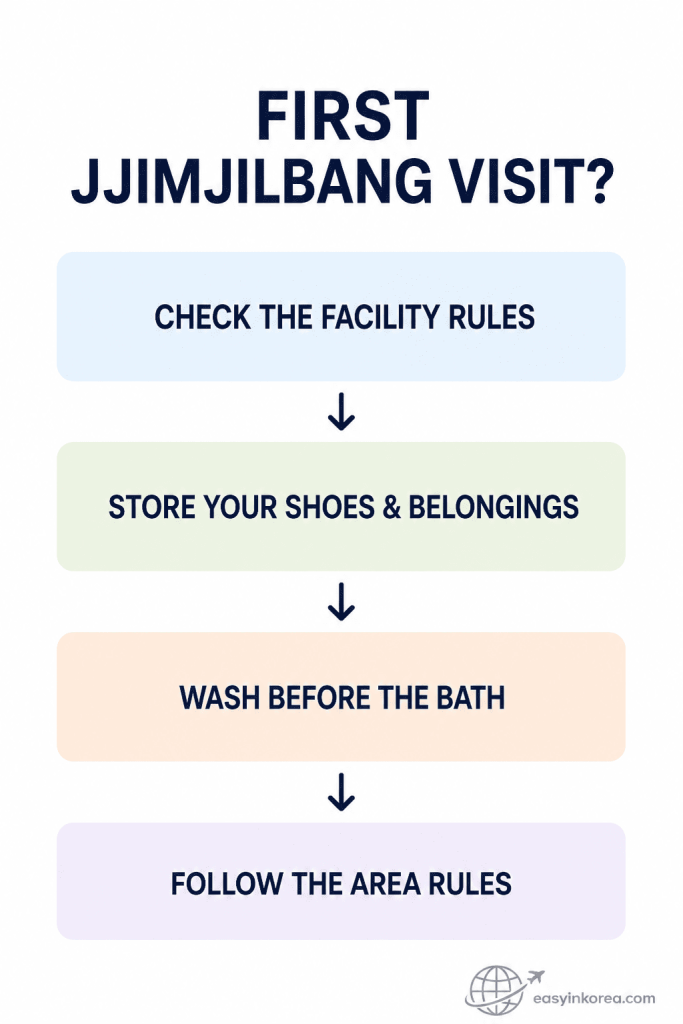
What does this first-visit order mean?
The basic Seoul jjimjilbang etiquette flow is to check the facility rules first, store your shoes and belongings, wash before entering a shared bath, and follow the rules for the area you are using.
The exact layout, locker system, clothing, payment method, and available facilities can vary. Use this image as the basic order, then follow the current signs and staff instructions at the jjimjilbang you actually visit.
Keep reading: the next steps explain what to check before you go, what happens at the entrance, and how to tell which rules apply in bathing and common areas.
What should you do on your first jjimjilbang visit?
Check the facility’s rules first. Store your shoes and belongings, change where directed, wash before entering a shared bath, and follow the rules for each area.
This is the basic order to remember when learning Seoul jjimjilbang etiquette. You do not need to know every custom before you enter, but you should understand which area you are using and what the facility expects you to do next.
The exact process can vary by facility. Some jjimjilbangs may use different shoe lockers, changing areas, keys or wristbands, towels, clothing, payment systems, bathing areas, or additional services.
What should you check if the layout is different?
Stop and check the current signs or ask staff. Do not assume the next jjimjilbang will use the same system as the last one you visited.
If you use a wheelchair, stroller, or have limited mobility, check the full route before moving deeper into the facility. Look at the entrance, locker area, shower access, bathing area, common rooms, toilets, elevators, steps, wet floors, and the route back to the exit.
Your first goal is simple: understand the order, follow the current facility rules, and confirm the next step before entering a new area.
Check the Facility Before You Go
Can I just show up? Check the facility’s current rules and opening information before you leave.
Can you visit any jjimjilbang without checking first?
Not always. Before you go, check the facility’s current opening hours, admission rules, available areas, payment methods, and any temporary restrictions that could affect your visit.
A useful part of Seoul jjimjilbang etiquette is knowing that each facility can operate differently. A place that was open late in the past may now use different hours, and services or access rules can also change.
Check these before you leave
Opening hours: Check the current opening and closing time for the day you plan to visit.
Admission rules: Confirm current entry requirements and whether any areas have separate access conditions.
Available areas: Check whether the bath, jjimjilbang rooms, rest areas, or other facilities you want to use are currently available.
Late-night or overnight access: If you plan to stay late or overnight, confirm that this is currently allowed.
Children and family rules: Check age-related or family access rules before visiting with children.
Tattoo policy: If this matters for your visit, check whether the facility has a current tattoo policy or any specific instructions.
Luggage and storage: Confirm whether large bags, suitcases, or other belongings can be stored safely at the facility.
Payment methods: Check which payment methods are accepted and whether extra services are paid separately.
Temporary closures: Look for maintenance, renovation, private events, or temporary area closures before you travel there.
Do not assume every jjimjilbang is open 24 hours
Opening hours and overnight access can change by facility, day, or current operating policy. Check the jjimjilbang’s current information before making a late-night or overnight plan.
If you use a wheelchair, stroller, or have limited mobility, check access before you arrive. Ask about the entrance, elevators, locker and changing areas, shower access, toilets, bathing spaces, common rooms, steps, and any areas that may not be part of a continuous step-free route.
Best next step: confirm the facility you actually plan to visit, then check its current rules and access information before starting the trip.
What Should You Bring?
Do I need to bring everything myself? Bring the personal items you may need, then check what the facility currently provides.
What should you bring to a jjimjilbang?
Bring the personal items you expect to use after bathing, such as clean clothes, toiletries, hair products, and any glasses or contact-lens supplies you need. Also bring a payment method accepted by the facility.
When preparing for your first visit, Seoul jjimjilbang etiquette is less about packing a fixed list and more about checking what the facility already provides. Towels, toiletries, jjimjilbang clothes, and other basic items may be included, sold, rented, or handled differently depending on the location.
Useful items to consider
Clean clothes: Bring something comfortable to wear after bathing if you plan to change before leaving.
Personal toiletries: Bring your own shampoo, conditioner, body-care items, or other products if you prefer specific brands or products.
Hair products: Bring any combs, brushes, hair ties, or styling products you expect to use afterward.
Personal care items: Pack any small hygiene or grooming items you normally need after a shower or bath.
Payment method: Check which cards, cash, mobile payments, or other payment methods the facility currently accepts.
Glasses or contact-lens supplies: Bring a case, solution, or other items you need to store or use them safely.
Are towels and jjimjilbang clothes always provided?
Not necessarily. Towels, toiletries, and jjimjilbang clothes may be provided, sold, rented, or managed differently by each facility. Check the current facility information instead of assuming a fixed number of towels or a standard clothing system.
If you use a wheelchair, stroller, or have limited mobility, bring any personal support items you normally rely on, and check whether the facility can store them safely. Also confirm whether changing areas, showers, bathing spaces, toilets, and common rooms have enough space for your needs.
Best next step: check what your chosen jjimjilbang currently provides, then pack only the personal items you still need.
What Happens When You Enter?
Where do I go first? Start at the entrance, check how this jjimjilbang handles entry, and follow the signs before moving farther inside.
Just walked in? Use this as a basic entry flow, but check the current signs and staff instructions before assuming the next step is the same at every jjimjilbang.
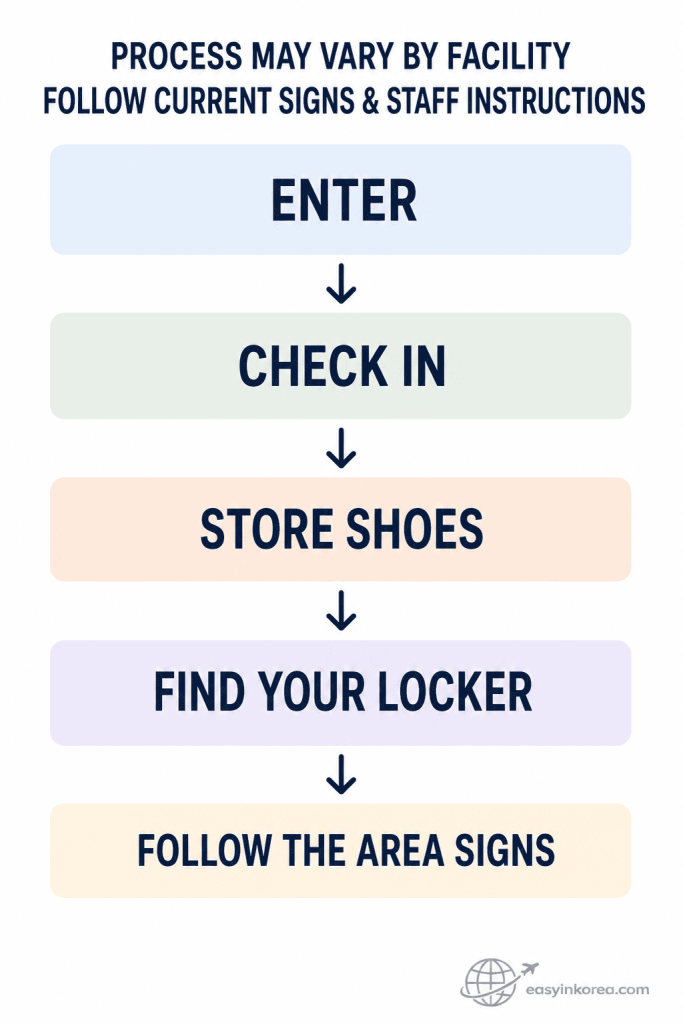
What should you do after entering a jjimjilbang?
A common Seoul jjimjilbang etiquette flow is to check in, store your shoes, locate your locker, and then follow the signs for the area you need. This gives first-time visitors a simple way to understand what may happen after entering.
The exact order can vary by facility. Shoe lockers may come before or after check-in, and keys, wristbands, changing areas, or locker systems may also work differently. Follow the current signs and staff instructions at the jjimjilbang you are visiting.
Keep reading: the next part explains what happens at the entrance in more detail and what to check if the system does not match this basic flow.
What usually happens after you enter a jjimjilbang?
You will usually need to complete the facility’s entry process, store your shoes, identify your locker or changing area, and then follow the signs for the next part of your visit. The exact order can vary.
A common Seoul jjimjilbang etiquette flow may involve a reception counter or kiosk, shoe storage, a locker or key system, and a changing area. Treat this as a basic pattern, not a fixed sequence that applies to every facility.
What might be different?
Check-in: You may check in at a staffed counter, kiosk, or another entry point depending on the facility.
Shoes: Some facilities may direct you to store your shoes before check-in, while others may use a different order.
Locker access: A locker may be linked to a key, wristband, receipt, number, or another system.
Changing area: Follow the current signs and staff instructions so you know where to change and which area comes next.
Do all jjimjilbangs use wristbands?
No. Some facilities use wristbands, while others may use keys, receipts, locker numbers, cards, or another system. Check what you are given at entry and ask staff if you are unsure how it works.
Keep any key, wristband, receipt, card, or locker information secure during your visit. If the item is connected to your locker, purchases, or checkout, losing it may make the next step more difficult.
If you use a wheelchair, stroller, or have limited mobility, check the route before leaving the entrance area. Confirm how to reach the locker and changing area, whether elevators or steps interrupt the route, how much space is available, and whether the next area continues as a step-free path.
If the process looks different from this guide: stop, check the current signs, and ask staff what to do next. The facility’s current instructions take priority over a general entry sequence.
Shoes and Locker Etiquette
Shoes off here? Check the shoe area first, then confirm which locker or storage space belongs to you.
Where should you put your shoes and belongings?
Use the shoe storage and locker system provided by the facility. Check your locker number or key carefully, store valuables securely, and follow the signs before moving into the changing or bathing area.
Shoes and lockers are a practical part of Seoul jjimjilbang etiquette. In Korea, removing shoes before entering certain indoor spaces is common, but the exact shoe-storage process at a jjimjilbang can vary by facility.
Check these before moving on
Shoe area: Look for the place where shoes should be removed and stored before entering farther into the facility.
Locker number: Confirm the number, key, wristband, receipt, or other identifier connected to your storage space.
Valuables: Store wallets, passports, phones, jewelry, and other important items according to the facility’s current storage system.
Key or wristband: Keep any item linked to your locker or account secure during your visit.
Area signs: Check where the changing room, bathing area, or next section begins before you continue.
What if you cannot tell which locker is yours?
Stop and check the number or identifier you received at entry. If it is still unclear, ask staff before placing your belongings in another locker.
Do not assume every facility uses the same system. Some jjimjilbangs may separate shoe storage from clothing lockers, while others may connect them through a key, wristband, card, or another method.
If you use a wheelchair, stroller, or have limited mobility, check whether the shoe and locker area can be reached without unnecessary steps or narrow passages. Also look for enough space to change, sit, turn, or manage personal belongings safely before continuing.
Simple rule: check the shoe area, confirm your locker, secure your belongings, and follow the current facility signs before entering the next space.
Where Are You Supposed to Be Naked?
Do I wear the jjimjilbang clothes everywhere? Check which area you are entering first, because bathing and common jjimjilbang spaces can use different clothing rules.
Not sure what to wear next? Check which area you are entering before you change, because bathing and common jjimjilbang spaces may use different clothing rules.
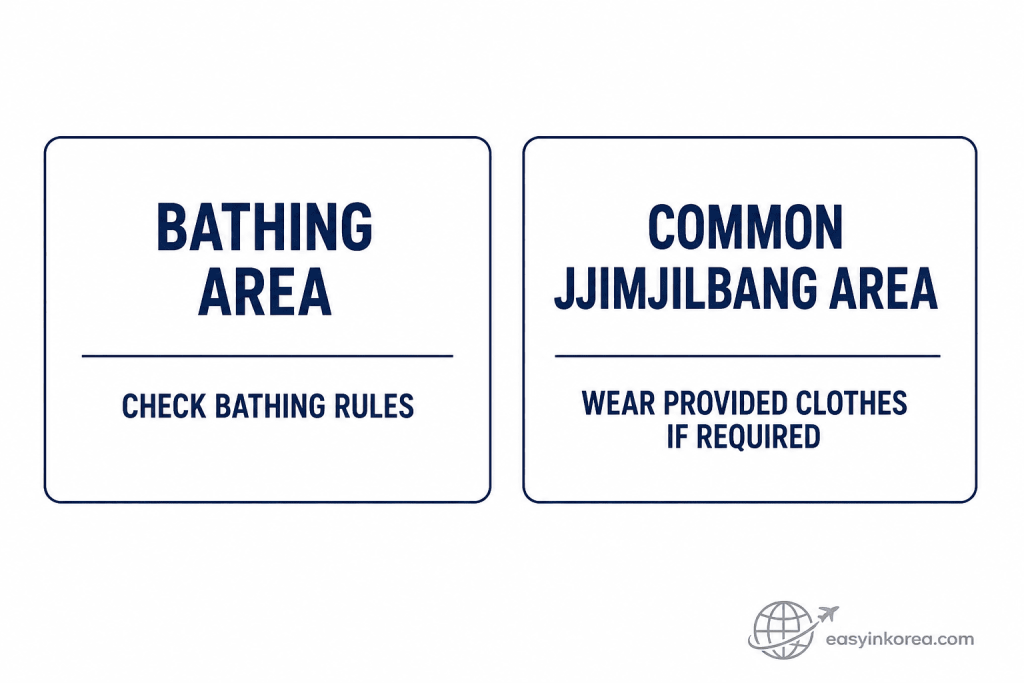
Do you wear the same clothes in every part of a jjimjilbang?
Not necessarily. A key part of Seoul jjimjilbang etiquette is checking which area you are entering. Bathing areas and common jjimjilbang spaces can have different clothing and privacy rules.
Do not assume the same rule applies throughout the building. Check the current facility signs, changing-area instructions, and staff guidance before moving between spaces.
Keep reading: the next part explains how bathing and common areas usually differ and what first-time visitors should check before changing or entering a shared space.
Do you wear the same clothes in every part of a jjimjilbang?
No. The bathing and changing areas are usually separate from the common jjimjilbang spaces. Check which area you are entering and follow the current clothing, bathing, and privacy rules for that space.
Understanding this difference is one of the most important parts of Seoul jjimjilbang etiquette. A jjimjilbang may include both bathing areas and shared relaxation or heated-room spaces, but they do not necessarily use the same clothing rules.
Bathing and Changing Area
These areas are typically separated according to the facility’s bathing and changing arrangements.
Check the posted rules before changing, showering, or entering a shared bath. Do not assume that clothing or swimsuit rules are identical at every facility.
Common Jjimjilbang Area
Common areas may include rest spaces, heated rooms, food areas, or other shared facilities.
Wear the clothing required by the facility and check any room-specific instructions before entering another space.
Are you supposed to be naked everywhere inside a jjimjilbang?
No. Do not treat the entire jjimjilbang as one bathing space. Clothing and privacy expectations can change when you move between the changing area, bathing area, and common jjimjilbang spaces.
The safest practical approach is to check the signs before crossing into a new area. If the clothing rule is unclear, stop and ask staff instead of copying another guest or assuming that the previous area’s rule still applies.
Privacy is especially important in changing and bathing spaces. Keep phones and cameras stored or used only where the facility clearly allows them, and follow any posted privacy instructions.
If you use a wheelchair, stroller, or have limited mobility, check whether the route between the changing area, bathing area, and common spaces is continuous for your needs. Look for steps, wet floors, narrow passages, elevator access, door thresholds, seating, and the route back to the locker and exit.
Simple rule: identify the area first, check the current signs, then follow the clothing and privacy rules for that specific space.
Wash Before Entering the Bath
Can I go straight into the hot bath? Wash first, then check the bathing-area rules before entering a shared bath.
Ready to enter the bath? Check this basic bathing sequence first so you know what to do before stepping into a shared bath.
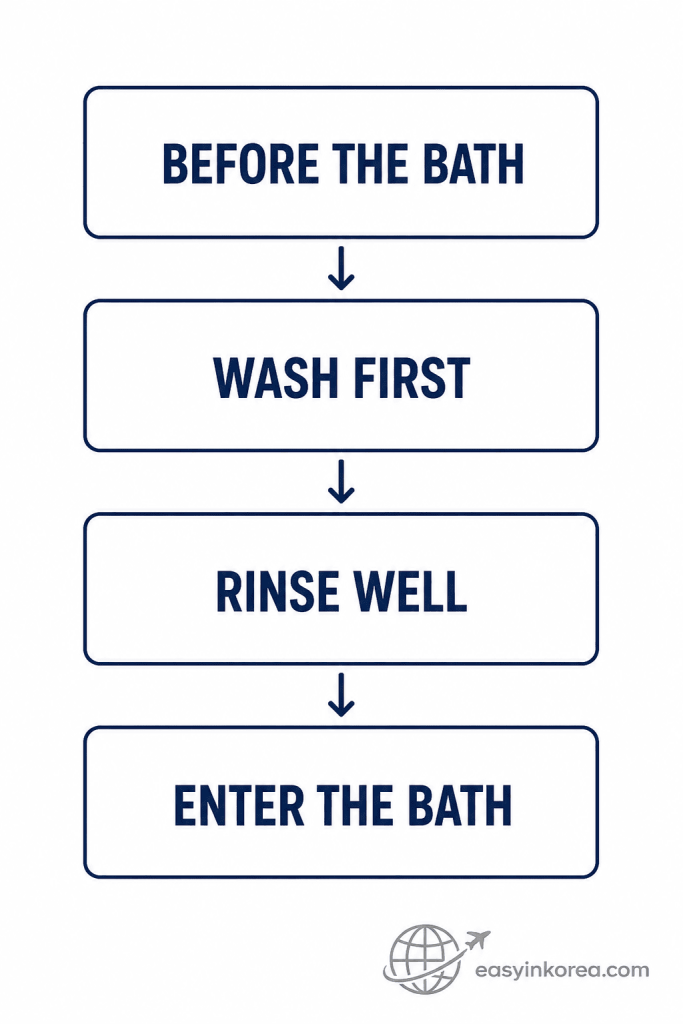
Should you wash before entering a jjimjilbang bath?
Yes. Washing before entering a shared bath is an important part of Seoul jjimjilbang etiquette. Wash first, rinse well, and then enter the bath after checking the current rules for that bathing area.
The exact shower setup, toiletries, bathing layout, and posted instructions can vary by facility. Follow the signs and staff guidance at the jjimjilbang you are actually visiting.
Keep reading: the next part explains the basic bathing etiquette to follow once you are inside the bathing area.
Should you wash before entering a shared bath?
Yes. Wash your body before entering a shared bath. Rinse well, then check the current bathing-area rules before you step into the water.
Washing first is one of the basic parts of Seoul jjimjilbang etiquette. Official public-bath guidance for foreign residents in Korea also describes showering and washing your hair before entering the bath.
Before you enter the bath
Wash first: Clean your body at the shower or washing area before entering a shared bath.
Rinse well: Rinse off soap, shampoo, and other products before stepping into the bath.
Check the area rules: Look for current signs or instructions before entering, because bathing layouts and house rules can vary by facility.
Can you wash or scrub inside the shared bath?
Use the designated washing area for washing and scrubbing. Official public-bath guidance also advises against scrubbing your body or washing clothes in the bath itself.
Do not rely only on what another guest is doing. The shower setup, washing stations, toiletries, bath layout, and posted instructions may be different at the jjimjilbang you visit.
If you use a wheelchair, stroller, or have limited mobility, check the complete route from the changing area to the washing area and bath. Wet floors, steps, thresholds, seating, handrails, and the way in and out of the bath can matter even when the main facility has an elevator.
Simple rule: wash first, rinse well, then follow the current bathing-area instructions before entering the shared bath.
Basic Bathing Etiquette
What should I avoid doing in the bath? Keep washing activities in the designated area, respect shared space, and follow the current bathing rules.
What is the basic etiquette inside a jjimjilbang bath?
Wash before entering, use the shared bath for soaking rather than washing or scrubbing, respect other guests’ space, and follow the facility’s posted rules.
These simple habits are an important part of Seoul jjimjilbang etiquette. Once you enter a shared bath, the goal is to keep the water and surrounding space comfortable for everyone using it.
DO
Wash before entering: Clean and rinse your body before stepping into a shared bath.
Follow posted rules: Check current signs for the bath you are using.
Keep personal items where directed: Use the storage or washing area provided for toiletries and other belongings.
Respect shared space: Give other guests room and keep your movements calm around wet areas.
DON’T
Do not wash clothes in the bath: Use only the areas permitted by the facility.
Do not scrub your body inside the shared bath: Use the designated washing area instead.
Do not ignore restrictions: Follow posted instructions even if another guest appears to be doing something different.
Do not treat the bath like a swimming pool: Shared baths are for bathing and soaking, not active swimming or play.
Can you scrub or wash clothes inside the shared bath?
No. Use the designated washing area for washing and scrubbing. Public-bath guidance for foreign residents in Korea also advises against scrubbing your body or washing clothes in the bath itself.
If you use a wheelchair, stroller, or have limited mobility, check the wet-floor route around the washing and bathing areas. Handrails, steps, bath edges, seating, thresholds, and enough space to turn or transfer can matter more than whether the main entrance has an elevator.
Simple rule: wash outside the shared bath, use the bath for soaking, respect the people around you, and follow the current facility rules.
Hair, Towels, and Personal Items
Where does the towel go? Keep hair, towels, toiletries, and personal items out of the shared bathing space unless the facility tells you otherwise.
What should you do with towels and personal items in the bathing area?
Keep towels, toiletries, glasses, and other personal items where the facility directs you to place them. Avoid letting personal belongings interfere with shared baths, walkways, or washing spaces.
Small details like these are part of Seoul jjimjilbang etiquette. The exact towel, storage, and washing-area setup can vary, so follow the posted instructions at the facility you are using.
Check these before you enter the shared bath
Long hair: Keep long hair controlled so it does not fall into the shared bath or interfere with other guests.
Towels: Place or carry towels according to the facility’s instructions instead of assuming there is one universal rule.
Toiletries: Keep shampoo, soap, brushes, and other washing items in the designated washing or storage area.
Glasses: Put glasses in a secure place when you do not need them, especially around wet or hot areas where they could be damaged or misplaced.
Personal items: Keep phones, jewelry, bags, and other belongings where they will not block shared spaces or create a privacy problem.
Is there one correct place for every towel and personal item?
No. Storage and towel rules can differ by facility. Check the current signs and use the racks, shelves, lockers, or other spaces provided for that area.
If you use a wheelchair, stroller, or have limited mobility, keep personal items arranged so they do not reduce the space you need to move safely. Check whether towels, toiletries, glasses, or mobility-related items can be reached without blocking a transfer area, wet walkway, or changing space.
Simple rule: keep personal items out of shared bathing space, use the storage provided, and follow the facility’s posted instructions.
Phone, Camera, and Privacy Rules
Privacy matters most in changing and bathing areas. Keep phones and cameras away unless the facility clearly allows their use in that specific space.
About to use your phone? Check which area you are in first. Changing and bathing spaces require extra care because other guests’ privacy comes before taking a photo or video.
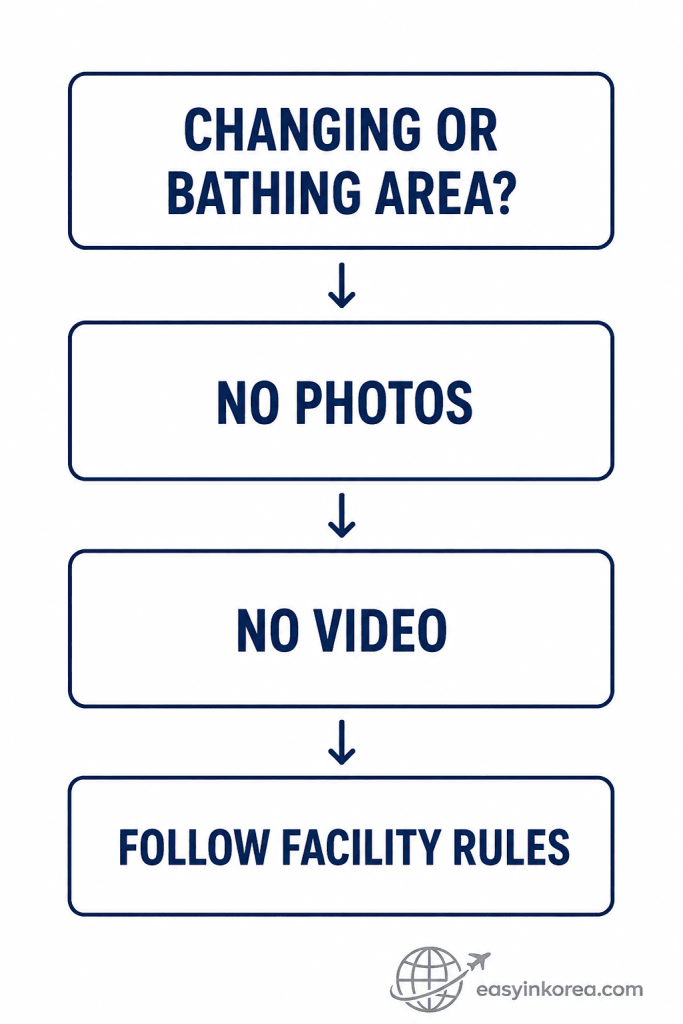
Can you take photos or videos inside a jjimjilbang?
Do not take photos or videos in changing or bathing areas. Protecting other guests’ privacy is an important part of Seoul jjimjilbang etiquette.
Phone and camera rules outside those areas may vary by facility. Check the current signs and staff instructions before taking photos in common rooms, food areas, rest spaces, or other shared parts of the jjimjilbang.
Keep reading: the section below explains how to handle phones, cameras, and personal privacy without assuming the same rule applies to every part of the facility.
Can you take photos or videos inside a jjimjilbang?
Do not take photos or videos in changing or bathing areas. In other parts of the facility, check the current phone and camera rules before recording or photographing anything.
Respecting privacy is an important part of Seoul jjimjilbang etiquette. Changing and bathing areas are private spaces where other guests may be undressed, so your phone or camera should never interfere with their privacy.
Check the area before using your phone
Changing area: Do not take photos or videos. Keep the camera away and protect the privacy of everyone using the space.
Bathing area: Do not photograph or record people, baths, or the surrounding space.
Common area: Phone and camera rules may be different. Check current signs or ask staff before taking a photo or video.
When unsure: Put the phone away first, then confirm whether photography or recording is allowed in that specific area.
What if you only want to check a message?
First check where you are and what the facility allows. Even when you are not taking a photo, using a phone in a privacy-sensitive area can make other guests uncomfortable or create confusion about whether the camera is active.
Do not rely on another guest’s phone use as proof that something is allowed. The facility’s current signs and staff instructions are the better guide, especially when you move from a common space into a changing or bathing area.
If you use a wheelchair, stroller, or have limited mobility, you may need your phone for navigation, communication, or assistance. If you need to use it in or near a privacy-sensitive area, check with staff first and move to an appropriate space when possible.
Simple rule: no photos or videos in changing or bathing areas. In other spaces, check the current facility rules before using your camera.
Using the Common Jjimjilbang Area
Finished bathing. What happens next? Dry off, return to the changing area, and check what you should wear before entering the common jjimjilbang spaces.
What should you do after finishing in the bathing area?
Dry off, return to the changing area, wear the clothing required by the facility, and then follow the signs to the common jjimjilbang spaces, hot rooms, or rest areas.
This transition is another important part of Seoul jjimjilbang etiquette. The bathing area and the common jjimjilbang area are not the same space, so clothing and behavior rules may change when you move between them.
A common transition after bathing
Dry off: Finish in the bathing area and dry yourself before returning to the changing space.
Return to the changing area: Use the locker and changing space assigned or indicated by the facility.
Check what to wear: Put on the facility clothing if it is required for the common jjimjilbang area.
Follow the area signs: Look for directions to shared rest areas, heated rooms, food areas, or other facilities you want to use.
Check each room: Individual rooms may have their own temperature, footwear, clothing, or usage instructions.
Do you keep the same rules after leaving the bathing area?
Not necessarily. Common jjimjilbang spaces can use different clothing, footwear, phone, food, and room-specific rules. Check the current signs before entering another area.
Do not assume every hot room or rest space works the same way. Some may have different temperatures, seating arrangements, entry instructions, or restrictions. Use the posted information for the room you are about to enter.
If you use a wheelchair, stroller, or have limited mobility, check the full route from the changing area to the common spaces. Look for elevator continuity, steps, thresholds, slopes, floor changes, seating, door width, and the route back to the locker and exit.
Simple rule: finish bathing, dry off, check what to wear, then follow the signs and room-specific instructions before moving into the common jjimjilbang area.
Using Hot Rooms Safely
How long should I stay inside? Do not follow a fixed time. Check the room information, pay attention to how you feel, and leave when you need to.
How long should you stay in a jjimjilbang hot room?
There is no single time that fits every person or every room. Hot rooms can vary in temperature and conditions, so check the posted information and leave if you become uncomfortable.
Safe hot-room use is part of practical Seoul jjimjilbang etiquette. The goal is not to stay for a certain number of minutes. The goal is to notice how your body feels and avoid forcing yourself to remain in a hot space.
What should you check before and during a hot-room visit?
Room information: Check the posted temperature, warnings, and any room-specific instructions before entering.
How you feel: Leave the room if you feel dizzy, weak, overheated, short of breath, or otherwise unwell.
Cooling down: Take a break when you need one instead of trying to stay longer.
Hydration: Drink water when needed and avoid treating dehydration as something to push through.
Staff help: If you feel unwell or are unsure about a room, leave and ask staff for assistance.
Should you follow a fixed hot-room routine?
No. Do not assume you should stay for a set number of minutes, move to a cold room, and repeat the same cycle a certain number of times. Follow the current room information and stop when your body tells you to stop.
Public-bath guidance in Korea also advises caution around prolonged exposure to high heat and sauna use after drinking alcohol. If alcohol or another condition could affect how you respond to heat, do not use a hot room casually or rely on a fixed routine.
If you use a wheelchair, stroller, or have limited mobility, check the route into and out of the hot room before entering. Door thresholds, floor level changes, seating height, transfer space, room temperature, and the distance back to a cooler rest area can all affect whether the room works for you.
Simple rule: check the room, pay attention to how you feel, cool down when needed, drink water, and leave if you become uncomfortable.
Food, Drinks, and Payment Inside
Can I buy something without my wallet? Maybe. Check how the facility handles purchases before ordering food, drinks, or extra services.
How do you pay for food, drinks, or extra services inside a jjimjilbang?
It depends on the facility. Some jjimjilbangs may connect purchases to a locker key, wristband, card, or account, while others may use a separate payment method.
Payment inside the facility is another practical part of Seoul jjimjilbang etiquette. Do not assume that a wristband always works as a payment tool or that every purchase will be added to your locker account.
Check how each purchase works
Snack bar or café: Check whether you pay immediately or charge the purchase to the facility’s internal payment system.
Restaurant: Confirm the payment method before ordering, especially if you left your wallet in a locker.
Drinks: Water and other drinks may be available from a counter, machine, or another service point depending on the facility.
Extra services: Body scrubs, massages, rentals, or other optional services may use a separate payment or booking process.
Final settlement: If purchases are added to your locker, key, wristband, or account, check how and when the balance is settled before leaving.
Do all jjimjilbangs use a wristband for payment?
No. A wristband may be used at some facilities, but others may use a key, card, receipt, cash, direct card payment, or another system. Check the method used at the jjimjilbang you are visiting.
Sikhye and baked eggs are often associated with the jjimjilbang experience, but they are optional food and drink choices, not etiquette requirements. Availability and menu items can vary by facility.
If you use a wheelchair, stroller, or have limited mobility, check whether food counters, payment points, vending machines, and seating areas can be reached without steps or narrow passages. Also check whether you can carry food or drinks safely while using any mobility aid.
Simple rule: check how the facility handles purchases before ordering, keep track of any charges linked to your account, and confirm the final payment process before checkout.
What About Seshin — Korean Body Scrub?
Is the body scrub included? Not always. Check whether seshin is available, how much it costs, and how the facility handles booking before you use the service.
What is seshin at a jjimjilbang?
세신 (seshin) is a Korean body-scrub service that may be offered inside or near the bathing area. It is usually an optional service rather than something automatically included with admission.
Understanding how optional services work is another practical part of Seoul jjimjilbang etiquette. Seshin availability, price, booking method, payment process, and preparation instructions can vary by facility.
Check these before booking a body scrub
Availability: Check whether the facility currently offers seshin and when the service is available.
Extra charge: Confirm the current price and whether the service is paid separately from admission.
Booking: Ask whether you need to reserve at a counter, speak to staff, use a number system, or follow another process.
Payment: Check whether payment is made directly, added to a locker or facility account, or handled another way.
Before the service: Ask staff what you should do before your appointment instead of following a fixed soaking time or routine from another facility.
Do you need to soak for a fixed amount of time before seshin?
Do not assume a fixed preparation time. Ask the facility or service staff what they want you to do before the body scrub starts.
Do not assume that a clipboard, locker number, wristband, or one specific booking method is standard. The process may be different at the jjimjilbang you visit.
If you use a wheelchair, have limited mobility, or need help transferring, check the service area before booking. Ask about steps, table or bed height, transfer space, wet-floor access, and whether staff can explain how the service is arranged for your needs.
Simple rule: treat seshin as an optional service, confirm the current price and booking process, and ask staff what to do before it starts.
Traveling With Children or Family?
Can the whole family use the same areas? Not always. Check the facility’s current child, bathing-area, and family access rules before you visit.
Can families stay together throughout a jjimjilbang visit?
Not necessarily. Bathing and changing areas may be separated, while common jjimjilbang spaces may follow different access rules. Check the facility’s current arrangements for children and families before visiting.
For families, understanding the difference between bathing and common areas is an important part of Seoul jjimjilbang etiquette. Do not assume that parents and children can enter every area together or that the same arrangement applies at every facility.
Check these before bringing children
Bathing areas: Check how the facility separates or organizes its bathing and changing spaces and which area each family member may use.
Child access rules: Confirm the facility’s current rules for children rather than relying on an age limit from another jjimjilbang or an older travel guide.
Parent and child arrangements: Ask whether any rule affects which bathing or changing area a parent and child can enter together.
Common areas: Shared rest spaces and other common jjimjilbang areas may work differently from the bathing section, so check their access rules separately.
Room-specific restrictions: Check signs before taking children into hot rooms, rest spaces, or other individual facilities.
Is there one age rule for children at every jjimjilbang?
Do not assume so. Child access and parent-child arrangements can depend on the facility and the area being used. Check the current rules directly with the jjimjilbang before your visit.
If your family may need to separate for the bathing or changing area, decide what to do afterward before going inside. Choose a clear meeting point in an appropriate common area and make sure everyone who can navigate independently knows how to reach it.
Families traveling with a stroller, wheelchair user, senior, or anyone with limited mobility should also check the complete route between the entrance, lockers, changing areas, bathing areas, and common spaces. Elevator access at the entrance does not guarantee that every part of the facility is step-free.
Before you go: confirm the facility’s current child and family rules, understand which areas may separate your group, and choose a meeting point if your family will need to split up.
Wheelchair, Limited Mobility, or Other Access Needs?
Can I use the whole facility step-free? Check the complete route, not just the entrance, because access can change between lockers, showers, baths, common areas, and the exit.
Does an elevator at the entrance mean the whole jjimjilbang is step-free?
No. An elevator at the entrance does not guarantee step-free access through the entire facility. Check the full route from entry to changing, bathing, common areas, toilets, and the exit.
Accessibility is an important part of practical Seoul jjimjilbang etiquette planning. A route can become difficult even when the building entrance itself looks accessible.
Check the full route
Entrance: Check for steps, ramps, door width, thresholds, and elevator access.
Changing area: Confirm that the route is wide enough and that there is enough space to sit, turn, or change safely.
Locker: Check locker height, reach, space in front of the locker, and whether the assigned area works for your needs.
Shower area: Look for wet floors, steps, seating, handrails, thresholds, and enough room to move safely.
Bathing area: Check the bath edge, entry method, handrails, floor level changes, and whether transfer space is available.
Common area: Confirm elevator continuity, door width, seating, floor changes, and access to rest spaces.
Hot rooms: Check thresholds, floor height changes, seating height, room access, and the route back to a cooler area.
Toilet: Confirm the location, entrance width, turning space, grab bars if needed, and the route from the areas you plan to use.
Exit: Make sure the return route remains usable and does not depend on stairs or a different inaccessible path.
What matters most inside wet areas?
Wet or slippery floors, bath edges, steps, thresholds, seating, handrails, and transfer space can matter more than the presence of one elevator elsewhere in the building.
If you use a wheelchair, walker, cane, stroller, or other mobility support, ask the facility about the exact route you plan to use. The entrance, locker, shower, bathing area, common rooms, toilets, and exit should be checked as one continuous journey.
If part of the route is unclear, ask staff before moving into the next area. A step-free entrance is useful, but the full experience depends on whether each section connects safely and practically.
Simple rule: check the complete step-free journey from entrance to exit, including lockers, showers, baths, common areas, toilets, and every transition in between.
What Travelers Wish They Knew Before Their First Jjimjilbang
The confusing part is often not the bath itself. It is knowing what happens next when everyone around you seems to already know the routine.
You put your shoes away and reach the changing room.
Other guests seem to know exactly where to go.
You have a towel, a locker key, and maybe a set of clothes, but you are not sure which area comes next.
That is the moment to stop and check the signs or ask staff. You do not need to copy the person in front of you.
This is one of the most useful things to understand about Seoul jjimjilbang etiquette: the next step matters more than trying to look like you already know everything.
A different facility may use a different locker system, changing-area layout, clothing rule, payment method, or bathing flow. What worked at one jjimjilbang may not match the next one.
What should you do when everyone else seems to know the routine?
Slow down and check the current signs. If the next step is still unclear, ask staff before entering another area or using another person’s behavior as your guide.
The same idea applies if you are traveling with children, carrying personal items, or moving through the facility with a wheelchair, stroller, or limited mobility. Do not rush into the next space just because other guests are moving quickly. Check whether the route, changing area, shower, bath, common space, or exit works for your situation.
What many first-time visitors wish they knew: you do not need to move fast or copy everyone around you. Check the area, understand the next step, and ask when something is unclear.
Useful Korean Phrases at a Jjimjilbang
A few short questions can solve most first-visit confusion. Use them when signs are unclear or you need staff to confirm the next step.
Which Korean phrases are most useful on a first jjimjilbang visit?
Use short questions about shoes, washing, the jjimjilbang area, seshin, and extra charges. These phrases can help when the next step is not clear.
You do not need to speak much Korean to handle basic Seoul jjimjilbang etiquette. A few simple questions can help you confirm what to do instead of guessing.
여기서 신발 벗어요?
Yeogiseo sinbal beoseoyo?
Do I take off my shoes here?
어디서 씻어요?
Eodiseo ssiseoyo?
Where do I wash?
찜질방은 어디예요?
Jjimjilbangeun eodiyeyo?
Where is the jjimjilbang area?
세신은 어떻게 예약해요?
Seshineun eotteoke yeyakaeyo?
How do I book a body scrub?
이거 추가 요금이에요?
Igeo chuga yogeumieyo?
Is there an extra charge for this?
What if you do not understand the answer?
Show the question on your phone or point to the relevant sign, then ask staff to show you where to go. You do not need a long conversation to confirm the next step.
If you use a wheelchair, stroller, or have limited mobility, these short questions can also help you confirm where to find an elevator, step-free route, shower, changing area, or other facility you need. Ask staff before moving into an area if the route is unclear.
Keep it simple: ask one short question, confirm the next step, and follow the current signs or staff instructions.
FAQ: Seoul Jjimjilbang Etiquette
These are the practical questions first-time visitors most often need to solve. Check the facility’s current rules when an answer depends on the location you plan to visit.
These answers cover the most common questions about Seoul jjimjilbang etiquette. General customs can help you understand what to expect, but current facility rules should guide the final decision.
1. Do I have to be naked at a jjimjilbang?
Not everywhere. Bathing and changing areas may use different clothing rules from common jjimjilbang spaces. Check which area you are entering and follow the current signs before changing.
2. Do I shower before entering the bath?
Yes. Wash and rinse before entering a shared bath. Check the bathing-area instructions for the facility you are using before stepping into the water.
3. Can I wear a swimsuit?
Do not assume so. Clothing and swimsuit rules can vary by facility and by area. Check the posted bathing rules or ask staff before entering.
4. Can I use my phone inside a jjimjilbang?
Do not take photos or videos in changing or bathing areas. Phone rules in common spaces may be different, so check the current facility rules before using your camera.
5. Do jjimjilbangs provide towels and clothes?
Many facilities provide or offer some basic items, but what is included can vary. Towels, toiletries, and jjimjilbang clothes may be provided, sold, rented, or handled differently. Check the facility’s current information before you visit.
6. Can I sleep overnight at a jjimjilbang?
Sometimes, but not at every facility. Overnight access, late-night hours, and sleeping arrangements can change. Confirm the current operating policy before making an overnight plan.
7. Can children use a jjimjilbang?
Often, but child access and parent-child arrangements can vary by facility and area. Check current family rules before visiting and do not rely on a fixed age rule from another jjimjilbang.
8. Can foreigners use jjimjilbangs in Seoul?
In general, foreign visitors can use jjimjilbangs, but entry rules and available services are set by each facility. Check the current admission information and ask staff if you are unsure about any part of the process.
What if you have accessibility or mobility needs?
Check the complete route through the facility, including the entrance, locker and changing areas, showers, bathing spaces, toilets, common rooms, hot rooms, and exit. One elevator does not guarantee that every part of the jjimjilbang is step-free.
Final rule: use general etiquette to understand the basic process, then follow the current rules, signs, and staff instructions at the jjimjilbang you actually visit.
Check Current Facility Information
Opening hours, admission rules, available facilities, and house rules can change. Check the current information for the jjimjilbang you actually plan to visit.
Which information should you trust before visiting a jjimjilbang?
Start with the facility’s current official information. Then check posted rules, reception or staff instructions, and current on-site signs when you arrive.
Current facility information is especially important when following Seoul jjimjilbang etiquette. Opening hours, overnight access, child rules, clothing requirements, payment systems, available rooms, and additional services may change over time.
Use this information priority
1. Facility official website or official channel
Check current opening hours, admission information, services, notices, and any temporary operating changes.
2. Current posted rules
Read the signs for changing, bathing, clothing, phone use, hot rooms, family access, and other area-specific rules.
3. Reception or staff instructions
Ask staff when the entry process, locker system, payment method, access rule, or next step is unclear.
4. Current on-site signs
Follow current signs for the area you are actually entering, especially when they differ from an older guide, screenshot, or review.
What if an old travel blog says something different?
Use the current facility information instead. An older blog post, map, photo, or screenshot may describe rules or services that have changed since it was published.
Public tourism or local-government information can still be useful for understanding general Korean bathing culture and common jjimjilbang practices. Use those sources for background, but use the facility’s current information for the final decision about your actual visit.
If you use a wheelchair, stroller, or have limited mobility, ask for current access information before you go. Check the complete route through the entrance, lockers, changing area, showers, baths, common rooms, hot rooms, toilets, and exit rather than relying only on a general accessibility label.
Information priority: current facility information → current posted rules → staff instructions → current on-site signs. Use older guides only as background, not as the final authority for your visit.
Disclaimer
This guide explains general jjimjilbang etiquette and first-visit navigation in Seoul. Current facility rules and on-site instructions should always guide your actual visit.
This Seoul jjimjilbang etiquette guide provides general information for first-time visitors. Individual facilities may use different layouts, services, payment systems, clothing rules, access arrangements, and house rules.
Check the current information for the jjimjilbang you plan to visit and follow its posted signs, staff instructions, and on-site rules when they differ from a general guide.
Hot rooms and bathing areas can involve heat, wet floors, and other physical conditions. If you feel unwell or uncomfortable, leave the area and seek appropriate assistance when needed.
If you use a wheelchair, stroller, or have limited mobility, check the complete route through the facility because access conditions can differ between the entrance, lockers, showers, bathing areas, common spaces, toilets, and exit.
Conclusion
Your first jjimjilbang visit becomes much simpler once you know which area comes next. You do not need to memorize every rule before you arrive.
The most useful way to understand Seoul jjimjilbang etiquette is to follow the visit one step at a time. Check the facility first, understand which area you are entering, and confirm the next action when something is unclear.
Final action
CHECK THE FACILITY RULES
↓
STORE YOUR BELONGINGS
↓
WASH BEFORE THE BATH
↓
RESPECT PRIVACY
↓
ASK STAFF IF UNSURE
You do not need to copy other guests or assume that every jjimjilbang uses the same layout, clothing rules, locker system, payment method, or bathing process. Current facility information and on-site instructions should guide the final decision.
If you use a wheelchair, stroller, or have limited mobility, check the complete route through the entrance, lockers, changing area, showers, bathing spaces, common rooms, toilets, and exit. One accessible entrance does not guarantee that the entire facility is step-free.
What should you remember most?
Know which area you are entering, follow the current rules for that space, and ask before guessing when the next step is unclear.
Easy in Korea focuses on the next practical step: understand the situation in front of you, check the current information, and make the next decision with less uncertainty.
Related Guides
Continue with the guide that matches the next practical step during your trip in Korea.