Last Updated: August 8, 2026
Dongdaemun can be confusing when you arrive with a suitcase. The closest exit on a map is not always the easiest exit when stairs, elevators, and the final walk are different.
Do this first: Check your exact destination before choosing a station or exit.
Check this first: Before you follow the nearest exit, see how the station, elevator, and final walk connect to your actual destination.
Finding an elevator is only part of the trip. The more important question is whether that elevator leads to the right exit for your hotel, DDP, shopping area, or other Dongdaemun destination.
Continue below: Check which Dongdaemun station you actually need, then compare the elevator, exit, and final walking route before you start moving.
What This Guide Helps You Check
Dongdaemun is not one simple arrival point. This guide helps you check the station, elevator, exit, luggage route, and final walk before you start moving.
Which Station?
Check whether your destination works better with Dongdaemun Station, Dongdaemun History & Culture Park Station, or another nearby station.
Which Elevator?
If you have luggage, a stroller, or mobility needs, check the elevator route before following the nearest staircase or exit.
Which Exit?
Match the exit with your actual destination, not only with the shortest route shown on a map.
What About Luggage?
A route can look short on a map but feel very different with a large suitcase. Check stairs, level changes, crossings, and the final walk.
What Should You Check Before You Leave the Station?
Direct answer: Check your destination, station, elevator route, exit, and final walking route before going to street level.
The closest exit is not always the easiest exit, especially with luggage or when you need a route with fewer stairs.
Wheelchair, Stroller, or Limited Mobility?
Do not judge the whole route by one elevator. Check the complete path from the platform to the exit, sidewalk, crossing, and final destination entrance.
If step-free access is important for your trip, confirm current elevator and accessibility information again before you travel.
Table of Contents
Quick Answer: What Should You Check First?
Carrying luggage and not sure which exit to follow?
Check these five things first:
- Check your exact destination.
- Confirm which Dongdaemun station you need.
- Look for an elevator route.
- Check the exit.
- Check the final walk.
The nearest exit is not always the easiest exit with luggage.
Using a Wheelchair, Stroller, or Need Fewer Stairs?
Do not check only whether one elevator exists. Check whether the full route works from the platform to the street and then to your destination.
Check the complete route:
Platform → Elevator → Concourse → Exit → Sidewalk → Final Walk → Destination Entrance
Elevator availability, construction, and step-free access can change. If this matters for your trip, check current official station information again before travel.
Dongdaemun Station or Dongdaemun History & Culture Park?
“Dongdaemun” on your map does not always mean the same subway station. Check your exact destination before deciding which station you need.
Check this before choosing a station: Find your exact destination first, then confirm which Dongdaemun station fits the rest of your route.

Which Dongdaemun station should you actually use?
The answer depends on where you are really going. Dongdaemun Station and Dongdaemun History & Culture Park Station are different subway stations, even though both names include Dongdaemun.
Continue below to compare your destination, station choice, elevator needs, exit, and final walking route before you decide.
These are different subway stations. Check the full station name and the subway line before you follow an exit or elevator sign.
Dongdaemun Station
Dongdaemun Station is served by Seoul Subway Line 1 and Line 4.
If your route or map says Dongdaemun Station, confirm that this is the station you actually need before looking for an elevator or choosing an exit.
Dongdaemun History & Culture Park Station
Dongdaemun History & Culture Park Station is a separate station served by Line 2, Line 4, and Line 5.
Do not treat it as another name for Dongdaemun Station. If your destination is near DDP or another part of the Dongdaemun area, check the exact destination and station name before you travel.
Why does this matter?
Seoul Metropolitan Government accessibility information lists Dongdaemun Station and Dongdaemun History & Culture Park Station separately. Even on Line 4, they appear as different stations with their own accessibility facilities. :contentReference[oaicite:1]{index=1}
Using a Wheelchair, Stroller, or Traveling with Large Luggage?
Station choice matters even more when you need an elevator, fewer stairs, or a step-free route.
Do not compare the two stations only by map distance. Check the complete route from the platform to the elevator, concourse, exit, sidewalk, final walk, and destination entrance.
Elevator availability and station access can change, so check current official information again when step-free access is important for your trip.
Do not choose a station only because the name “Dongdaemun” looks closer to your destination.
Choose the Station, Exit, and Elevator for Your Destination
Where are you actually going after you leave the station?
Start with the exact place you want to reach. Then check the station, exit, elevator route, and final walk that fit that destination.
Going to Dongdaemun Design Plaza
If you are going to Dongdaemun Design Plaza (DDP), start with DDP as the destination. Do not start by choosing an exit first.
DDP → Station → Exit → Elevator → Final Walk
Check how the route works on the day you travel. Do not assume that one exit is always step-free or that the closest exit will be the easiest with luggage, a stroller, or a wheelchair.
Going Shopping
“Dongdaemun shopping” is too broad for choosing a station or exit.
Check the exact shopping mall or building name first. Then confirm its address, the station you need, the exit, and the final walking route.
Going to a Market
The Dongdaemun area has more than one market and shopping area.
Check the exact market name and address before choosing a subway station or exit. A general map label may not show the best route for your actual destination.
Going to Your Hotel
A hotel name that includes “Dongdaemun” does not automatically mean Dongdaemun Station is the right station.
HOTEL NAME → ADDRESS → STATION → EXIT → FINAL WALK
Check the hotel address and map pin first. Then compare the route from the station to the hotel entrance, not just the straight-line distance on the map.
Using a Wheelchair, Stroller, or Traveling with Large Luggage?
Check the complete route, not only the station entrance or one elevator.
Platform → Elevator → Concourse → Exit → Sidewalk → Crossing → Final Walk → Destination Entrance
Elevator availability, construction, slopes, road crossings, and step-free access can change. If these details matter for your trip, check current official information again before travel.
Choose your destination first. Then choose the station, exit, elevator route, and final walk.
Finding an Elevator with Luggage
A suitcase can change which route is actually easier. Before you follow the closest exit, check whether an elevator connects with the rest of your route.
Carrying a large suitcase? Check the elevator route before you commit to the nearest exit.

Found an elevator? Check where it takes you next.
An elevator can make one part of the station easier, but it does not automatically mean the full route works well with a suitcase.
Continue below to check how the elevator connects to the concourse, exit, street level, and final walk before choosing your route.
Finding one elevator is only the first step. With a suitcase, check how each part of the route connects before you follow the nearest exit.
What Should You Check First?
Check the route in this order:
Platform
↓
Elevator Sign
↓
Concourse
↓
Exit Elevator
↓
Street
↓
Final Walk
Why Is One Elevator Not Enough?
An elevator may help you move from the platform to the concourse, but that does not automatically mean the rest of the route is step-free.
You may still need to check another elevator for street level, the exit you need, road crossings, slopes, curbs, and the final walk to your destination.
Elevator available ≠ Complete step-free route.
Traveling with Large Luggage?
With a large suitcase, the closest exit may not be the most practical choice.
A slightly longer route with working elevators can be easier than a shorter route with stairs. Check the complete route before you commit to an exit.
Using a Wheelchair, Stroller, or Need Fewer Stairs?
Check more than the elevator symbol. Confirm whether the full route works from the platform to the street and then to your destination entrance.
Pay attention to level changes, transfers, sidewalks, crossings, slopes, curbs, and the final walking distance.
Check Current Accessibility Information
Seoul Metropolitan Government accessibility information lists facilities such as elevators and escalators for subway stations, including Dongdaemun Station by subway line.
However, the presence of an accessibility facility does not guarantee that every route to every exit or destination will always be completely step-free.
Elevator availability, construction, station routing, and accessibility conditions can change. If step-free access is important for your trip, check current official information and follow current station signs on the day you travel.
With luggage, check the elevator first — then check where that elevator actually takes you.
How to Read Exit and Elevator Signs
Your phone may be less useful underground. The signs around you become more important, so check the station information in a simple order.
What Should You Check on the Signs?
Check these six things in order:
- Station Name — Make sure you are at the correct station.
- Subway Line — Confirm the line you are using.
- Direction — Check which way you need to travel inside the station.
- Elevator / Accessibility Sign — Look for the route that matches your mobility needs.
- Exit Number — Confirm the exit only after the route makes sense.
- Destination Name — Check that the sign still points toward where you actually want to go.
Do Not Follow Old Color-Tracking Advice
Do not rely on old guides that tell you to follow specific wall colors, floor colors, or other visual patterns through the station.
Station interiors can change, and temporary signs may appear during construction or maintenance. Use the current station name, line, direction, accessibility symbols, and exit signs around you instead.
What If an Old Screenshot Looks Different?
Question: What should you do if an old screenshot or online guide does not match the station?
Answer: Follow the current station signs around you. Current official and on-site information should take priority over an old image or guide.
Using a Wheelchair, Stroller, or Need Fewer Stairs?
Pay special attention to elevator and accessibility symbols, but do not stop after finding one sign.
Confirm where the elevator leads, whether another level change appears later, and how the route connects to the exit, sidewalk, crossing, and final destination entrance.
If an old screenshot or online guide does not match the signs around you, follow the current station signs.
Step by Step: From Platform to Street
Do not try to solve the whole station at once. Follow one sign, reach the next point, and then check your next step.
Start with the next step, not the whole station: Follow the route from the platform toward street level one stage at a time.
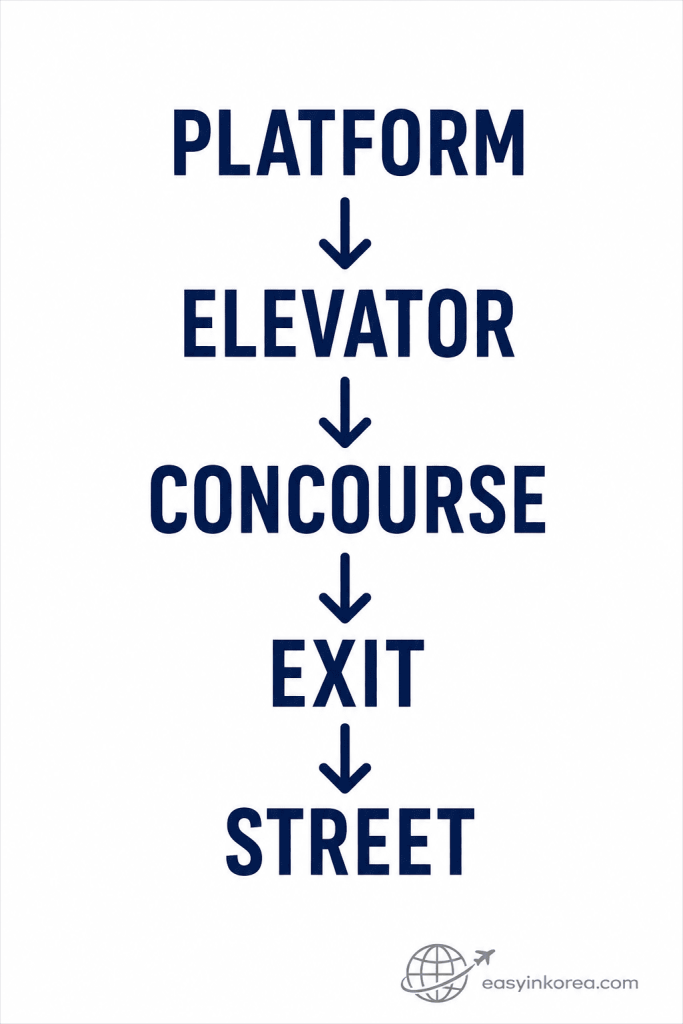
Reached the concourse or exit? Check the next connection before you keep walking.
Getting from the platform to street level is only part of the route. You still need to confirm that the elevator, exit, and street connection lead toward your actual destination.
Continue below for the step-by-step route, what to check at each stage, and what to do if the signs or elevator route do not match what you expected.
Move through the station one step at a time. At each point, stop, check the signs around you, and then decide your next move.
Step 1 — Stop After Leaving the Train
What should you check first?
Check the station name, subway line, and your current direction before you start walking toward an exit.
Step 2 — Find the Elevator Sign
Carrying a suitcase?
Look for the elevator or accessibility sign before automatically following the stairs. Check where the elevator leads before you commit to that route.
Step 3 — Reach the Concourse
What should you do on the next level?
Stop again and check the signs. Confirm the exit direction, accessibility route, and destination before continuing.
Step 4 — Check the Exit
Do not check the exit number alone.
Check the exit number and the destination name together. Make sure the route still points toward the place you actually want to reach.
Step 5 — Reach Street Level
Are you finished once you reach the street?
Not yet. Check your final walking route again. Confirm the direction, road crossings, and the entrance to your actual destination before you continue.
Using a Wheelchair, Stroller, or Need Fewer Stairs?
Follow the same five-step process, but check the complete step-free connection at every stage.
An elevator from the platform may not guarantee an elevator to the street. Check the concourse, exit connection, sidewalk, crossings, slopes, curbs, and final destination entrance as separate parts of the route.
One step at a time: Platform → Elevator → Concourse → Exit → Street.
Do not rely on old color lines, fixed elevator locations, or an old screenshot if they do not match the station around you. Follow the current station signs and recheck current official information when elevator or step-free access is important for your trip.
Nearest Exit vs Easiest Exit
The shortest route on a map can still be the harder route with a suitcase. Before choosing the nearest exit, check which route is actually easier to use.
Before choosing the closest exit: Check the elevator connection and what the final walk looks like after you reach the street.
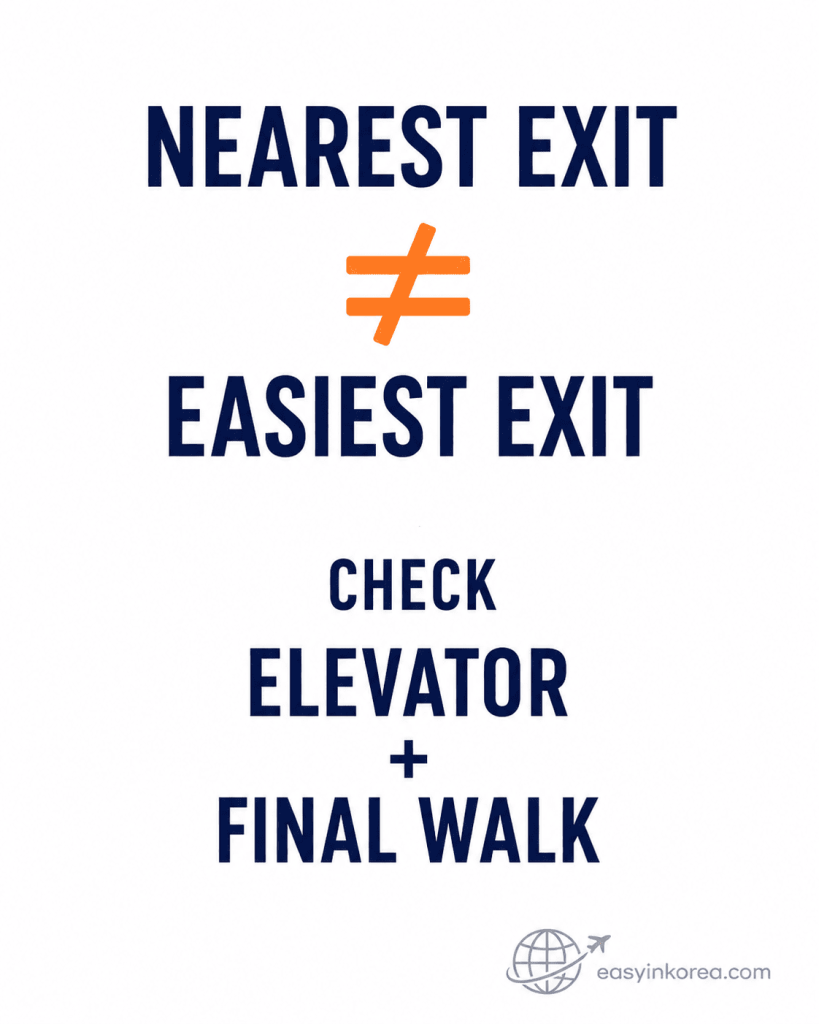
Which exit is actually easier for your trip?
Map distance is only one part of the decision. A nearby exit may still require stairs, while another route may connect better with an elevator and your destination.
Continue below to compare stairs, elevator access, street-level distance, crossings, and the final walk before deciding which exit to use.
The closest exit on a map is only one part of the decision. Before choosing an exit, compare the route you will actually use underground and after you reach the street.
What Should You Compare Before Choosing an Exit?
| Check | Why It Matters |
|---|---|
| Elevator | Check whether you can avoid stairs on the route you need. |
| Level Changes | Check how many times you need to move between different station levels. |
| Walking Distance | Compare the walking distance inside the station and after you reach street level. |
| Street Crossing | Check whether you need to cross a large road after leaving the station. |
| Slope | Check whether the route has slopes or curbs that may affect luggage or mobility. |
| Final Walk | Check how far you still need to walk from the exit to your actual destination. |
Which Exit Is Easier with Luggage?
Question: Should you always choose the closest exit?
Answer: No. A slightly longer route can be more practical if it has a usable elevator, fewer level changes, and a better final walk.
Using a Wheelchair, Stroller, or Need Fewer Stairs?
Do not compare exits only by distance. Check whether the complete route works from the platform to the elevator, concourse, exit, sidewalk, crossing, final walk, and destination entrance.
An exit with an elevator is not automatically a complete step-free route. Street crossings, slopes, curbs, and the entrance to your destination can still affect the trip.
Nearest ≠ Easiest
Compare the elevator, level changes, walking distance, street crossing, slope, and final walk before choosing your exit. If accessibility or elevator availability is important for your trip, check current official information again before travel.
Wheelchair, Stroller, or Limited Mobility?
Need a route with fewer stairs or easier level changes? Check the full route, not just the nearest elevator.
Accessibility Is Not the Same as Convenience
A route that feels convenient with a suitcase is not automatically suitable for a wheelchair, stroller, senior traveler, or someone with limited mobility.
Check each part of the trip separately, including level changes, elevators, exits, sidewalks, crossings, slopes, curbs, and the final entrance to your destination.
One elevator does not guarantee a complete step-free route.
What Should You Check?
Check the complete route:
Platform
↓
Elevator
↓
Concourse
↓
Exit
↓
Sidewalk and Crossing
↓
Slope or Curbs
↓
Final Walk
↓
Destination Entrance
Does an Elevator Mean the Route Is Step-Free?
Question: If you find an elevator, is the rest of the route automatically step-free?
Answer: No. Another level change, exit connection, slope, curb, road crossing, or destination entrance may still affect the route.
Check Current Accessibility Information
Seoul provides subway accessibility information for facilities such as elevators and other mobility-related station features. Accessibility information can help you check the station before you travel.
Conditions can change because of maintenance, construction, or temporary service changes. If step-free access is important for your trip, check current official information again on your travel day.
Ask Station Staff If You Need Help
If the route is unclear, ask station staff before continuing toward an exit.
Show your destination name or address if needed, and ask which current elevator and exit connection fits your route.
Check the whole route, not one elevator.
What If You Cannot Find or Use the Elevator?
The elevator you expected may not be where you thought it was. Stop, check the signs around you, and choose the next safe action.
What Should You Do First?
| Situation | First Action | Next Action |
|---|---|---|
| Cannot find elevator | Check accessibility signs. | Ask station staff. |
| Elevator unavailable | Check another accessible route. | Ask staff before using stairs. |
| Wrong direction | Stop and check the line and destination. | Ask before tapping again. |
| Cannot find exit | Check the exit number and landmark. | Show your destination to staff. |
| Transit card problem | Read the message on the card reader. | Ask staff before paying or tapping again. |
Cannot Find the Elevator?
Do not keep walking only because one direction looks familiar. Stop and look again for elevator or accessibility signs.
If the route is still unclear, ask station staff before choosing stairs or another exit.
Elevator Unavailable?
Question: Should you just use the stairs if the elevator is unavailable?
Answer: Not automatically. Check whether another accessible route is available and ask station staff before using stairs if mobility or luggage makes stairs difficult.
Went the Wrong Way?
Stop before tapping your transit card again. Check the subway line, direction, and destination first.
If you are unsure whether you need to pass through a gate again, ask station staff before tapping or paying again.
Cannot Find the Exit?
Check the exit number together with the destination or landmark shown on the station signs.
If the signs are still confusing, show your hotel name, address, or destination on your phone to station staff.
Using a Wheelchair, Stroller, or Need Fewer Stairs?
Do not assume that stairs are the only backup option if an elevator is unavailable.
Ask whether another elevator, exit, or accessible route is available. If step-free access is essential, check current official information again and ask station staff for the safest current route.
Do not rush.
Read the signs and messages around you first. If the route, elevator, gate, or payment situation is unclear, ask station staff before making the next move.
Common Mistakes at Dongdaemun
Most problems start before the traveler reaches the exit. A small check at the beginning can prevent a much harder route later.
1. Assuming the Dongdaemun Area Means Dongdaemun Station
The Dongdaemun area includes more than one subway station and many different destinations.
Do this instead: Check your exact destination first, then confirm the station.
2. Choosing a Station Before Checking the Destination
A hotel, market, shopping mall, or DDP may connect better with a different station than you expected.
Do this instead: Destination → Station → Exit → Final Walk.
3. Assuming the Nearest Exit Is the Easiest Exit
Question: Is the closest exit on the map always the easiest choice?
Answer: No. Check stairs, elevators, level changes, crossings, slopes, and the final walk before deciding.
4. Following the Stairs First with Large Luggage
The most visible route is not always the most practical route with a suitcase.
Do this instead: Look for the elevator or accessibility sign before committing to the stairs.
5. Assuming One Elevator Means the Whole Route Is Accessible
One elevator may only solve one part of the trip.
Do this instead: Check the full route from the platform to the concourse, exit, sidewalk, crossing, final walk, and destination entrance.
6. Checking GPS Only While Underground
Your phone may not show your exact underground position clearly.
Do this instead: Use the station name, line, direction, accessibility signs, exit number, and destination signs around you.
7. Forgetting to Check the Final Walk
Reaching street level does not mean the difficult part is finished.
Do this instead: Check the walking distance, road crossing, slope, and destination entrance before choosing the exit.
8. Following an Old Online Guide Instead of Current Station Signs
Station layouts, signs, elevator access, and temporary routes can change.
Do this instead: If an old screenshot or online guide does not match the station around you, follow the current station signs and check current official information when needed.
Using a Wheelchair, Stroller, or Limited Mobility?
The biggest mistake is treating accessibility as the same thing as convenience.
A route that is easier with luggage may still include a curb, crossing, slope, or entrance that does not work for your mobility needs. Check the complete route and ask station staff if the current path is unclear.
Check the destination first. Then check the station, elevator, exit, and final walk.
What Travelers Wish They Knew Before Dongdaemun
The route can look simple on your phone. It can feel very different once you are carrying a suitcase through the station.
The Exit Looks Close Until You Reach the Stairs
You find the closest exit on your phone.
Your suitcase feels manageable.
Then you reach a long staircase.
The elevator is in another direction.
The closest exit on the map may not be the easiest exit with a suitcase.
A Longer Route Can Feel Shorter
Five extra minutes on an easier route can feel much shorter than carrying a suitcase up a long staircase.
A route with an elevator and a simpler final walk may be worth checking, even when another exit looks closer on the map.
Using a Wheelchair, Stroller, or Limited Mobility?
The same idea matters even more when stairs, slopes, curbs, or long level changes are difficult.
Do not judge the route only by how close the exit looks. Check how the full path works from the platform to the destination entrance.
Sometimes the easier route is the one you choose before the stairs begin.
Useful Korean Phrases
If the signs are not enough, one simple question can save a lot of walking. You can also show the sentence on your phone to station staff.
Where Is the Elevator at Dongdaemun Station?
동대문역 엘리베이터 타는 곳이 어디예요?
English: Where is the elevator at Dongdaemun Station?
I Have a Lot of Luggage and Want to Use the Elevator
짐이 많아서 엘리베이터로 가고 싶어요.
English: I have a lot of luggage, so I would like to use the elevator.
Need a Step-Free Route?
계단 없이 갈 수 있는 길이 어디예요?
English: Which way can I go without using stairs?
Show Your Destination on Your Phone
If the station name, hotel name, or destination is difficult to pronounce, show the station staff the name and address on your phone.
Point to the destination and ask which elevator and exit connection you should use.
Using a Wheelchair, Stroller, or Limited Mobility?
Tell the staff if stairs are difficult for you. Then show your destination so they can help you check the current elevator and exit route.
If step-free access is important, ask about the complete route rather than only asking where one elevator is.
If speaking is difficult, show the Korean sentence and your destination on your phone.
FAQ: Dongdaemun Station Elevators and Exits
These quick answers cover the most common questions about Dongdaemun Station, elevators, exits, luggage, and step-free routes.
Is Dongdaemun Station the Same as Dongdaemun History & Culture Park Station?
Answer: No.
Dongdaemun Station and Dongdaemun History & Culture Park Station are different subway stations. Check your exact destination and the full station name before choosing your route.
Does Dongdaemun Station Have Elevators?
Answer: Accessibility facilities, including elevators, are listed for Dongdaemun Station in official Seoul subway accessibility information.
However, elevator availability, maintenance, and station routing can change. Check current official information again if elevator access is important for your trip.
Which Station Should I Use for Dongdaemun Design Plaza?
Answer: Start with Dongdaemun Design Plaza as your exact destination, then confirm the station and exit that fit your route.
Follow current station signs and check the final walking route rather than choosing a station only because “Dongdaemun” appears in the name.
What Is the Easiest Exit with Luggage?
Answer: There is not one exit that is always easiest for every traveler.
Compare your destination, elevator connection, level changes, street crossing, and final walking distance before choosing an exit.
What If I Cannot Find the Elevator?
Answer: Stop and check the elevator or accessibility signs around you first.
If the route is still unclear, ask station staff before using stairs or choosing another exit.
What If My Map Does Not Work Well Underground?
Answer: Use the current station signs around you.
Check the station name, subway line, direction, elevator or accessibility sign, exit number, and destination name. If an old screenshot does not match the station, follow the current signs.
Is the Entire Route Wheelchair Accessible?
Answer: An elevator at the station does not by itself confirm a complete step-free route.
Check the full connection from the platform to the elevator, concourse, exit, sidewalk, crossing, slope or curb, final walk, and destination entrance.
If step-free access is essential, check current official accessibility information on your travel day and ask station staff when the route is unclear.
Destination first. Then check the station, elevator, exit, and final walk.
Check Current Official Information
Elevator access, station construction, exit conditions, and accessible routes can change. Check current official information when these details affect your trip.
What Should You Check?
- Elevator availability
- Temporary maintenance
- Station construction
- Exit access
- Accessibility facilities
- Current station routing
Seoul Subway Accessibility Facilities
Seoul Metropolitan Government provides subway accessibility information for facilities such as elevators and other mobility-related station features.
Use the official page below as one of your main checks when elevator or step-free access is important.
For Wheelchair, Stroller, or Limited Mobility Routes
An elevator shown in official station information does not by itself confirm that your complete route to the destination is step-free.
Check the connection from the platform to the concourse, exit, sidewalk, crossing, slope or curb, final walk, and destination entrance. Ask station staff if the current route is unclear.
Check current official information again on your travel day if elevator access is important for your trip.
Conclusion
An easier route in Dongdaemun is not decided by the nearest exit alone. Your destination, elevator connection, level changes, and final walk can all change which route works better.
Final Action
Check your destination first. Then check the station, elevator, exit, and final walk.
If you are using a wheelchair, stroller, carrying large luggage, or need fewer stairs, check the complete route rather than relying on one elevator or the closest exit.
A few seconds of checking before you move can save unnecessary stairs and extra walking later.
Related Guides
Continue with the guide that matches what you need to do before or after navigating Dongdaemun.