Last Updated: August 10, 2026
Introduction
Getting off near the right exit can save you extra walking on Seoul Subway Line 2. The useful boarding position depends on where you need to go after you leave the train.
Using Seoul Subway Line 2?
See what to check before choosing a fast-exit boarding position.
A Seoul Subway Line 2 Fast Exit can reduce extra walking after you leave the train, but the boarding position is only useful when it matches the exit or transfer route you actually need.
Start with your destination. Then check the train direction, station exit, and current boarding information before you move.
A Seoul Subway Line 2 Fast Exit can help you get off closer to an exit, transfer passage, or the part of the station you need next.
The important part is the order. First check where you are going. Then check the train direction, your exit, and the current boarding position.
A fast exit is not automatically an elevator route or a step-free journey. If you have a large suitcase, use a stroller, or need step-free access, check those conditions separately before you move.
Quick Answer: How Do You Use a Fast Exit on Line 2?
Want to get off closer to where you need to go?
Not sure where to stand on Line 2?
Check the order below before choosing a fast-exit boarding position.
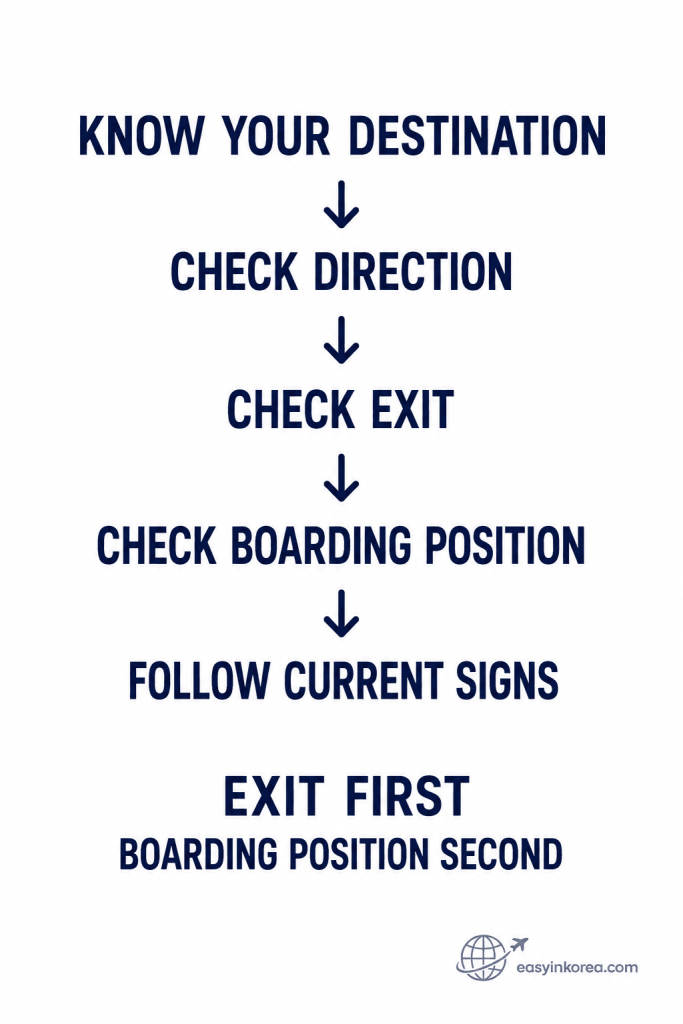
A Seoul Subway Line 2 Fast Exit works best when you check things in the right order. Start with your destination and train direction before looking for a boarding position.
Once you know the exit you need, use current subway or station information to check where to board. When you arrive, look at the station signs again before following the crowd.
Start with your destination. Check which direction your Line 2 train is traveling, then find the exit you need at your destination station.
Once you know the exit, check the current boarding position for that part of the station. This may place you closer to the stairs, escalator, transfer passage, or exit route you plan to use.
Destination → Direction → Exit → Boarding Position
When you arrive, check the current station signs again. They take priority if something looks different from information you saved earlier.
What Does “Fast Exit” Mean?
What does a fast-exit position actually help with?
A fast-exit position is a place to board the train that may reduce the distance you walk after getting off.
It is useful when the boarding position matches the exit or transfer route you need.
Fast exit = a useful boarding position for your next move.
Fast exit ≠ the fastest total journey.
Fast exit ≠ an elevator route.
Fast exit ≠ a confirmed step-free journey.
Think of the boarding position as one small part of the trip, not the whole route.
Check Inner Circle or Outer Circle First
Going the right way comes before choosing a train car.
Inner Circle or Outer Circle?
Check the destination stations before you choose which Line 2 train to board.
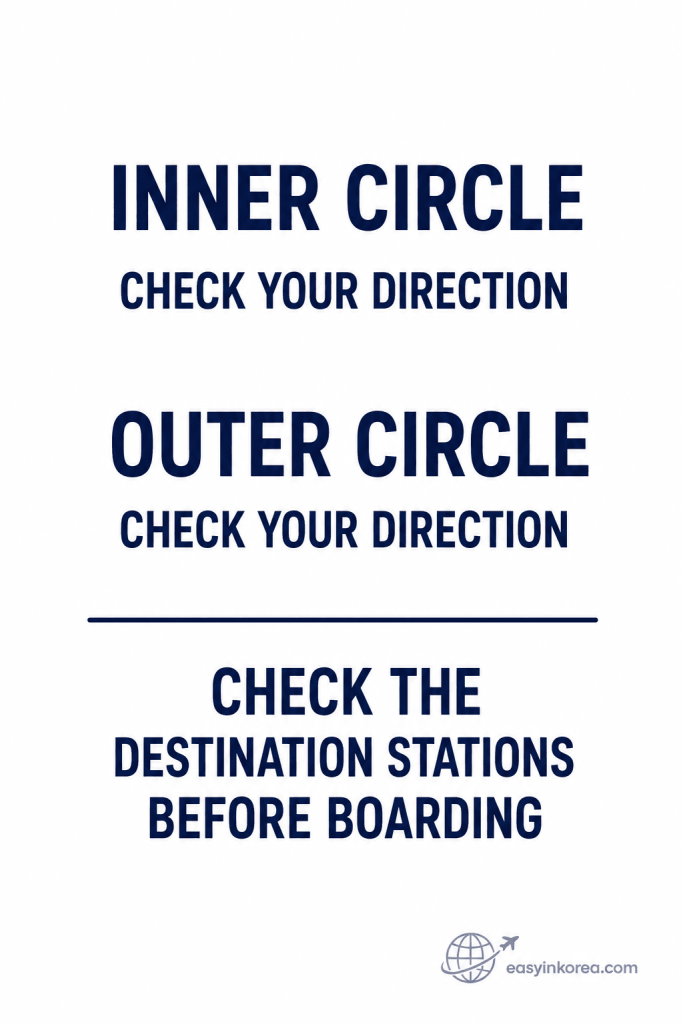
On Seoul Subway Line 2, Inner Circle and Outer Circle describe the two directions around the loop. You do not need to memorize every station to choose the right train.
Find your destination station, then compare it with the stations shown for the current platform direction. Once the direction is clear, you can move on to checking your exit and boarding position for the Seoul Subway Line 2 Fast Exit route.
Line 2 runs around central Seoul in two directions. Station signs may show Inner Circle or Outer Circle together with the stations ahead.
You do not need to memorize the whole loop. Look at your destination station and check which train direction reaches it.
Before boarding, compare the destination name with the stations shown on the current platform sign. Once the direction is clear, you can think about the exit and boarding position.
Check Your Destination Before the Exit
Where are you going after you leave the station?
Start with the place you actually want to reach. A station can have several exits leading to different streets, buildings, shopping areas, and transfer routes.
Your destination might be a hotel, café, attraction, meeting point, shopping mall, or another subway line. The useful exit depends on that next step.
Check the destination first. Then choose the exit that matches it. This is usually more useful than choosing the most familiar or busiest exit.
Check Your Exit Before Choosing a Train Car
Know your exit? Now the boarding position becomes useful.
Know your destination but not where to board?
Check the exit first. Then use the boarding position to support that route.
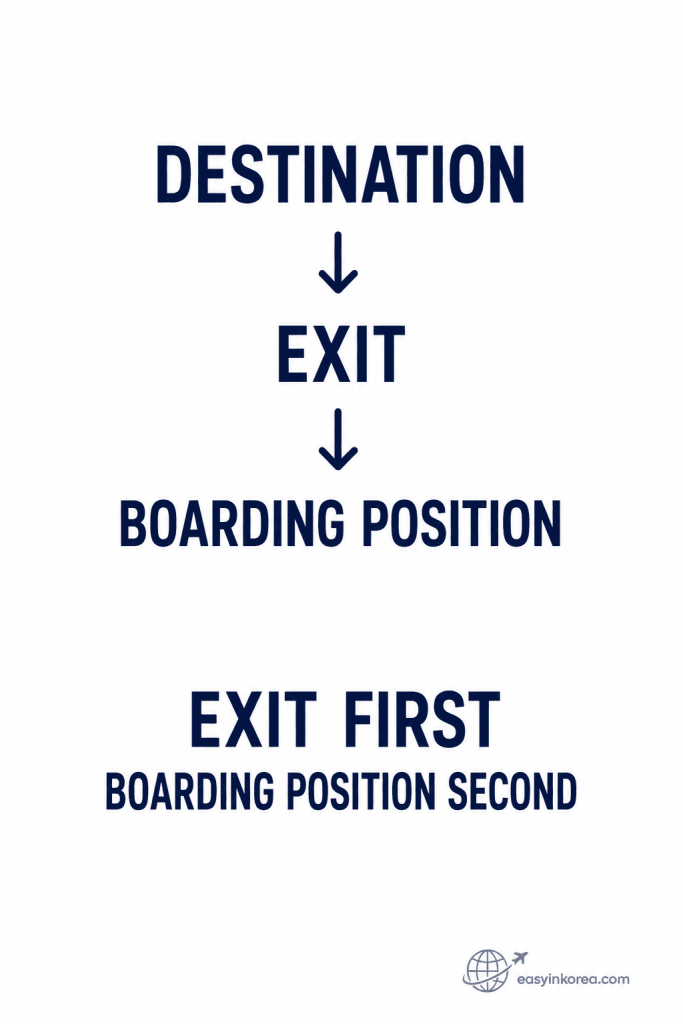
A Seoul Subway Line 2 Fast Exit is more useful when you choose the exit before the boarding position. The exit connects your station arrival to the place you actually want to reach.
Once the exit is clear, check current subway or station information for a boarding position that matches it. This keeps the train-car choice tied to your real destination instead of treating one saved number as a permanent rule.
A car or door position only helps when you already know what you want to reach after leaving the train.
Check your destination exit first. Then use current subway or station information to see whether a particular boarding area places you closer to that route.
Check the exit first. Use the boarding position to support that decision.
This order also makes it easier to change plans if the station layout, transfer route, or destination changes.
Where Should You Check the Boarding Position?
Found your exit? Check the current boarding information.
Boarding-position information may appear in a subway or navigation app, on platform information, or in other current station guidance.
Check that the information matches your station, travel direction, and destination exit. A saved number is not useful if one of those details is different.
If an old screenshot or saved note does not match what you see at the station, follow the current station information.
When a Car and Door Number Is Useful
A car or door number helps only when it matches your next move.
Platform boarding positions can help you choose where to wait before the train arrives.
The number is useful when current information connects that position with the exit, transfer passage, stairs, or escalator you need.
Do not treat one car or door number as a permanent rule for every trip. Check the station, direction, and current information together.
Get Off and Check the Station Signs Again
Doors open. What should you check next?
Once you leave the train, look up and check the station signs again.
Find your exit number, transfer line, elevator sign, or destination direction before joining the main flow of people.
If the sign points somewhere different from what you expected, follow the current station sign. A fast-exit position helps with where you arrive on the platform, but the station signs guide the rest of the journey.
Fast Exit at Major Line 2 Stations
Busy Line 2 stations can have very different next steps.
The same fast-exit idea works at many Line 2 stations, but your next action changes with the station and destination. Use the examples below as decision points, then follow the current signs when you arrive.
Hongik University Station
Are you heading into Hongdae, toward Yeonnam-dong, or changing to another rail service? Check that destination first. The useful exit and internal route may be different for each one.
Euljiro 1-ga Station
This Line 2 station serves several parts of central Seoul. If you are walking toward Myeongdong, a department store, City Hall, or Cheonggyecheon, check the destination and exit together before leaving the platform area.
Dongdaemun History & Culture Park Station
This is a transfer station with several possible directions after you leave Line 2. Decide whether you are transferring or leaving the station before choosing which signs to follow.
Gangnam Station
Gangnam Station has many street-level destinations. Check the building, street, or meeting point you need before choosing an exit or boarding position.
Samseong Station
If you are visiting the COEX area, confirm the part of the complex you need. A large destination can have several useful approaches, so the nearest station exit is only one part of the decision.
Jamsil Station
Jamsil connects Line 2 with other routes and serves several large destinations. Check whether you are transferring, going to a shopping complex, or walking to another nearby place before choosing your path.
Seongsu Station
In Seongsu, the final walk matters. Check your café, shop, hotel, or meeting point on the map before choosing the exit, because destinations in the area can be spread across different streets.
Fast Exit vs Fast Transfer
Leaving the station or changing trains?
Leaving the station or changing trains?
Check which position matches your next move before choosing where to board.
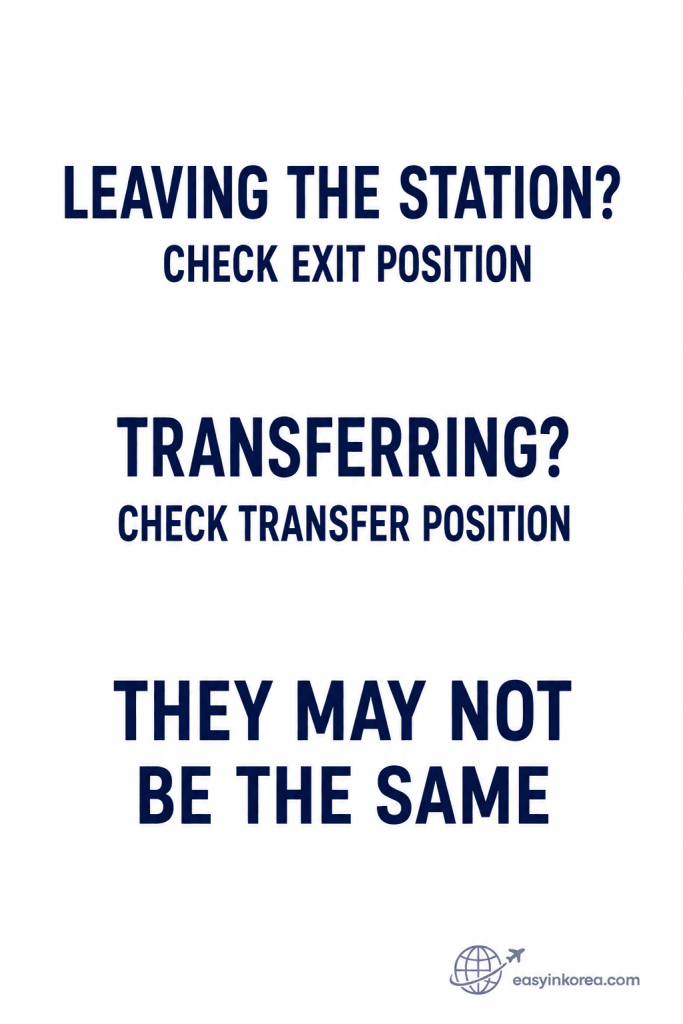
A Seoul Subway Line 2 Fast Exit helps when you are leaving the station, but a transfer may require a different boarding position. The useful location depends on what you need to do after the train stops.
If you are heading to the street, check the exit connected to your destination. If you are changing lines, check the current transfer route instead. These positions may be different, so decide which job you are doing first.
A good position for leaving the station may not be the same position you want for a subway transfer.
If you are leaving the station, check the exit connected to your destination. If you are changing trains, check the transfer passage and the line you need next.
Leaving the station
Check the destination exit.
Changing trains
Check the transfer route.
Decide which of those two jobs you are doing before choosing where to board.
Traveling With Large Luggage?
Got a large suitcase?
Carrying a large suitcase on Line 2?
Check the whole station route before choosing a fast-exit boarding position.
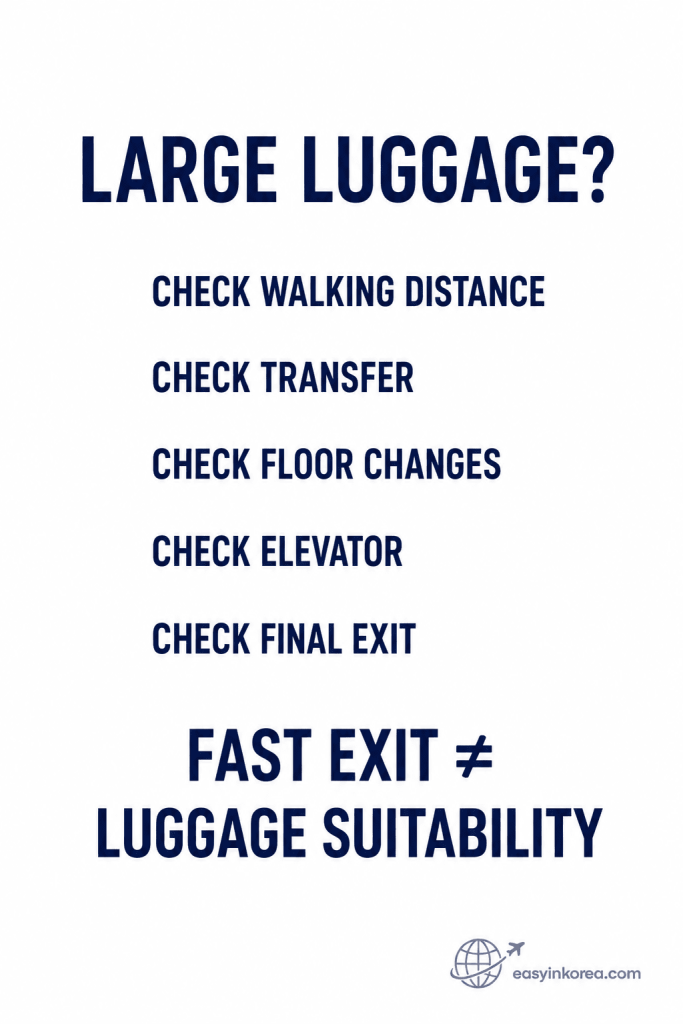
A Seoul Subway Line 2 Fast Exit can reduce some platform walking, but that does not tell you whether the full route works well with a large suitcase.
Check the walking distance, transfers, floor changes, elevator location, and final exit together. If the elevator route is farther along the platform, walking a little more inside the station may be more practical than taking the closest stairs.
A fast exit can reduce platform walking, but that does not tell you whether the rest of the route works well with a large suitcase.
Check how far you need to walk, whether there is a transfer, how many floor changes are involved, and where the elevator is in relation to your exit.
✓ Check walking distance
✓ Check transfers
✓ Check floor changes
✓ Check elevator availability
✓ Check the final walk after the exit
If the elevator route is farther away than the fast-exit position, using the elevator route may make more sense for your trip.
Wheelchair, Stroller, or Limited Mobility?
Need a step-free journey?
Need a step-free route on Line 2?
Check the whole journey, not just the elevator near your platform.
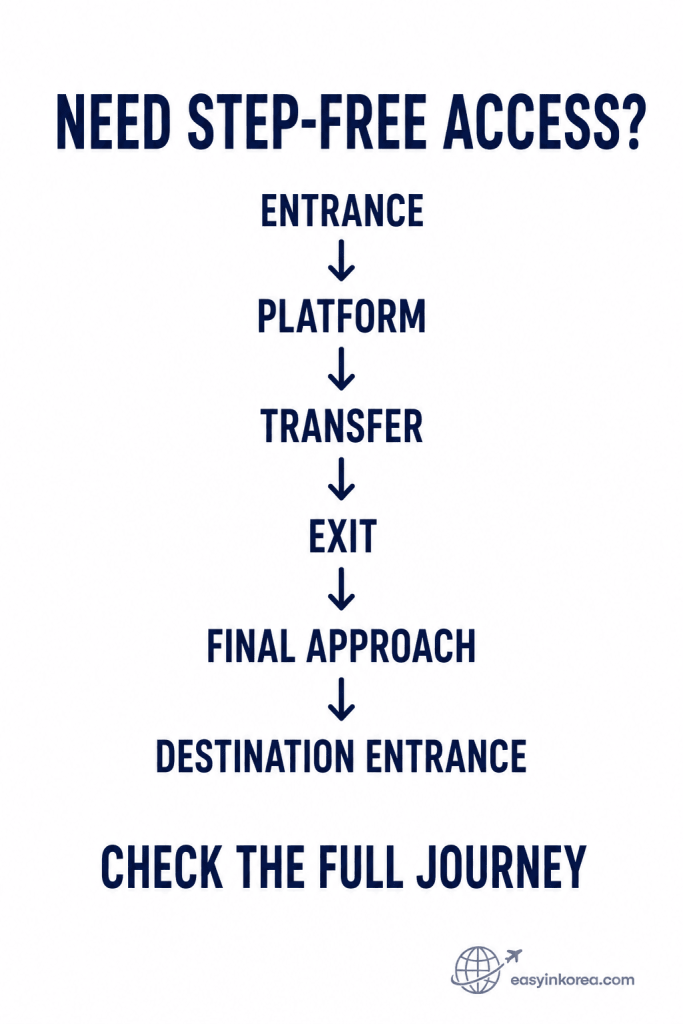
A Seoul Subway Line 2 Fast Exit does not confirm a step-free journey. Check the route from the station entrance to the platform, through any transfer you actually need, and from the destination platform to the street.
Keep checking after you leave the station too. Road crossings, slopes, walking distance, and the entrance to your final destination can affect whether the full route works for a wheelchair, stroller, or limited mobility.
A fast-exit position does not confirm that the full journey is step-free.
If you use a wheelchair or stroller, or have limited mobility, check the route from the station entrance to the platform and from the destination platform all the way to the street.
Look for elevator access, floor changes, transfer continuity, road crossings, slopes, and the entrance to your final destination.
One elevator does not confirm a step-free route for the whole journey.
If any part of the route is unclear, check current station or operator information before continuing.
Platform Gaps and Boarding Safety
Moving a suitcase, stroller, or wheelchair?
Look at the actual space between the train and the platform before moving across it. The gap and height can feel different from one boarding position to another.
Keep control of suitcase, stroller, or wheelchair wheels as you board and leave the train. Move at a pace that gives you time to see the platform edge.
If you need assistance, follow station guidance or ask staff. Do not rely on an old measurement or a fixed gap number from a travel guide.
What If the Fast Exit Information Does Not Match?
The boarding information looks different from what you expected?
Does the station look different from your saved information?
Recheck the station, direction, and exit before following an old boarding position.
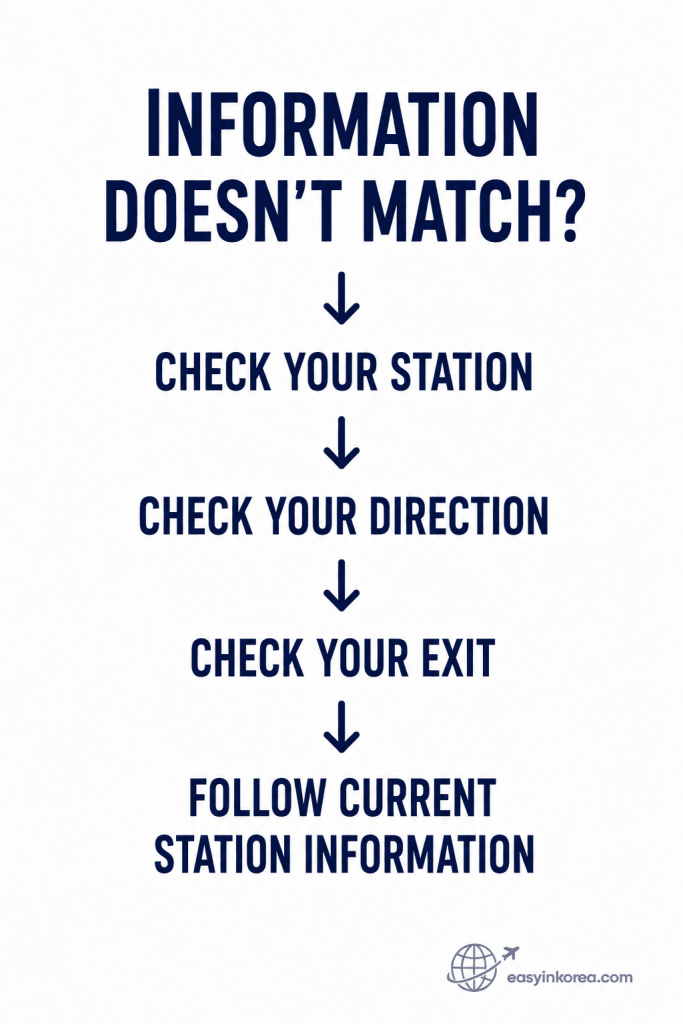
If a Seoul Subway Line 2 Fast Exit number or saved screenshot does not match what you see, check the basics again before moving. Make sure you are at the correct station, traveling in the correct direction, and looking for the exit you actually need.
If the information still differs, follow current station signs, temporary notices, and staff guidance. Current on-site information should take priority over an older screenshot, note, or travel guide.
Stop before you board or start walking. First make sure you are looking at information for the correct station and travel direction.
Then check your destination exit again. A different direction or exit can change which boarding position is useful.
If a saved screenshot, old blog post, or note does not match the station, use the current platform signs, station information, and staff guidance.
You do not need to force an old number to fit the trip in front of you.
Common Mistakes on Seoul Subway Line 2
A small check can prevent a long walk.
- Boarding before checking the travel direction.
- Choosing a train car before checking the destination exit.
- Following the busiest exit instead of the exit for your destination.
- Confusing a fast exit with a fast transfer.
- Assuming a fast exit also has the elevator you need.
- Treating an old car or door number as a permanent rule.
- Ignoring the street-level walk after leaving the station.
- Treating luggage needs and step-free access as the same problem.
What Travelers Wish They Knew Before Using a Fast Exit
Sometimes the closest way out is not the route that fits the rest of your trip.
You step off the train and see stairs almost immediately. Other passengers are already heading up, so following them feels natural.
But your hotel may be closer to another exit. Before joining the crowd, check the exit number and the final walking route.
On another trip, you may have a large suitcase. The fast-exit position puts you close to the stairs, but the elevator is farther along the platform.
In that situation, walking a little farther inside the station may work better than lifting your suitcase up the stairs.
The useful question is not only, “Where can I get off faster?” It is also, “What do I need to do after I get off?”
FAQ: Seoul Subway Line 2 Fast Exit
These answers cover common questions about fast exits, boarding positions, transfers, and station access on Seoul Subway Line 2.
What is a fast exit on Seoul Subway Line 2?
A fast exit is a boarding position that may place you closer to the exit, transfer passage, stairs, or escalator you need after leaving the train.
How do I find the best car for my exit?
Check your destination exit first. Then use current subway, platform, or station information to find the boarding position that matches it.
Should I check the exit or train car first?
Check the exit first. The train-car position is useful only after you know where you need to go.
Is a fast exit the same as a fast transfer?
No. A fast exit helps when you are leaving the station. A transfer position is meant to help you reach another subway line or platform. The useful boarding positions may be different.
Does a fast exit always have an elevator?
No. The fast-exit position and elevator position may be in different parts of the platform or station.
Can I use a fast exit with large luggage?
Yes, but check the full route before choosing it. Walking distance, stairs, floor changes, transfers, and elevator location may matter more than the fast-exit position.
Does an elevator mean the whole route is step-free?
No. Check the journey from the entrance to the platform, through any transfer, and from the destination platform to the final entrance you need.
Can car and door information change?
Boarding information and station conditions can change. Check current information before relying on a saved number.
Should I follow an old screenshot or current station signs?
Follow the current station signs and current official information when they differ from an older screenshot or saved guide.
Check Current Seoul Subway Information
Station layouts, facilities, and boarding information can change. Check current official information when the exact route matters.
For current subway accessibility information, check the official Seoul Metropolitan Government subway accessibility page. It lists station facilities such as elevators, escalators, accessible restrooms, and other mobility-related equipment.
Check Seoul Subway Accessibility Facilities
Facility availability does not by itself confirm that every part of your journey follows one continuous step-free path. Check the route you actually need.
Use information in this order:
Current official information
↓
Current station information
↓
Current signs and staff guidance
Temporary maintenance, construction, or operating conditions can also affect the route you see on the day you travel.
Disclaimer
Subway information can change as stations, facilities, and operating conditions are updated.
Boarding positions, station layouts, elevator availability, and transfer routes may change. Use this guide to understand what to check, and follow current official information, station signs, temporary notices, and staff guidance when you travel.
Conclusion
A useful fast exit starts with knowing what you need to do after the train stops.
CHECK YOUR DESTINATION
↓
CHECK YOUR DIRECTION
↓
CHECK YOUR EXIT
↓
CHECK YOUR BOARDING POSITION
↓
FOLLOW CURRENT STATION INFORMATION
You do not need to memorize every car and door number on Line 2. Know your destination, make the next decision, and check again when you arrive.
Easy in Korea focuses on the next practical step, so you can spend less time figuring out the station and more time getting where you want to go.
Related Guides
Continue with the guide that matches your next practical step while using the Seoul subway.