You expected to pay one amount in Korea, but the amount connected to your card payment looks different.
A wrong amount charged to your card in Korea does not always mean the same thing. The price you expected, the merchant’s payment record, and the amount shown by your card issuer may need to be checked separately.
Do not start by asking for another payment or another refund. First find out which amount is different.
That one check tells you what to do next and whether your next question belongs to the merchant or your card issuer.
Quick Answer
Start with the three numbers connected to the purchase.
If the amount charged to your card in Korea looks wrong, compare three things first: the amount you expected to pay, the merchant receipt or payment record, and the transaction shown by your card issuer.
If the merchant processed the wrong amount, ask the merchant to check and correct that transaction. If the merchant-side amount is correct but your card still shows an amount you do not understand, check the transaction with your card issuer.
Do not create another payment or ask for another correction until you understand which amount is different.
If you paid once but see two separate card transactions, that may be a duplicate-charge problem instead of a wrong-amount problem.
Table of Contents
Travelers Wish They Knew Before Leaving the Store
A few checks are much easier while you still have the receipt, purchase and merchant in front of you.
Check the receipt before you leave.
Compare it with the price you expected to pay.
Save the price you expected to pay.
A menu, price tag, booking confirmation or order record may help explain the difference.
A different-looking card amount does not automatically prove that the merchant entered the wrong amount.
Know who controls the next answer.
The merchant can check what it processed. Your card issuer can explain issuer-side transaction information.
Quick Navigation
Follow the step that matches what you still need to confirm.
First, Find Which Amount Is Different
Before deciding that a merchant charged the wrong amount, separate the three amounts connected to the purchase.
Before you blame the wrong number: find out where the mismatch first appears.
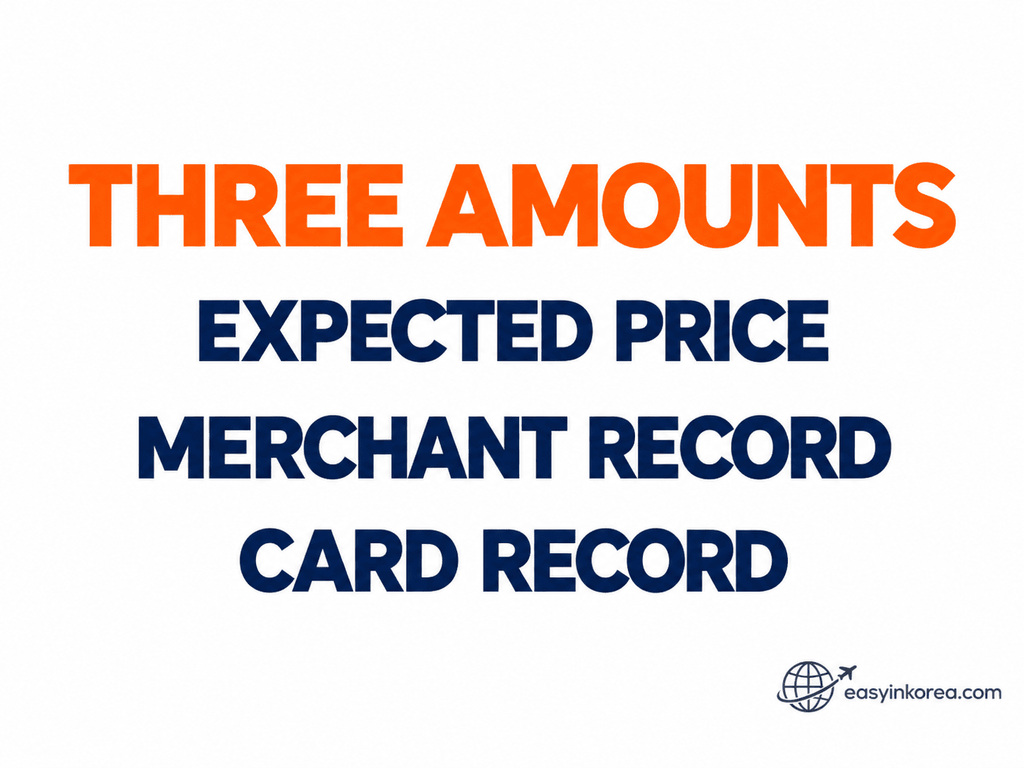
Found this image from search? Do not treat every different-looking amount as the same card problem.
Continue below to identify where the mismatch starts. That decision tells you whether your next question belongs to the merchant or your card issuer.
1. Expected Amount
This is the amount you understood and agreed to pay. It may come from a price tag, menu, booking confirmation, order page or checkout screen.
2. Merchant Amount
This is the amount shown on the merchant’s receipt or other payment record.
3. Card-Side Amount
This is the amount or transaction information shown by the issuer of the card you used.
Key decision: A different-looking card amount does not by itself prove that the Korean merchant processed the wrong amount. First identify where the mismatch appears.
This is the first step when you think there was a wrong amount charged to your card in Korea.
Check What You Actually Agreed to Pay
Find the best record of the price you expected before comparing it with the payment.
Use the clearest record available for your purchase.
This may be a price tag, restaurant menu, booking confirmation, order confirmation, checkout screen or written quote.
Use a Record If You Have One
Do not rely only on memory when a price, order or booking record is still available. Save it before the page, message or booking information becomes harder to find.
Your goal is simple: identify the amount you reasonably expected to pay before deciding whether the payment itself is wrong.
Compare the Receipt With the Card Transaction
Now compare the expected price with the merchant record and the card information you can see.
See a different number? Do not decide who made the mistake until you compare the records.
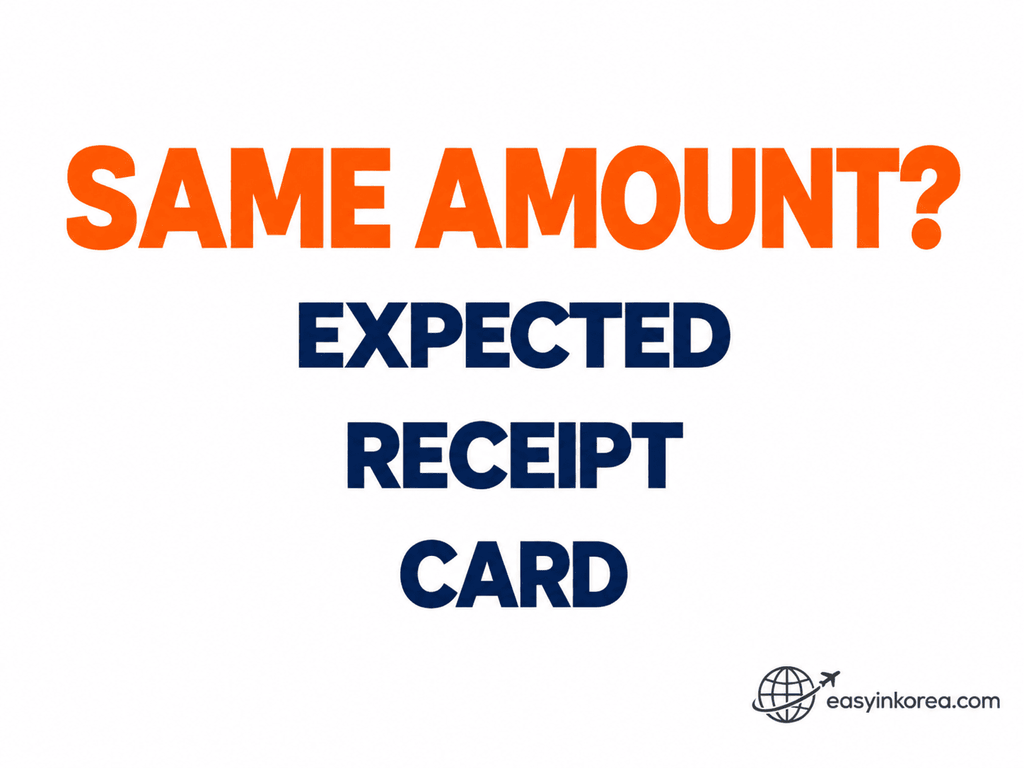
Which number breaks the match? That is the clue that determines your next step.
Continue below to see how the comparison changes when the receipt matches the expected price and when the receipt itself shows a different amount.
Example A: The Expected Price and Receipt Match
Expected price: ₩48,000
Receipt: ₩48,000
In this example, the merchant receipt does not show a different transaction amount. If your foreign card still looks different, you need to identify what the card-side information represents before asking the merchant to change the transaction again.
Example B: The Receipt Shows a Different Amount
Expected price: ₩48,000
Receipt: ₩84,000
In this example, there is a clear reason to ask the merchant to check the payment amount.
Example amounts only.
Ask the Merchant One Clear Question
If the merchant-side amount looks wrong, keep your first question simple.
Show or say:
“The payment amount is different from the amount I expected. Could you check the transaction?”
Korean Phrase
결제 금액이 제가 확인한 금액과 달라요. 결제 내역을 확인해 주세요.
The payment amount is different from the amount I expected. Please check the payment record.
If numbers make the problem easier to explain, show the expected amount and the amount on the receipt.
For example: “I expected to pay 48,000 won, but this shows 84,000 won. Could you check the amount?”
Example amounts only.
If the Merchant Confirms the Wrong Amount
A confirmed mistake changes the question from “What happened?” to “What was done to correct it?”
The wrong amount is confirmed. What now? Do not leave with only a verbal answer.
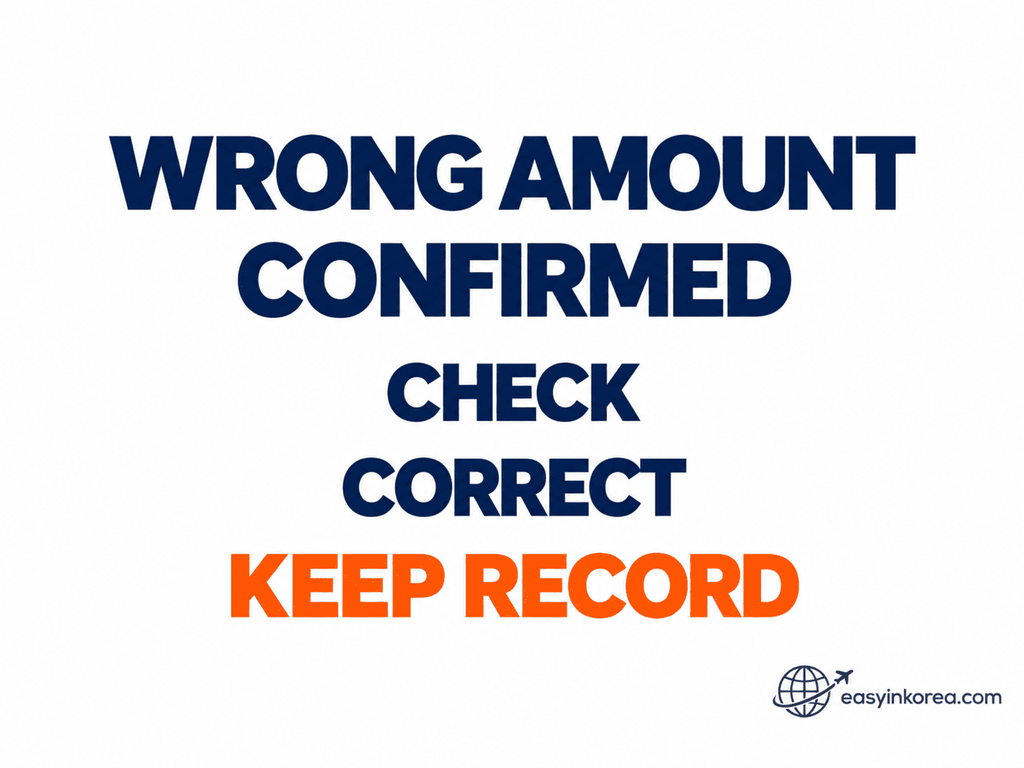
Found this image while trying to fix a card charge in Korea? A verbal promise is not the last step.
Continue below to check what the merchant actually changed and which record may help if you later need to explain the transaction to your card issuer.
Ask what transaction or amount was wrong and what action the merchant is taking.
Ask What Was Corrected
Depending on the transaction and the merchant’s payment process, the merchant may describe the action as a correction, cancellation, reversal or refund.
Do not assume that all of these words mean exactly the same thing in every card system. Ask what was done to your specific transaction.
Keep the Correction Record
If a receipt, cancellation record, refund record or other confirmation is available, keep it. The amount and processing date can be useful if you later need to explain the case to your card issuer.
What If the Receipt Is Correct but Your Card Looks Different?
A correct merchant receipt changes the next question.
If the receipt matches the amount you agreed to pay, do not ask the merchant to create another correction only because your card app or statement looks different.
Check the transaction with the issuer of the card you actually used.
Keep This Problem Separate
Currency conversion or other card-side processing may create a different issue. This guide first helps you identify whether the transaction amount itself was wrong.
Do not guess at the meaning of an issuer-specific transaction label. Use your card issuer’s official app, website or customer-service channel for issuer-specific information.
Save Evidence Before You Leave
Save enough information to explain the problem later without exposing unnecessary financial details.
Could you explain the problem again tomorrow? Save the records now while the purchase is still easy to identify.
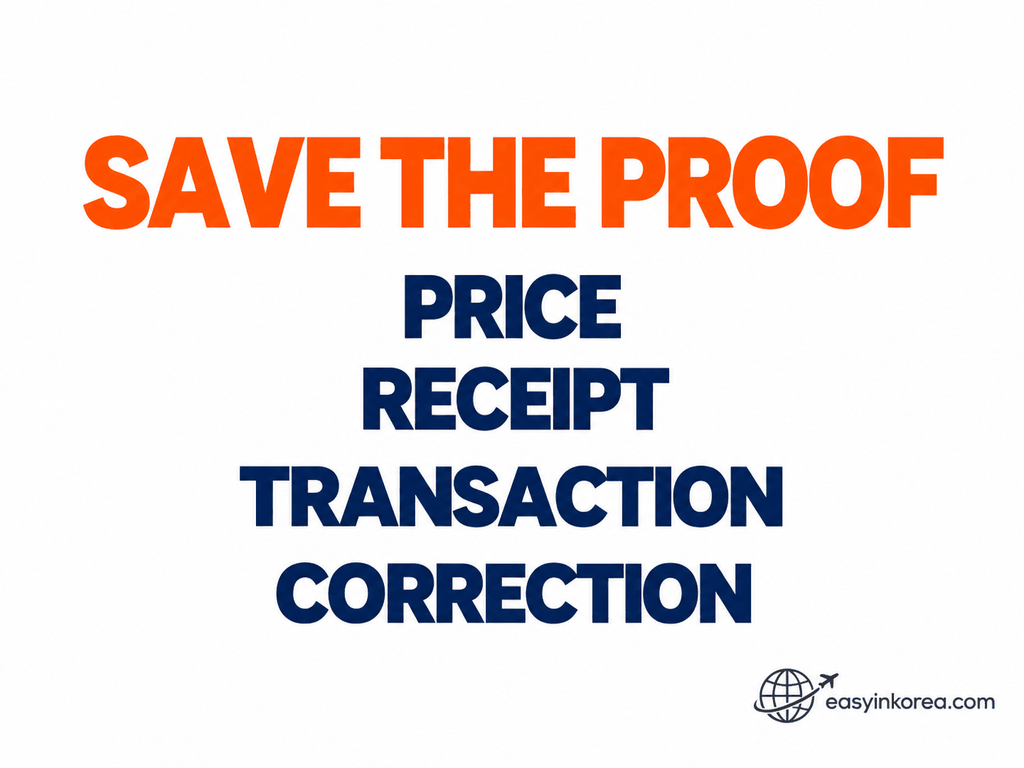
Found this image while dealing with a wrong card payment in Korea? Good evidence keeps the problem understandable after you leave the counter, store, or even Korea.
Continue below to build a useful evidence record and see which details can help when you need to follow up with the merchant or your card issuer.
Useful Evidence
Save the price, menu, booking or order evidence that shows what you expected to pay.
Also keep the receipt, merchant name, date and approximate time, expected amount, processed amount, currency, relevant transaction entry and any correction, cancellation or refund record.
If the purchase had an order or booking number, save that too.
Protect Your Card Information
If you save a screenshot, crop or hide card, account and personal information that is not needed to explain the transaction.
Do not share your full card number, CVV, banking password or one-time security code with a merchant or an AI assistant.
Who Controls the Next Step?
The fastest next step depends on which part of the payment still needs an answer.
Ask the Merchant
Use the merchant when the question is: “What amount did you process?”
Ask Your Card Issuer
Use the issuer of the card you actually used when you need issuer-specific information about the transaction, the card-side result, or the issuer’s current inquiry or dispute procedure.
Use Tourism or Consumer Help When Relevant
If an eligible merchant-side problem remains unresolved, a tourism or consumer-assistance route may help with the underlying dispute.
These services do not replace your card issuer for issuer-specific transaction information.
Can 1330 Help With a Wrong Card Amount?
1330 can be useful when the problem is connected to your travel experience in Korea, but its role has limits.
The Korea Tourism Organization operates the 1330 Korea Travel Helpline and Tourist Complaint Center. It provides tourism information, multilingual assistance and a route for relevant tourism complaints.
The official complaint process allows a complaint to be submitted and then relayed for investigation or resolution.
Important: 1330 does not determine the processing status of your foreign card transaction. Use your own card issuer for issuer-specific transaction information.
The current official contact information lists 1330 in Korea and +82-2-1330 from overseas.
If you are not sure whether your unresolved merchant problem fits a tourism complaint route, ask 1330 which current channel is appropriate for your situation.
Already Left the Store or Korea?
You can still start checking a wrong card amount after leaving the merchant or Korea.
Start With the Evidence You Saved
Find the receipt, price or booking evidence, merchant name, transaction information and any message you already received from the merchant.
Contact the Merchant When the Merchant Amount Is the Problem
Explain the amount you expected and the amount shown on the merchant record. Keep the merchant’s reply.
Continue With Your Card Issuer When Needed
If the card-side result remains unclear or you need to use an issuer inquiry or dispute process, follow the current procedure and deadline provided by your own card issuer.
Do not use a universal deadline from another bank or card as if it automatically applies to your card.
What If the Merchant Says It Was Corrected?
A merchant saying “It was corrected” is useful, but it is not the final check.
Keep any correction, cancellation, reversal or refund record the merchant gives you.
Then check whether the card-side result eventually reflects the correction you expected.
Do Not Use One Universal Waiting Time
Processing can depend on the transaction, merchant, card network and issuer. Use your own issuer’s current information rather than assuming that every correction must appear within the same number of days.
If the result does not match what the merchant said was corrected, keep the merchant’s record and use it when you contact your card issuer.
Final Check: Does the Amount Now Make Sense?
Finish the problem by confirming what happened, not only by hearing that it was fixed.
✓ I know the amount I agreed to pay.
✓ I know the amount the merchant processed.
✓ I know whether those amounts match.
✓ I saved evidence of any correction.
✓ I know whether I still need to contact my card issuer.
The problem is finished when you can explain the amount and confirm the result — not only when someone says, “It was fixed.”
FAQ
These quick answers cover the most common next questions about a wrong card amount in Korea.
Why is the amount on my card different from the price I expected in Korea?
First compare the expected price, the merchant receipt or payment record, and the transaction information shown by your card issuer. A different card-side amount does not automatically prove that the merchant processed the wrong amount.
What should I do if a Korean store charged the wrong amount?
Show the merchant the expected amount and the payment record. Ask what amount was processed and, if the merchant confirms an error, ask what correction was made and keep the record.
Should I contact the merchant or my card issuer first?
Ask the merchant about the amount it processed. Ask your card issuer about issuer-specific transaction information, card-side results and its current inquiry or dispute process.
What evidence should I keep for a wrong card amount?
Keep the expected price or booking evidence, receipt, merchant name, date, amount, currency, relevant transaction information and any correction, cancellation or refund record.
What if I notice the wrong amount after leaving Korea?
Use your saved evidence to identify the merchant and transaction. Contact the merchant when the merchant-side amount needs checking, and contact your card issuer when issuer-side clarification or a dispute process is needed.
AI Travel Assistant
An AI assistant can help organize the problem, but it should not receive sensitive card information.
Copy this prompt:
“I expected to pay [amount] KRW in Korea. My receipt shows [amount] KRW, and my card shows [amount/currency]. Help me identify which amount I should verify first and whether my next question is for the merchant or my card issuer.”
Do not paste your full card number, CVV, banking password, one-time security code or other sensitive financial information into an AI chat.
Official Sources
Use the source that has authority over the part of the problem you are checking.
Visa — Dispute Resolution Guidance
Visa provides official dispute-resolution guidance for merchants and links to its current Dispute Management Guidelines. The guidance explains the importance of transaction records and documentation when a payment is disputed.
Visit Official Visa Guidance →
Korea Tourism Organization — 1330
Use the Korea Tourism Organization’s current 1330 information for tourism assistance, multilingual support, tourist complaints and current contact methods.
Check Official 1330 Information →
Your Card Issuer
Use the official app, website or customer-service channel of the card issuer you actually used for issuer-specific transaction information, current procedures and applicable deadlines.
Card procedures can vary, so do not replace your own issuer’s current instructions with a universal rule from another card or bank.
Conclusion
A wrong-looking card amount becomes easier to solve when you stop treating every number as the same problem.
If you think there was a wrong amount charged to your card in Korea, start with the amount you expected, the merchant’s payment record and the information shown by your card issuer.
If the merchant processed the wrong amount, ask the merchant what was corrected and keep the evidence. If the merchant-side amount is correct but the card-side information still needs an explanation, continue with your card issuer.
First find which amount is different. Then ask the party that can explain or correct that specific amount.
Related Guides
Continue with the guide that matches the payment or shopping problem you still need to solve.