Restaurant Charged Wrong Amount in Korea? Start by comparing the price you expected with the restaurant bill or receipt and the payment record.
If a restaurant charged the wrong amount in Korea, do not start by assuming that every difference is the same kind of overcharge.
First compare three things: the price you expected, the restaurant’s record, and the payment record.
The point where those amounts stop matching helps you decide what to ask the restaurant to check and whether another recovery route is needed.
Restaurant Charged the Wrong Amount? Start Here
Find the first amount that does not match before deciding who should fix the problem.
If a restaurant charged the wrong amount in Korea, compare the price you expected, the restaurant’s bill or receipt, and the payment record.
If the restaurant record looks wrong, show the difference and ask the restaurant to check it. If the restaurant record is correct but the payment record is different, separate the payment-side problem before choosing the next recovery route.
Do not assume that a surprising amount automatically tells you what caused the difference. An order detail, quantity, restaurant record or payment-side result may need a different check.
Table of Contents
Travelers Wish They Knew Before Leaving the Restaurant
A few details are much easier to check while the menu, bill and restaurant are still in front of you.
Keep the bill or receipt when one is available.
It helps show what the restaurant recorded.
Save the relevant menu or displayed price.
Focus on the item, quantity or option connected to the difference.
Check the payment record you actually used.
Do not assume that the restaurant record and payment record show the same problem.
If the restaurant agrees to a correction, confirm what it actually does.
A promised correction and a completed result are not always the same step.
Quick Navigation
Jump to the step that matches the wrong-amount problem you still need to solve.
Which Amount Does Not Match?
A wrong restaurant amount becomes easier to investigate when you separate the numbers before choosing a recovery route.
Does the restaurant amount look wrong? Do not decide what caused it yet. Check the numbers first.
Found this image while checking a restaurant charge in Korea? The number that looks wrong does not always show where the problem started.
Continue below to find which amount does not match and what to check next.
Start by identifying what made you think the amount was wrong.
Was it different from the menu or displayed price? Did the bill contain an item or quantity you did not expect? Or does the restaurant receipt look correct while your payment record shows something different?
These are not automatically the same problem. Find the first mismatch before deciding what needs to be corrected.
Compare the Three Amounts
Use three separate records instead of treating every unexpected restaurant charge as one number.
Which number should you compare first? Separate the three records before deciding where the problem started.
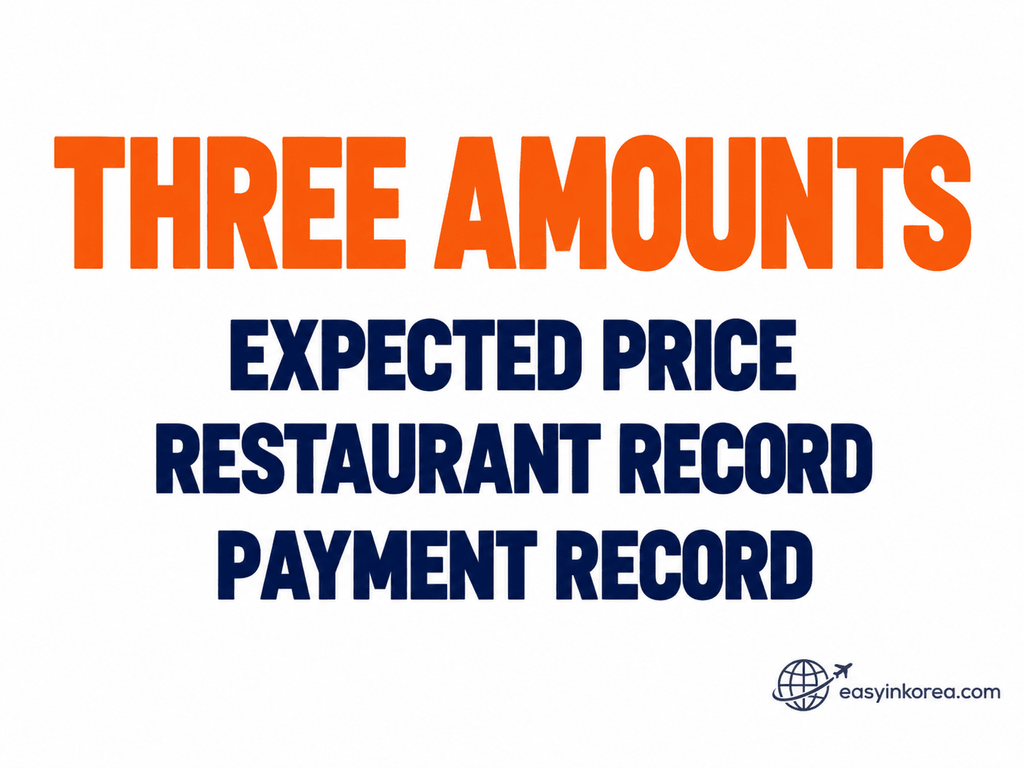
Found this image while checking a restaurant payment in Korea? The useful clue is not simply that two numbers look different, but where the records first stop matching.
Continue below to compare the three amounts and identify the next record to check.
When a restaurant charged the wrong amount in Korea, this three-part comparison helps you find where the problem begins.
1. Expected Price
This is the amount you expected from the relevant displayed price, what you ordered, the quantity and any additions or options that apply.
2. Restaurant Record
This is what the restaurant recorded on the bill, receipt or order record.
3. Payment Record
This is the amount shown by the payment method you actually used.
EXPECTED PRICE → RESTAURANT RECORD → PAYMENT RECORD
The first point where the amounts stop matching is the clue that matters most.
Check the Expected Price
Start with the price information connected to the food and options you actually ordered.
Compare the relevant menu or displayed price with what you actually ordered. Check the item, quantity, portion, additions and options that matter to the difference.
Are Restaurant Prices in Korea Supposed to Include VAT?
Korean government guidance states that the price of food sold by restaurants should be displayed as the final price including value-added tax.
The same guidance explains that food-service businesses must display prices where customers can see them, with additional display requirements applying to certain restaurants based on business type and floor area.
Do not automatically add VAT to a displayed restaurant food price yourself. But a difference between what you expected and what you paid still needs to be checked before deciding what caused it.
Check the Restaurant Bill or Receipt
Now check what the restaurant itself recorded before moving to the payment side.
Compare the restaurant record with the order and the relevant price information.
• The item
• The quantity
• The relevant price
• Additions or options
• The final restaurant total
If the restaurant record itself does not match the order or relevant displayed price, keep the payment-side question separate for the moment.
Check the Payment Record
The payment record is the third number, not a replacement for checking the restaurant bill.
Compare the restaurant’s final record with the payment record from the method you actually used.
If the two amounts match, the original problem may still be with the restaurant-side calculation or order record.
If the restaurant record shows one amount but the payment record shows another, keep that difference separate because the unresolved question may be payment-side.
Do not turn every card entry into a duplicate-charge, failed-payment or missing-refund problem. Identify what the payment record actually shows first.
Ask the Restaurant to Check the Difference
Once you find the mismatch, show the two relevant amounts instead of beginning with a long complaint.
Found where the numbers stop matching? Turn that difference into one clear question for the restaurant.

Found this image while trying to fix a restaurant charge in Korea? A verbal answer alone may not tell you whether the payment record now matches the correction.
Continue below to see what to verify before you consider the restaurant payment problem resolved.
Menu or Displayed Price vs Bill
“This price shows one amount, but the bill shows another amount. Could you check it?”
Order vs Bill
“I did not expect this item or amount. Could you check the order and bill?”
Receipt vs Payment Record
“The receipt shows this amount, but my payment record shows a different amount. Could you check the payment?”
If language is difficult, show the two relevant records while asking the restaurant to check the difference.
Did the Restaurant Correct the Amount?
A promise to fix the amount is not yet the same as knowing what action was actually taken.
Bill Corrected
Check the corrected restaurant total before paying or completing another payment when practical.
Payment Canceled or Reprocessed
Keep the restaurant record showing what it says happened. The payment-side result may still need to be checked separately.
Refund Promised
Save what the restaurant says it refunded and any useful receipt or confirmation. A refund being promised or initiated is not the same as confirming the final card-side result.
No Correction
Save the relevant records and identify who controls the unresolved part before moving to another recovery route.
What Evidence Should You Save?
Keep enough information to show the mismatch later without collecting unrelated personal data.
Useful evidence depends on the problem, but the goal is simple: preserve the records that show where the amounts differ.
• Bill or receipt
• Relevant menu or displayed price
• Relevant order details
• Payment record
• Restaurant name and location
• Date and approximate time
• Relevant messages or photos
• Any correction, cancellation or refund information
Do not share your full card number, CVV, banking password or one-time security code with a restaurant or an AI assistant.
Is This Actually a Card-Side Problem?
Separate a restaurant-side amount problem from a card-side transaction problem before changing recovery routes.
Restaurant Record Is Wrong
Start with the restaurant when the order, bill or restaurant-side total needs correction.
Restaurant Record Is Correct but the Payment Amount Is Different
Keep the restaurant record and payment record separate. The remaining question may belong to the card issuer or applicable payment route.
You See Two Card Entries
Do not finish that problem here. Continue with the dedicated Card Charged Twice in Korea? guide to check whether you are looking at two actual payments or another card-side status.
A Refund Is Not Showing
If the restaurant says a refund was processed but you cannot identify the card-side result, continue with the dedicated Refund Not Showing on Your Card in Korea? guide.
The Payment Did Not Complete
Continue with the dedicated Card Payment Failed in Korea? guide when the problem is a failed payment rather than an incorrect restaurant amount.
Who Controls the Next Result?
If the amount is still unresolved, match the remaining question to the organization that can actually handle it.
Still unresolved after you asked the restaurant? Choose the next route by what still needs to be corrected.
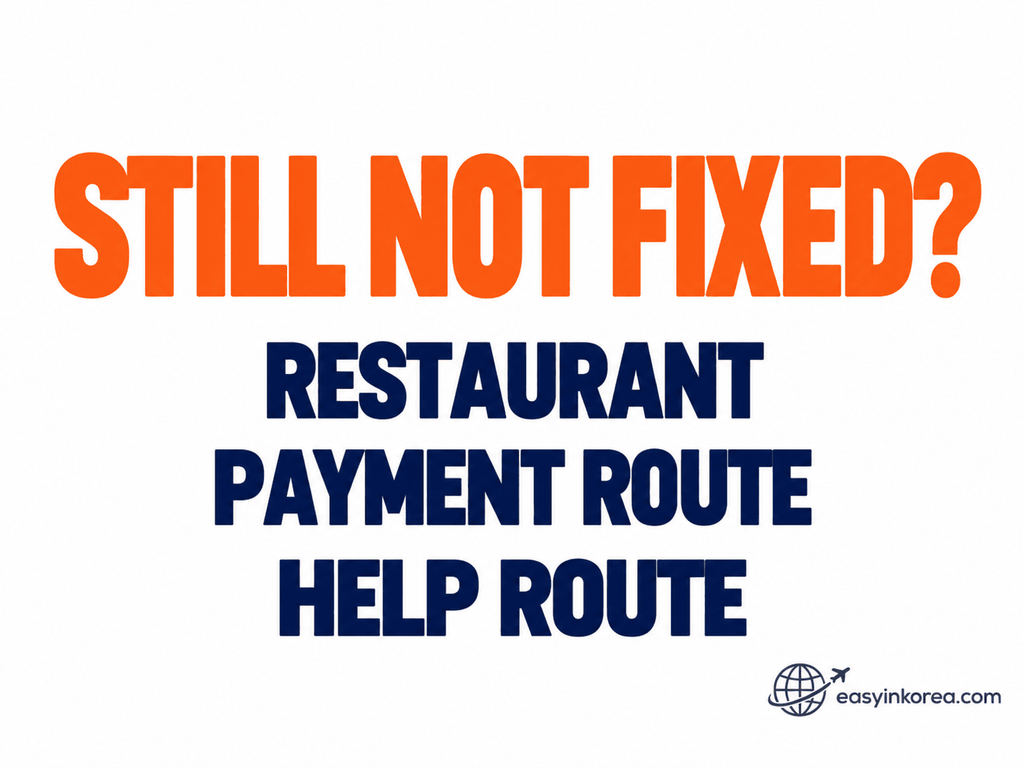
Found this image while looking for help with a restaurant charge in Korea? These are different recovery routes, not three steps that every traveler must follow.
Continue below to match the unresolved record or dispute to the route that can address it.
Restaurant
Use the restaurant when the unresolved issue is its order, bill, restaurant record or a correction the restaurant controls.
Card Issuer or Payment Route
If the restaurant-side record is clear but the unresolved difference is in the card transaction, use the issuer of the card you actually used or the applicable payment route.
Tourism Assistance
If you are an international traveler and need tourism information, multilingual assistance or a tourist-complaint route, 1330 can be a useful starting point.
Consumer Route
If an eligible consumer problem remains unresolved, consumer counseling may help identify the appropriate next procedure.
Already Left the Restaurant?
Leaving the restaurant changes what is easy to check, but it does not automatically change who controls the problem.
Start with the records you saved. Compare the expected price, restaurant record and payment record again.
Contact the restaurant when the unresolved difference is still in its order, bill or correction.
Use the applicable payment route when the restaurant-side record is clear but the payment-side result remains different.
If another tourism or consumer recovery route becomes relevant, keep the evidence that shows the specific mismatch.
What If You Already Left Korea?
Being outside Korea does not by itself change where the original mismatch happened.
If the restaurant record is the unresolved problem, keep that separate from a card-side transaction question.
If the restaurant-side action is already clear but your payment record remains different, continue with the applicable payment route.
Leaving Korea does not automatically turn a restaurant-side billing problem into a card-issuer problem.
Korea Tourism Organization currently lists +82-2-1330 for 1330 calls from overseas when tourism assistance or the tourist-complaint route is relevant.
Can 1330 Help With a Wrong Restaurant Charge?
Use 1330 for the tourism-assistance role it actually provides, not as a universal refund authority.
1330 can be useful when an international traveler needs tourism information, multilingual assistance or access to a tourist-complaint route.
It can therefore be a useful starting point for some unresolved restaurant problems, especially when you are unsure how a tourism-related complaint should be routed.
Do not treat 1330 as the organization that automatically controls a restaurant refund or card transaction. The organization that controls the unresolved amount may still need to handle that result.
Current Korea Tourism Organization information lists 1330 for calls in Korea and +82-2-1330 from overseas.
When Should You Use Consumer Counseling?
Consumer counseling becomes relevant when an eligible consumer problem remains unresolved after the direct restaurant-side step.
Korea Consumer Agency explains that the 1372 Consumer Counseling Center handles consumer complaints and provides counseling and information.
If the problem is not resolved through consumer counseling, an eligible case may move to the damage-redress process.
CONSUMER COUNSELING → ELIGIBLE UNRESOLVED CASE → DAMAGE REDRESS
Korea Consumer Agency describes damage redress as a process involving fact-finding and recommendations for an agreement between the consumer and business. It does not have the same compulsory force as a court judgment.
Final Check: Is the Wrong Amount Problem Finished?
Finish by checking the result, not only whether someone said they would look into the problem.
✓ I know the price I expected.
✓ I know what the restaurant recorded.
✓ I know what the payment record shows.
✓ I identified where the amounts stopped matching.
✓ I asked the organization that controls that difference.
✓ I saved the useful evidence.
✓ I know whether another recovery step is still needed.
The wrong-amount problem is complete when the incorrect amount has been corrected or you have a clear next recovery path — not simply when someone says they will check it.
FAQ
These answers cover the most important decisions when a restaurant amount in Korea does not look right.
What should I do if a restaurant charges me the wrong amount in Korea?
Compare the price you expected, the restaurant bill or receipt and the payment record. Find where the amounts stop matching, then ask the restaurant to check the part it controls.
Are restaurant menu prices in Korea supposed to include VAT?
Korean government guidance states that prices for food sold by restaurants should be displayed as final prices including value-added tax.
What if the menu price and restaurant bill are different?
Check the item, quantity, additions and relevant displayed price first. Show the restaurant the specific difference and ask it to check the bill.
What if the restaurant receipt is correct but my card shows a different amount?
Keep the restaurant receipt and payment record separate. If the restaurant-side amount is clear but the card-side amount remains different, the next question may belong to your card issuer or applicable payment route.
Can 1330 help if a restaurant charged the wrong amount in Korea?
1330 provides tourism information, multilingual assistance and access to tourist-complaint channels. It can be a useful starting point for some unresolved tourism-related problems, but it does not control every restaurant or card transaction result.
What if I notice the wrong restaurant charge after leaving Korea?
Start with the records you saved and identify where the amounts differ. Being outside Korea does not automatically change whether the unresolved problem is restaurant-side or payment-side.
AI Travel Assistant
Use AI to organize the mismatch and your next question, not to replace the restaurant, payment provider or official recovery route.
An AI assistant can help separate the amounts and organize the questions you need to ask. It cannot independently inspect a private restaurant or card record.
Copy this prompt:
“I think a restaurant charged me the wrong amount in Korea. The price I expected was [amount]. The restaurant bill or receipt shows [amount]. My payment record shows [amount]. I am [still at the restaurant / already left / outside Korea]. I have [receipt / menu price / payment record / photo / message]. Help me identify which amounts do not match and what I should ask the restaurant first. Do not assume that the restaurant, card issuer or complaint service controls every result.”
Do not paste your full card number, CVV, banking password, one-time security code, passport number or unnecessary personal information into an AI chat.
Official Sources
Use the official source that has authority over the part of the wrong-amount problem you need to verify.
Easy Law — Restaurant Price Display Rules
Use Korea’s Easy Law information to check current restaurant price-display rules, including the rule that restaurant food prices are displayed as final prices including VAT.
Check Official Restaurant Price Information →
Korea Tourism Organization — 1330 Travel Helpline & Complaint Center
Use current 1330 information for tourism assistance, multilingual support, tourist complaints and current contact methods.
Check Official 1330 Information →
Korea Consumer Agency — Consumer Counseling
Use Korea Consumer Agency information when an unresolved restaurant problem may require consumer counseling before an eligible damage-redress application.
Check Official Consumer Counseling Information →
Korea Consumer Agency — Damage Redress
Use the official damage-redress information to check current eligibility, procedure, evidence and dispute-resolution steps.
Conclusion
Finish with the mismatch you can verify, not an assumption about who caused it.
If a restaurant charged the wrong amount in Korea, do not treat the unexpected number as the answer to what went wrong.
Compare the expected price, restaurant record and payment record. Find the first mismatch, ask for the correction that matches it, and confirm what actually happened before moving to another recovery route.
EXPECTED PRICE → RESTAURANT RECORD → PAYMENT RECORD → FIND THE MISMATCH → ASK → CONFIRM → RECOVER → COMPLETE
Related Guides
Continue with the guide that matches the restaurant or payment problem you still need to solve.