Quick Answer
Lost something on the Seoul subway? Start with the trip you just took, not a citywide search.
Lost something on the Seoul subway? Rebuild your subway trip first.
Remember the line or rail service, direction, approximate time, stations and where you were inside the train if possible.
If you are still at or near a station, tell station staff as soon as practical. Give them the trip details you remember and a clear description of the missing item.
Do not assume every train on the wider Seoul metropolitan rail network uses the same lost-property route. The useful next contact can depend on the line, rail service or section you used.
Start here: LINE / SERVICE → DIRECTION → TIME → STATION → CONTACT
If the station or responsible rail operator cannot find your item, keep the same trip details and expand the search through Korea’s current police lost-property system when appropriate.
If you lost a phone, wallet or passport, protect the device, payment methods or travel document while the physical search continues.
Travelers Wish They Knew Before Searching Everywhere
The best clue may not be the missing item. It may be the subway trip that can lead someone back to it.
Before calling different lost-and-found centers, try to rebuild the journey.
Which line or rail service did you use? Which direction were you traveling? When did you get off? Which station did you use?
If you remember where you were inside the train, save that detail too.
What travelers often miss: The wider Seoul metropolitan rail network is not one single lost-property system. The useful next contact can depend on the line, service or section you used.
You do not need every detail before asking for help. Use what you know and clearly separate what you remember from what you are only estimating.
Rebuild the trip first. Then find who controls the next step.
Quick Navigation
Jump to the step that matches where you are in the recovery process now.
Can You Rebuild the Subway Trip?
Did You Just Get Off the Train?
Which Subway Line or Rail Service Did You Use?
Contact the Station or Correct Subway Operator
What Should You Do First If You Lost Something on the Seoul Subway?
Your first job is not to search all of Seoul. Rebuild the subway trip that may still lead to your item.
Before you search everywhere: can you still remember the subway trip where the item disappeared?

The missing item is only half of the problem. The trip can help narrow down which train, station or rail service should be checked first.
Next: rebuild the route while the details are still fresh, then use those clues to find the right recovery path.
Start with facts you already know. You do not need an exact train number before asking for help.
Your boarding station, destination or transfer station, direction and approximate time can already narrow the search.
If you used a map or route-planning app, check the route you followed. A route history or screenshot may help you remember the journey.
Can You Rebuild the Subway Trip?
You do not need perfect information. Combine the clues you still remember.
Before choosing who to contact: can you narrow the loss down to one part of your subway journey?
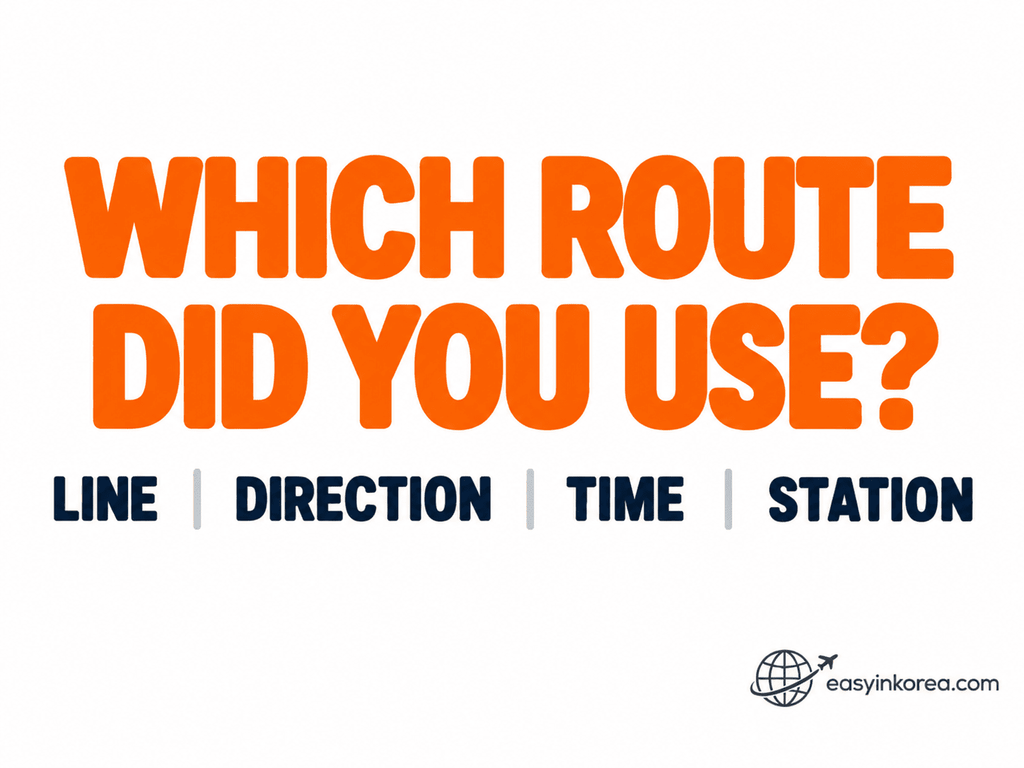
These clues do more than describe where you traveled. Together, they can narrow down which part of the rail journey should be checked first.
Next: turn what you remember into one usable trip record, even if some details are only approximate.
Save These Clues
- Subway line or rail service.
- Boarding station.
- Station where you got off.
- Direction of travel.
- Approximate boarding or exit time.
- Transfer station, if you changed lines.
- Approximate train-car position, if remembered.
- Where the item may have been left inside the train.
Do not delay asking for help because one detail is missing. Give the useful information you have and clearly say which details are uncertain.
Did You Just Get Off the Train?
If you noticed the loss immediately, the station you are standing in may be your best first contact.
If you notice the loss immediately after getting off, go to station staff or the customer information point as soon as practical.
Tell staff what you lost and give the trip details you remember.
The time, direction, station and approximate position inside the train can make your report more specific.
If the Item Fell onto the Tracks
Do not enter the track area or try to retrieve the item yourself.
Tell station staff and follow their safety instructions.
What Details Should You Give Station Staff?
Give staff enough information to identify both the journey and the missing item.
Use This Simple Order
I lost a __________.
I used __________ Line / rail service.
I traveled from __________ toward __________.
I got off at __________ at about __________.
I think I left it __________.
Describe the item clearly enough to distinguish it from similar property. Color, brand, size, case, bag type or another visible feature may help.
Do not unnecessarily share passwords, PINs, one-time codes, full payment-card numbers or other high-risk information.
Which Subway Line or Rail Service Did You Use?
Identifying the service matters because the wider Seoul rail network is not controlled by one lost-property desk.
Check the line or rail service you actually used.
The wider Seoul metropolitan rail network includes different services and operating organizations. Do not assume every train shown on a Seoul subway map uses the same customer-service or lost-property route.
If your journey included a transfer, consider both parts of the trip. You may have lost the item before or after changing lines.
If You Are Not Sure
Start with the stations, direction and route you remember. Those clues can help identify the likely service.
If you still cannot identify the responsible organization, ask station staff or use a current official travel-information route to help identify the correct contact.
Why Does the Subway Operator Matter?
The organization responsible for the relevant train or station may control the first recovery step.
A list of lost-and-found phone numbers is useful only after you know which service may have your item.
Different rail services can have different customer-service and lost-property routes.
This is why the safer sequence is:
TRIP → SERVICE / OPERATOR → CORRECT CONTACT
Do not choose a contact only because it is the first Seoul subway lost-and-found number you find online.
Contact the Station or Correct Subway Operator
Once you can identify the journey, move from remembering the trip to contacting the organization that can check it.
Still near the station? This is the moment to turn what you remember into an immediate recovery action.
Acting quickly is more useful when your explanation points to a specific journey instead of only describing the missing item.
Next: use the trip record you rebuilt to give staff a clear starting point for the search.
Keep your first explanation short.
Give the line or service, direction, stations, approximate time and item description.
Then ask what the current next lost-property step is for that specific service.
If staff direct you to another office or system, save that information before moving to the next step.
What If You Already Left the Station?
Leaving the station does not end the search. Rebuild the journey before deciding where to go back.
Check your route history, messages, photos or other time clues that can help establish where you were.
Then contact the station or responsible rail operator using current official information.
Do not automatically travel across Seoul just because you remember one station.
First check whether that station or operator is actually the useful next contact.
What If You Do Not Know the Exact Train?
An exact train number can help, but it is not the only way to identify the journey.
Build the strongest timeline you can from partial clues.
Combine the Details You Remember
Example: Line 2 → direction of travel → got off at City Hall → about 3:20 PM
This is more useful than saying only: “I lost my bag somewhere on the subway.”
If you transferred, describe both parts of the journey. You may not know exactly when the item disappeared.
What If the Station or Operator Cannot Find It?
“Not found yet” does not always mean the recovery path is finished.
A found item may be reported later, move through an operator’s lost-property process or be transferred into the police lost-property system.
Keep your trip details and item description. They can still help when the search moves to another system.
Do not treat seven days as a universal deadline for every Seoul subway lost item.
Current police guidance explains that found property handled by participating institutions may be kept for a period or transferred immediately before entering the police lost-property process.
Follow the current instructions of the organization handling your case rather than assuming one fixed timeline applies everywhere.
When Should You Expand the Search?
If the first station or operator search produces no result, move to the wider recovery system without losing your trip record.
The first search ended without a match? Keep the trip record you already built. You may need it again as the recovery path moves beyond the first station or operator.

A missing match at the first contact does not tell you where the item will appear next. Keep the same journey details and item description ready as you move to the wider recovery system.
Next: check the current official found-property route and decide whether a lost-item report is also useful.
Expand the search when the responsible station or operator does not have the item, or when their current instructions direct you to a wider lost-property system.
Do not discard the information you collected earlier. The date, time, location and item description can still help when you move to another recovery route.
Search Police Civil Service 24
Korea’s current police lost-property services are available through Police Civil Service 24, or 경찰민원24.
Police Civil Service 24 provides current lost-property services, including found-property searches and lost-item reporting.
Foreign visitors are included among the users who can use the applicable found-property search service.
Older Korea travel guides may still refer to LOST112. When checking your case now, use the current police service and its current instructions rather than relying only on an older screenshot or travel article.
Search With Useful Details
- Item type.
- Date.
- Approximate location.
- Color or visible identifying features.
- Other details that distinguish the item.
If you find a possible match, check which organization currently holds the property and follow its current collection instructions.
Should You File a Lost-Item Report?
Searching found-property records and reporting your own missing item are different recovery actions.
If your item has not appeared in the available search and a lost-item report is appropriate, Police Civil Service 24 provides a current reporting route.
An applicable police office can also handle a lost-property report.
Use accurate information. If you only know an approximate time or location, describe it as approximate instead of creating a false exact detail.
Keep any management number, receipt or reference information you receive so you can identify the report later.
What If You Lost Your Phone, Wallet or Passport?
Important items need two recovery paths: find the physical item and protect what the missing item can expose.
Do not wait for the physical search to finish before protecting an important item when protection is needed.
If You Lost Your Phone
Continue the physical search, but also consider the security of the device, SIM, accounts and payment functions.
Use legitimate device-location or security tools when available. Contact your mobile carrier or relevant account provider if necessary.
If You Lost Your Wallet or Payment Cards
Continue looking for the wallet, but check your cards and payment accounts at the same time.
If a card needs to be locked or reported missing, use the card issuer’s official service.
Do not give a stranger, business or unofficial support contact your full card number, CVV, banking password or one-time verification code just to prove that a wallet belongs to you.
If You Lost Your Passport
Continue the physical search, but remember that a missing passport can affect your ability to continue the trip or leave Korea.
Contact your embassy or consular authority when document protection or replacement guidance is needed.
Do not unnecessarily publish your full passport number while asking strangers, communities or unofficial services for help.
What If You Think the Item Was Stolen?
A missing item and a suspected theft are not automatically the same problem.
If you simply cannot find an item after a subway trip, start with the lost-property recovery route.
If you have a specific reason to believe someone stole the item or another crime occurred, the situation may require a separate police route.
For an immediate police emergency in Korea, the emergency number is 112.
Do not use an emergency route merely as a substitute for an ordinary lost-property search.
Can 1330 Help You Find the Right Route?
1330 can help reduce a travel-information or language barrier, but it does not replace the organization holding or searching for your item.
The 1330 Korea Travel Helpline provides tourism information and multilingual travel assistance for visitors in Korea.
It can be useful when language is blocking your next step or you need help understanding which tourism-related route to try.
However, 1330 is not the subway operator, the holder of your missing item or the police lost-property database.
Use 1330 to reduce the information or language barrier when appropriate. Then contact the organization that actually controls the next recovery step.
Remember: Help finding the right route is not the same as finding the item.
Final Check: Do You Know Who Controls the Next Step?
Before moving again, check whether you know exactly who controls your next recovery action.
Still at the station?
Tell station staff and give them your trip details.
Know the line or rail service?
Use the correct station or operator lost-property route.
No result yet?
Expand the search through the current police lost-property system when appropriate.
Lost a phone, wallet or passport?
Protect the device, payment methods or travel document while the physical search continues.
Specific reason to suspect a crime?
Separate the crime issue from the ordinary lost-property search and use the appropriate police route.
The recovery problem becomes easier when you know who controls the next action.
REBUILD → IDENTIFY → CONTACT → EXPAND → PROTECT → COMPLETE
FAQ
These quick answers cover the most common questions after losing something on a Seoul subway trip.
What should I do immediately after leaving something on a Seoul subway train?
Rebuild the trip using the line or rail service, direction, approximate time, stations and train position if remembered. If you are still at a station, tell station staff as soon as practical.
Do all Seoul subway lines use the same lost-and-found center?
Do not assume they do. The wider metropolitan rail network includes different services and operators, so identify the service you actually used first.
What if I do not know the exact train?
Give the line, direction, boarding and exit stations, approximate time, transfer information and train position if you remember them.
Where can I search for found property in Korea?
Police Civil Service 24, or 경찰민원24, provides current police lost-property services including applicable found-property searches and lost-item reporting.
Should I use LOST112 or Police Civil Service 24?
Older information may still refer to LOST112. For current police lost-property services, use Police Civil Service 24 and follow its current instructions.
What if I lost my phone, wallet or passport?
Continue the physical search while also protecting the device, payment methods or travel document when necessary.
Should I call 112 for a lost item?
An ordinary missing item does not automatically require an emergency call. Use the normal lost-property route unless there is an immediate police emergency or another situation requiring urgent police response.
AI Travel Assistant
Use AI to organize the subway trip you remember before contacting the organization that can actually help.
Useful Information to Give the AI
- What you lost.
- Subway line or rail service.
- Boarding station.
- Station where you got off.
- Direction.
- Approximate time.
- Transfer station.
- Where you think the item was left.
Example Prompt
I lost my bag while using the Seoul subway. I boarded at [station], used [line/service] toward [direction], transferred at [station if applicable], and got off at [station] at about [time]. Help me organize the trip details I should give station staff and identify what type of official service I should check next.
Use AI to organize the problem, not to replace current official information.
Do not give an AI your banking password, CVV, OTP, full payment-card number or other unnecessary high-risk information.
Official Sources
Use current official information for variable contacts, lost-property procedures and the organization responsible for your trip.
Relevant Subway or Rail Operator
Use the official operator responsible for the line or section you traveled. Lost-property contacts and procedures can vary by service, so current operator information should control variable details.
If you are not sure which organization is responsible, use the current police lost-property information below to check linked lost-property institutions, including applicable rail and subway organizations.
Police Civil Service 24 — Linked Lost Property Institutions ↗
Korean National Police — Police Civil Service 24
Use Police Civil Service 24, 경찰민원24, for current police lost-property services, including applicable found-property searches and lost-item reporting procedures.
Police Civil Service 24 — Official Website ↗
Police Civil Service 24 — Found Property Search Information ↗
Korea Tourism Organization — 1330 Travel Helpline
Use 1330 for current tourism information, multilingual travel assistance and applicable tourism-help guidance.
1330 does not replace the subway operator, the property holder or the police lost-property system.
Korea Tourism Organization — 1330 Travel Helpline & Complaint Center ↗
Contact information, service interfaces, office locations and lost-property procedures can change. Check the current official source that applies to your line, operator and item before relying on an older screenshot or travel post.
Conclusion: Rebuild the Trip Before You Search Everywhere
A successful recovery search starts with one clear question: what subway trip did you actually take?
If you lost something on the Seoul subway, do not begin by searching every lost-and-found office in the city.
Start with the trip.
Remember the line or rail service, direction, approximate time and stations. If you are still nearby, tell station staff.
Then identify the organization responsible for the relevant part of the journey.
If the first search does not find the item, keep those same details and expand the recovery route.
For a phone, wallet or passport, protect what the missing item can expose while you continue looking for it.
The goal is not simply to make more calls.
Know who controls the next step.
REBUILD THE TRIP → IDENTIFY THE RIGHT ROUTE → CONTACT → EXPAND THE SEARCH → PROTECT → COMPLETE
Related Guides
Continue with the guide that matches the recovery problem you still need to solve.
Lost Something in Korea? What to Do and Where to Check
Use this broader recovery guide when you are not sure where the item was lost or which organization may have it.
Read Guide →
Left Something in a Taxi in Korea? What to Do Next
Use this guide when the missing item was left in a taxi and you need to identify the ride before expanding the search.
Read Guide →
Problem in Korea? Who to Contact and What to Do Next
Use this guide when you know there is a problem but are not sure which business, operator, service or authority controls the next step.
Read Guide →
How to Use 1330 in Korea: Get Tourist Help Step by Step
Use this guide when language or travel information is blocking your next action and you need help finding the appropriate tourism-help route.
Read Guide →
Easy in Korea Travel Guides
Browse more practical Korea travel guides for transportation, lost property, tourist problems and the next travel problem you need to solve.
View All Guides →