Seoul Travel with Luggage: Store It, Carry It or Send It?
Your next destination changes the answer.
Before comparing lockers or delivery services, check whether you will need the bag again soon and whether you will naturally return to your current area. That tells you which option to examine first.
Seoul Travel with Luggage becomes easier when you decide what your bags need to do before choosing a locker, delivery service, train, or taxi.
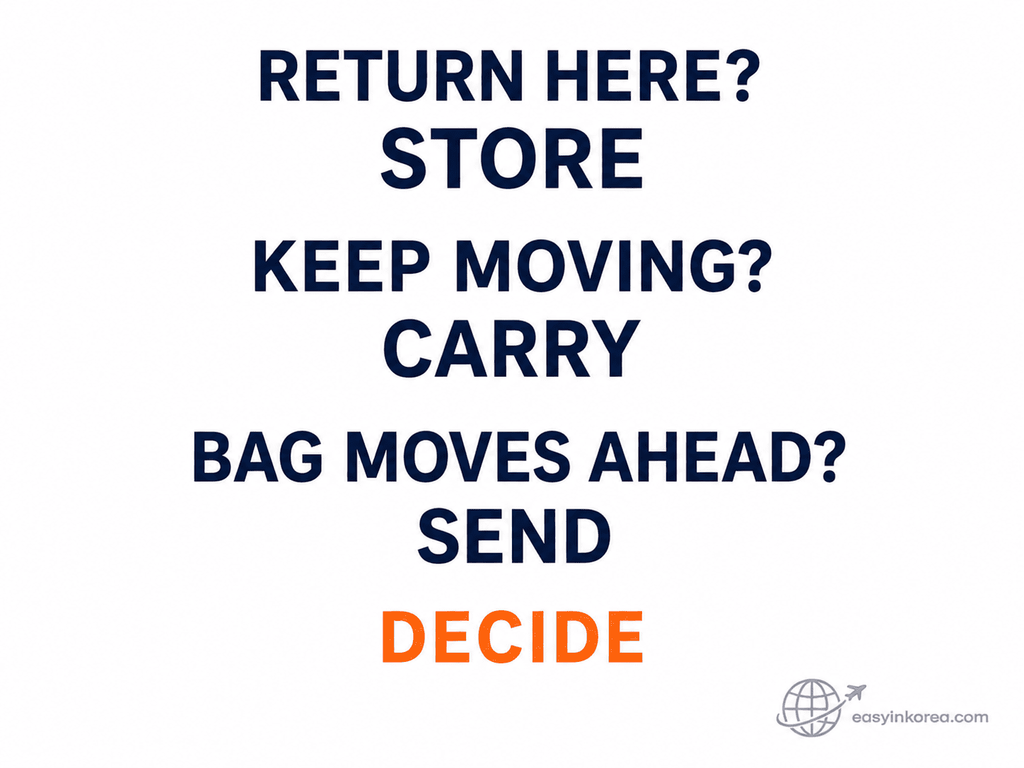
Carry your luggage when the complete route is manageable and you still need the bag. Store it when the bag can wait and you can return for it naturally. Send it when you are moving somewhere else and a supported delivery route can move the bag separately.
WAIT → STORE
MOVE WITH YOU → CARRY
MOVE WITHOUT YOU → SEND
Do not choose a luggage service first. Start with your next destination, whether you need the bag, and whether you will return to your current area.
Table of Contents
First Decide What Your Luggage Needs to Do
This first decision prevents a common Seoul Travel with Luggage problem: solving storage first and discovering later that you must cross Seoul again just to collect the bag.
Your luggage plan should support your travel route. Your travel route should not be rebuilt around your luggage.
When Should You Carry Your Luggage?
Check CARRY first when:
✓ You can manage every bag yourself.
✓ The walking and transfer route is manageable.
✓ You need access to the luggage soon.
✓ Storage or delivery would create an unnecessary extra step.
Do not judge this only by suitcase weight. A bag that feels manageable inside a hotel can become difficult after a long walk, stairs, floor changes, transfers, gates, or a crowded station.
Carry the luggage only when the whole route works with it.
Check the Whole Route Before You Carry It
The difficult part may be between the stations, not on the train.
Check how you enter, transfer, change floors, leave the station, and reach the final address. If one part creates too much luggage handling, compare storage or delivery before continuing with the bag.
↓
Street
↓
Station or Stop
↓
Elevator / Stairs
↓
Transfer
↓
Exit
↓
Destination
Count the places where you must physically control, lift, pull, or reposition your luggage.
If you are using the subway, an elevator somewhere in the station does not automatically mean your complete route is step-free. The useful entrance, transfer path, or exit may require a different route.
If one part of the route creates too much luggage friction, compare storage or delivery before committing to carrying the bag all day.
When Should You Store Your Luggage?
Ask one question first:
Will I naturally return here?
If yes, storage can remove unnecessary luggage from your sightseeing route without creating a difficult collection trip.
If no, storing the bag may create a new problem. You could finish your day in another part of Seoul and then need to travel back only to collect your luggage.
Before choosing storage, compare the storage location with where you will be when you need the bag again.
Check Your Accommodation Before Looking for Another Storage Option
Luggage holding is an accommodation-specific service. Do not assume that every hotel, guesthouse, or other property provides the same service, hours, conditions, or fee.
If storage is available, also check whether returning to the accommodation later fits your itinerary.
Free or convenient storage is not useful if collecting the bag creates a large detour from your next destination.
Locker or Staffed Luggage Storage?
The nearest storage option is not always the right one.
Before leaving your luggage, check whether the bag fits, the service is available, and the collection point still matches your later route. If one condition fails, move to another storage option instead of rebuilding the whole day.
Seoul Metropolitan Government currently lists T-Locker as subway-station self-storage and T-Luggage as staffed luggage storage plus same-day delivery at selected locations.
Check a Locker When
Your bag fits an available locker, the station is useful for your route, and you can return during the available retrieval period.
Check Staffed Storage When
A staffed location better matches your luggage, route, or service needs.
Do not assume that every station has the same locker sizes, availability, interface, staffed service, or operating conditions. Check the location you actually plan to use.
What If the Locker Is Full or Your Bag Does Not Fit?
LOCKER DOES NOT WORK?
1. Check another suitable locker or storage point.
2. Check staffed storage if practical.
3. Recheck accommodation storage.
4. Check delivery if your bag needs to move elsewhere.
5. Carry it only if the complete route is manageable.
Do not spend too much time protecting a storage plan that no longer works. Return to the original question: does the bag need to wait, stay with you, or move to another place?
When Should You Send Your Luggage?
Check SEND when:
✓ You will not naturally return to the storage point.
✓ You do not need the bag during the journey.
✓ Your origin and destination are supported.
✓ The current handoff and collection conditions fit your schedule.
Seoul Metropolitan Government currently lists T-Luggage as a same-day storage and delivery service on supported routes. Delivery is different from leaving a suitcase in a T-Locker.
Never assume that a service advertised as luggage delivery can collect from or deliver to every hotel, station, airport point, or locker.
Can Your Luggage Actually Be Delivered?
Check both ends of the journey before sending the bag.
Confirm where the luggage can be handed over, where it can be collected, and whether the timing fits your travel plan. If either end does not work, return to storage or carrying instead of forcing the delivery option.
START POINT?
DESTINATION?
BAG ACCEPTED?
HANDOFF TIME WORKS?
COLLECTION PLAN WORKS?
A delivery service works only when the entire chain works.
Check the exact origin and destination, accepted luggage conditions, current reservation or handoff requirements, and when and where the bag can be collected.
If one required part is unsupported, return to STORE or CARRY instead of assuming the delivery can be adapted.
Store or Send? Check Whether You Need to Return
| Your Plan | Check First | Why |
|---|---|---|
| Sightsee and return here | STORE | Collection already fits your route. |
| Finish somewhere else | SEND | It may remove a return trip if the route is supported. |
| Need the bag during the day | CARRY | You need continued access. |
| Delivery route unsupported | STORE / CARRY | Do not build the day around an unavailable service. |
| Locker unavailable | OTHER STORAGE / SEND / CARRY | Recover from the failed option instead of restarting the day. |
The lowest storage price is not automatically the lowest-cost travel decision if collecting the bag creates another long trip across Seoul.
What If You Have Heavy Luggage, Children, a Stroller or Limited Mobility?
Count difficult luggage moves.
Walking → stairs → elevators → gates → transfers → street crossings → final destination
This matters when you have several large bags, travel with children or a senior, use a stroller or wheelchair, or need a lower-effort route.
A route with fewer train transfers is not automatically easier. One transfer can still involve a long walk or several floor changes.
Compare CARRY, STORE, and SEND by how much luggage handling each option creates on your actual route.
First Day, Hotel Change or Last Day?
| Journey Stage | Main Question | Decision |
|---|---|---|
| First Day | Can the accommodation take the bag before check-in? | Compare accommodation storage, other storage, delivery, or carrying. |
| Hotel Change | Do you want to sightsee between the two accommodations? | Compare carrying with supported delivery or useful storage. |
| Last Day | Where will you finish before leaving Seoul? | Avoid storage that creates an unnecessary return trip. |
Seoul Travel with Luggage is easier when your luggage plan follows the direction of your journey instead of pulling you back toward a place you have already left.
Seoul Travel with Luggage: Quick Decision
Found the option that matches your route?
Stop comparing the choices that no longer apply. Confirm the practical details for your selected option, keep a backup if it fails, and move on once your luggage plan works from this point to where you need the bag next.
Will you naturally return?
Check STORE.
Will the bag stay with you?
Check the complete CARRY route.
Will you finish somewhere else?
Check whether SEND is supported.
Did your first option fail?
Use the next option that still fits your journey.
Stop comparing options once one complete plan works from your current location to the point where you need your luggage again.
September 2026 official check:
Seoul Metropolitan Government currently lists T-Locker as hourly self-storage in subway stations and T-Luggage as staffed luggage storage plus same-day delivery at selected stations.
The current Seoul page lists T-Luggage locations including Seoul Station, Hongik Univ. Station, Jamsil Station, Myeong-dong Station, Gimpo Int’l Airport Station, and Jongno 3(sam)-ga Station.
Incheon Airport currently states that T-Luggage same-day delivery can connect supported Seoul Metro locations with the airport, but at least one end must be a T-Luggage on-site registration counter and the service has route and locker-size restrictions.
Locations, availability, fees, baggage rules, handoff times, and supported delivery routes can change. Verify only the service detail that controls your selected option.
FAQ: Seoul Travel with Luggage
Should I carry my luggage around Seoul?
Carry it when you can manage the complete route and need continued access to the bag. Check walking, stairs, elevators, transfers, crowds, and the final destination rather than judging only by luggage weight.
Where can I store luggage in Seoul?
Depending on your location and current availability, options can include accommodation storage, subway station lockers, and staffed luggage storage. Check the specific location and current conditions before relying on one option.
Can I leave luggage at a Seoul subway station?
Seoul Metro provides T-Locker storage at many subway stations. Locker size, availability, access, and operating conditions can matter, so check the station and current service before travel.
What is the difference between T-Locker and T-Luggage?
T-Locker is a subway-station self-storage locker service. T-Luggage provides luggage storage and supported same-day delivery services at selected locations and routes.
Can I send luggage to Incheon Airport?
Supported same-day airport delivery options exist. Incheon Airport currently says at least one end must be a T-Luggage on-site registration counter, so confirm the exact origin, destination, luggage size, handoff time, and collection point before relying on the service.
Should I store or send luggage on my last day in Seoul?
Store it when you will naturally return to collect it. Check delivery when you will finish somewhere else and a supported service can move the bag toward the place where you need it next.
What if a luggage locker is full?
Check another suitable locker or staffed storage option, accommodation storage, supported delivery, or carrying. A full locker should change the storage option, not destroy the whole itinerary.
Can I leave luggage at my hotel after checkout?
Ask the property directly. Luggage holding before check-in or after checkout depends on the accommodation’s current policy and conditions.
Seoul Travel with Luggage: Check Your Plan Before You Move
□ I know my next destination.
□ I know when I need my luggage again.
□ I know whether I will return to this area.
□ I checked the complete route if I will carry it.
□ I checked the actual storage option if I will store it.
□ I checked the supported route if I will send it.
□ I kept anything I need during the day with me.
□ I have a backup if my first option does not work.
Your Seoul Travel with Luggage plan is complete when your bags can reach the point where you need them next without creating an unnecessary return trip.
Once this problem is solved, continue with the next unresolved part of your Seoul journey.
You know whether the bag should stay with you, wait in storage, or move separately, and you know the route, return plan, service conditions, and backup that apply to that choice.
Once one complete luggage plan works from your current location to the point where you need the bag next, stop comparing options and continue with the trip.
Official Closing
Check current official information for:
• T-Locker locations, availability, sizes, access, and operating conditions.
• T-Luggage locations and current storage conditions.
• Supported luggage-delivery origins and destinations.
• Current handoff and collection times.
• Current fees, restrictions, and airport procedures when relevant.
Use current official information for details that can change after this guide is published.
Seoul Metropolitan Government — Subway Storage Facilities →
Check current T-Locker and T-Luggage locations, sizes, availability, fees, hours, and service conditions.
Incheon International Airport — T-Luggage Airport Delivery →
Check current T-Luggage airport delivery counters, supported routes, handoff information, locker-size restrictions, and airport conditions.
If current official information differs from an older guide, reservation page, screenshot, or previous trip, follow the current service information.
Easy in Korea
Do not solve every luggage problem at once. Decide what your bag needs to do next, verify the service that controls that step, and complete one real travel problem at a time.