Last Updated: August 10, 2026
Introduction
At Seoul Station, the first question is simple: what are you taking next?
Transferring at Seoul Station? Check whether you need AREX, KTX, or the subway before you start walking.
This Seoul Station Transfer Guide starts with the decision that matters most: what are you taking next? AREX connects Seoul Station with Incheon Airport, KTX connects Seoul with major cities across South Korea, and Seoul subway services continue into the city.
Do not try to memorize the whole station first. Identify your next connection, follow the current transfer signs, and check the fare gate, floor change, elevator, or walking distance when your route requires it.
Seoul Station connects airport trains, KTX trains, Seoul subway services, and street exits in one large transport area.
You do not need to understand the whole station before you start moving. First, check what you are taking next. Then follow the signs for that connection.
This Seoul Station Transfer Guide focuses on the decisions that matter during the transfer: your next train, the transfer signs, fare gates, floor changes, walking distance, elevators, and the next platform.
If you are carrying large luggage or need a step-free route, check those conditions before following the shortest-looking path.
Table of Contents
Quick Answer: What Should You Check First?
Not sure where to go first?
Not sure which way to go at Seoul Station? Find your next connection first—AREX, KTX, subway, or street exit—before you start walking.
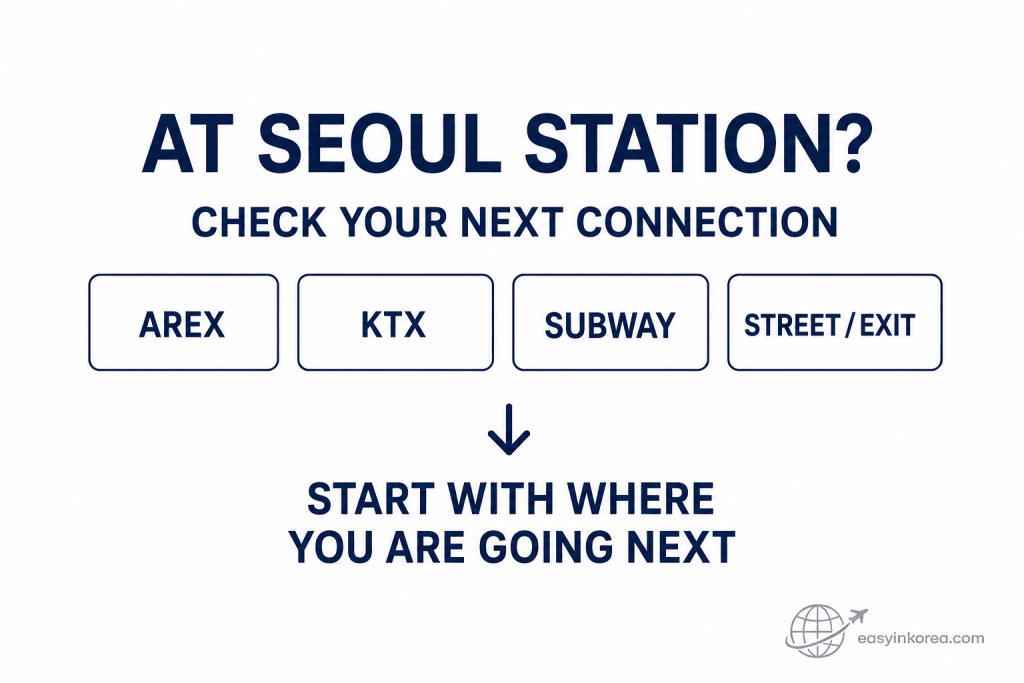
The first decision in this Seoul Station Transfer Guide is not which corridor or exit to use. It is what you are taking next.
Choose AREX for an airport railroad connection, KTX for your next railway trip, the subway for travel within Seoul, or a street exit when Seoul Station is your final rail stop.
Once you know the next connection, follow the current station signs and check the fare gate, floor change, platform, elevator, or walking distance only when your route requires it.
Start with your next connection, not with an exit number or a floor number.
- Check what you are taking next. AREX, KTX, subway, or a street exit.
- Look for the matching station sign.
- Check whether your transfer includes a fare gate or floor change.
- If you have large luggage, check the elevator and walking distance before moving.
- If you need step-free access, check the full route to the next platform or street level.
The same station name can lead to different parts of the complex. Your next connection gives you the clearest starting direction.
Why Seoul Station Transfers Can Feel Confusing
Everything says “Seoul Station,” so why does the walk feel different?
Seoul Station is not one small platform area. Different rail and subway services use different parts of the station complex.
You may be moving between:
- Airport Railroad / AREX
- KTX and other railway services
- Seoul subway services
- Street exits and nearby destinations
This is why simply following a sign that says “Seoul Station” is not enough once you are already inside the station.
Look for the name of your next transport service or your next destination.
Think of the transfer as one small decision at a time. You only need to find the next correct sign.
Know What You Are Transferring From
Which train did you just get off?
Before walking, identify your arrival service.
You may have arrived by AREX, KTX, another railway train, or the Seoul subway.
Your starting point matters because two travelers going to the same next train may begin from different parts of Seoul Station.
Do not copy another traveler’s route only because you have the same final destination. Check your own arrival point first.
Use this simple check
- Where did I arrive?
- What am I taking next?
- Which sign matches that connection?
Once you know those three things, the transfer becomes much easier to follow.
Know What You Are Transferring To
What is your next train?
Your next connection is usually more useful than trying to memorize the whole station map.
Common Seoul Station transfers include:
- AREX → KTX
- KTX → AREX
- AREX → Subway
- Subway → AREX
- KTX → Subway
- Subway → KTX
- Subway → another subway line
- Train or subway → street exit
Find your own combination first.
Then follow the current station signs for the service you need next. This is safer than depending on an old screenshot, a remembered floor number, or a fixed train-car position.
Seoul Station Transfer Decision
Once you know your next train, the station becomes easier to read.
Know what you are transferring to? Choose AREX, KTX, or the subway first, then look for the matching transfer sign before you walk farther.
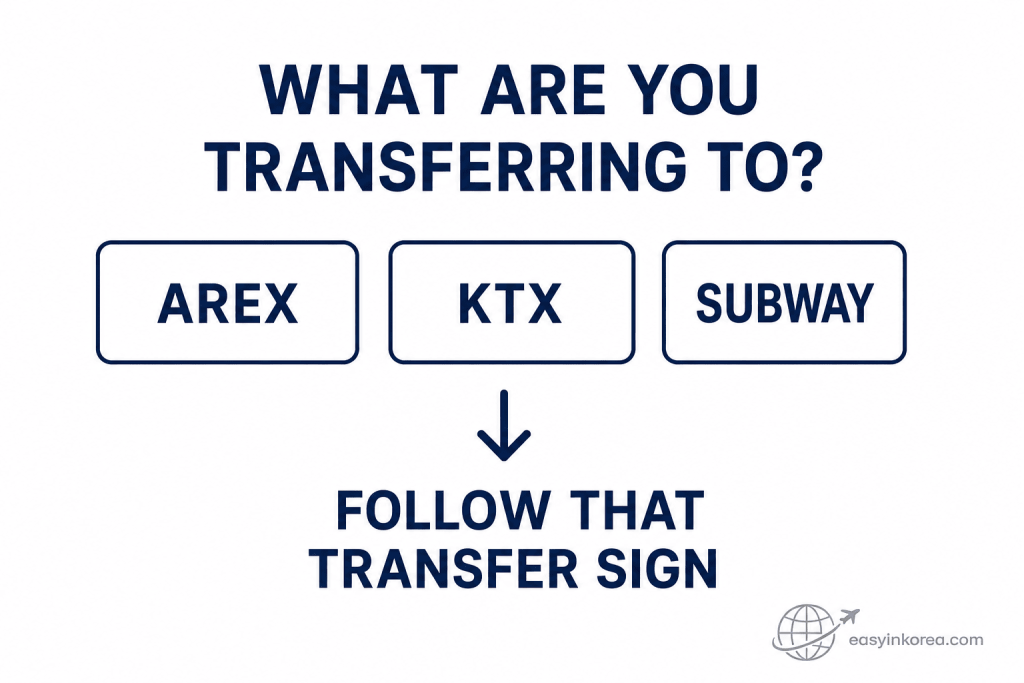
This part of the Seoul Station Transfer Guide turns a large station into one simple decision: identify the transport service you need next.
If you are transferring to AREX, follow Airport Railroad signs. If you are taking KTX, follow KTX or railway train signs. If you are continuing by subway, follow the subway signs for the line and direction you need.
After choosing the correct connection, keep checking the current station signs as you move. Fare gates, floor changes, elevators, and platform access may differ depending on your route.
Use your next connection as the main decision point.
| Next Connection | What to Look For |
|---|---|
| AREX | Airport Railroad / AREX signs |
| KTX | KTX / railway train signs |
| Subway | Subway and the line you need |
| Street | Your destination direction and exit signs |
Do not start with a fixed floor number unless you have confirmed that it applies to your current route.
The station signs should lead the decision. Your phone map can then help with the final destination after you reach the correct station area or street level.
AREX to KTX
Arriving from Incheon Airport and taking a KTX next?
After leaving your AREX train, confirm your KTX departure before walking far into the station.
Use this order:
- Check your KTX train and departure information.
- Follow the current signs for KTX or railway trains.
- Check any floor change along the route.
- Allow extra walking time if you have large luggage.
- Find the boarding area for your train.
Avoid depending on a specific AREX car or door as the main transfer rule. Your train position, station conditions, and the route you need can make the practical walking path different.
If the signs become unclear, stop and confirm the KTX direction before continuing farther.
KTX to AREX
Heading to Incheon Airport after your KTX trip?
After arriving by KTX, first look for Airport Railroad or AREX signs.
Before you reach the boarding area, check which airport train service matches your plan.
Check before boarding
- Which AREX service are you taking?
- Which airport terminal do you need?
- What is the current departure time?
- Do you have enough time for the walk and ticket process?
Do not assume that every train leaving toward Incheon Airport works the same way.
If you are traveling with several bags, check the walking distance and elevator route before following stairs or escalators automatically.
AREX to Subway
Going into Seoul after the airport train?
After arriving by AREX, check the subway line and direction you need before following the subway signs.
Your basic sequence is:
NEXT SUBWAY LINE → TRANSFER SIGNS → FARE GATE → PLATFORM
Pay attention to fare-gate instructions during the transfer. Moving between different rail systems may involve a different gate or ticket process from a normal subway-to-subway transfer.
Before going down to a platform, check the direction of travel. Reaching the correct subway line is only the first step; you also need the correct direction.
If you are unsure, confirm the destination stations shown on the platform signs before boarding.
Subway to AREX
Taking the airport train next?
From the subway, follow the Airport Railroad or AREX signs rather than following a street exit.
Before boarding, check:
- the airport train service you plan to use
- the current departure information
- your airline terminal at Incheon Airport
- any ticket or gate steps required for your chosen service
If you plan to use a Seoul Station airport-related service before departure, check its current eligibility and operating conditions before building your airport schedule around it.
Airport services, participating airlines, operating times, and procedures can change. Use the current official information for the day of your trip.
KTX to Subway
Finished your KTX trip and continuing by subway?
After leaving your KTX train, check the subway line and direction you need before following the subway connection.
Do not choose a route only because it appears to be the closest stairway or escalator.
Instead:
- Confirm the subway line.
- Follow the current subway signs.
- Check the fare-gate area.
- Confirm the direction of travel.
- Go to the correct platform.
If you have luggage, a stroller, or limited mobility, check the elevator before committing to a long stair or escalator route.
Subway to KTX
Have a KTX train to catch?
Taking KTX next at Seoul Station? Check your train and departure time before following the KTX signs to your platform.
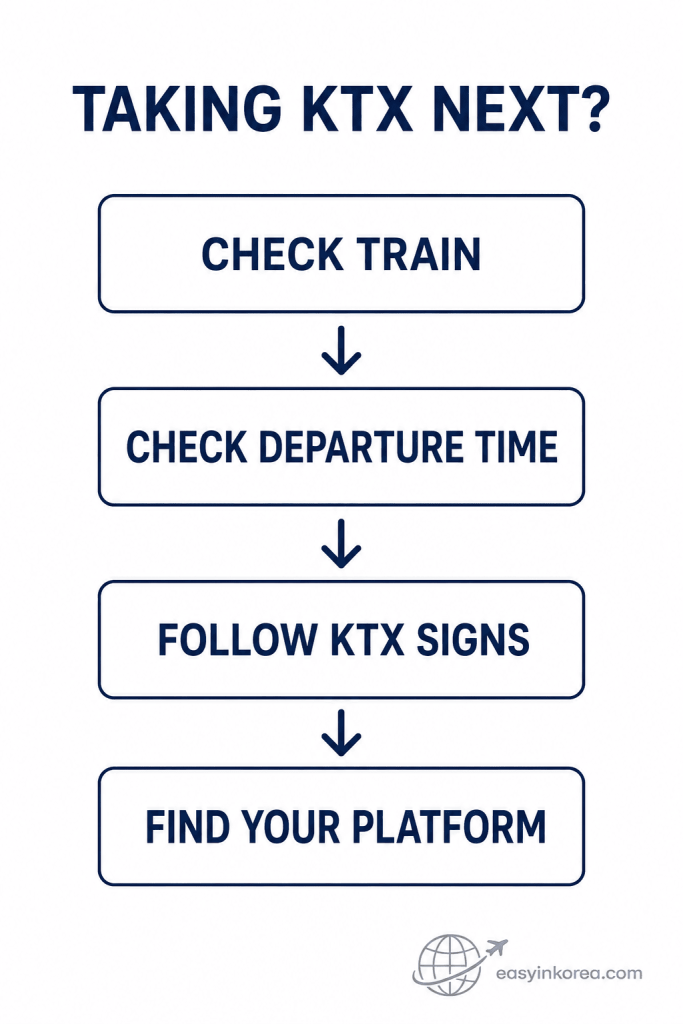
This Seoul Station Transfer Guide uses a simple KTX boarding sequence: confirm your train first, check the departure time, follow the current KTX signs, and then find the platform shown for your departure.
Do not start with a remembered platform number or an old station screenshot. KTX departure information can vary by train, so use the current departure board and station signs at Seoul Station.
If you are transferring from the Seoul subway, AREX, or another train, also allow time for the walk, fare-gate changes, luggage, elevators, and any floor changes before you reach the KTX boarding area.
If you are arriving by subway for a KTX trip, check your train information before you begin the final walk through Seoul Station.
Follow the KTX or railway signs, then confirm your departure information again before going to the platform.
Do not plan the connection around one fixed transfer time. The practical time you need can change with:
- your arrival platform
- your walking speed
- luggage
- elevator use
- crowds
- ticket or boarding steps
- the location of your departure area
Give yourself enough time to solve a wrong turn without having to rush through the station.
What About Line 1 and Line 4 Transfers?
Changing subway lines at Seoul Station?
If your trip continues on another subway line, start by checking the line and direction you need next.
Then follow the current transfer signs.
Your transfer logic is:
CURRENT PLATFORM → TRANSFER SIGNS → NEXT LINE → DIRECTION → PLATFORM
A train-car position may sometimes reduce walking, but it should not be treated as the main rule for every traveler.
If you miss the most convenient transfer position, you can still complete the transfer by following the station signs.
For a wheelchair, stroller, or large suitcase, elevator access matters more than reaching a particular train door.
Check the Fare Gate Before You Move
Do you need to pass through another gate?
Before you follow the crowd at Seoul Station, check your transfer route. Confirm the transfer sign, fare gate, and floor change before heading to your next train.
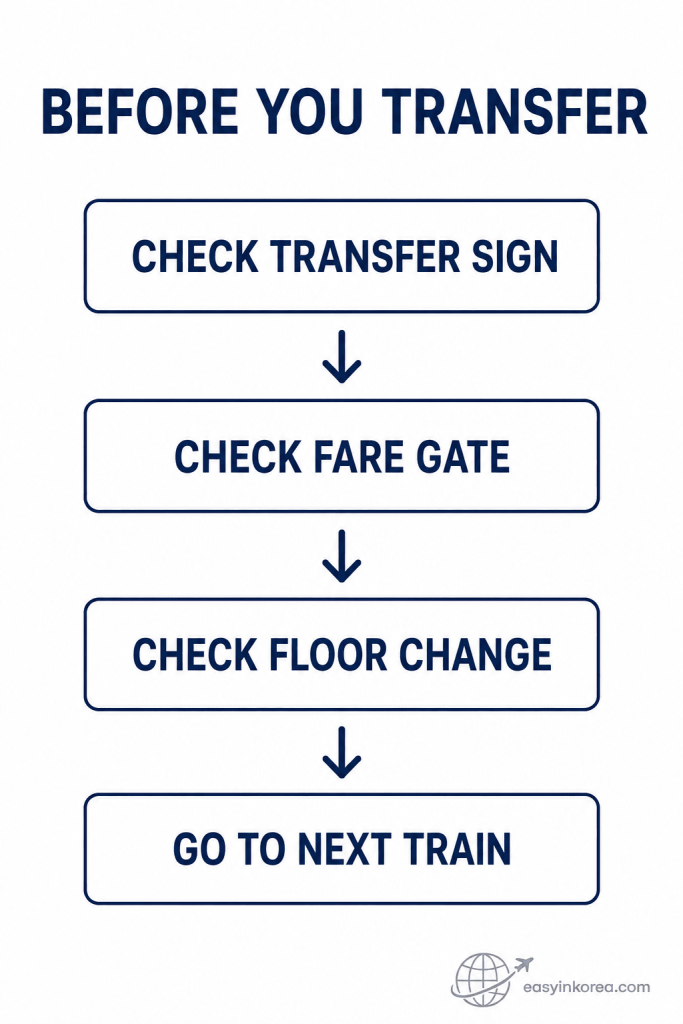
This part of the Seoul Station Transfer Guide focuses on the checks that can change your route inside the station: the transfer sign, fare gate, and floor change.
Do not assume that every Seoul Station connection is a simple platform-to-platform transfer. Moving between AREX, KTX, and Seoul subway services may lead you through different station areas, gates, or levels.
Keep following the current signs for your next service. If a fare gate or floor change appears, confirm that the route still matches your train before continuing.
Do not assume that every Seoul Station connection works like a simple platform-to-platform subway transfer.
Depending on the services you are moving between, the route may include a fare gate, ticket check, or a different station area.
Before passing through a gate:
- check that the sign still points to your next service
- look for any ticket or fare instructions
- check whether you are leaving one transport area and entering another
If you pass through the wrong gate and become unsure about the route, do not look for an unofficial shortcut. Ask station staff how to return to the correct transfer direction.
Traveling with Large Luggage
Got a suitcase with you?
Carrying a large suitcase through Seoul Station? Check the elevator, floor changes, transfer distance, fare gate, and next platform before choosing your route.
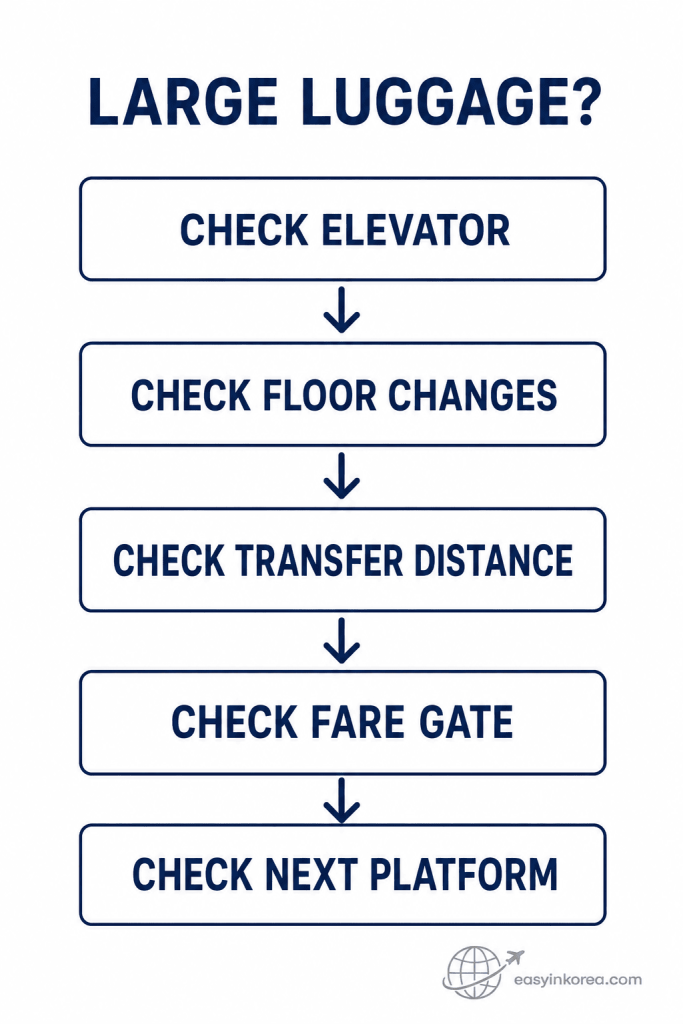
This Seoul Station Transfer Guide separates large-luggage planning from general accessibility. With a suitcase, the route that looks shortest on a map may still include long walks, floor changes, or a tight fare-gate area.
Before moving between AREX, KTX, or Seoul subway services, check whether your route has an elevator, how many levels you need to change, and how far you may need to walk with your bags.
Then confirm the fare gate and next platform. If the elevator route is unclear, follow the current station signs or ask staff before committing to stairs or a long detour.
A short-looking transfer can feel much longer when you are pulling a large suitcase.
Before choosing stairs or following the first crowd you see, check:
- Elevator: Is there an elevator on the route you need?
- Floor changes: How many levels do you need to move between?
- Transfer distance: Is there a long walk between services?
- Fare gate: Can you move through the gate comfortably with your bags?
- Next platform: Do you still need another floor change after the gate?
The shortest route is not always the simplest route with a large suitcase.
Keep enough space around your bags in busy passages, and avoid stopping suddenly in front of fare gates, escalators, or platform entrances.
Wheelchair, Stroller, or Limited Mobility?
Need a step-free transfer?
Need a step-free transfer at Seoul Station? Check the full route from your arrival platform to your next platform instead of relying on one elevator alone.
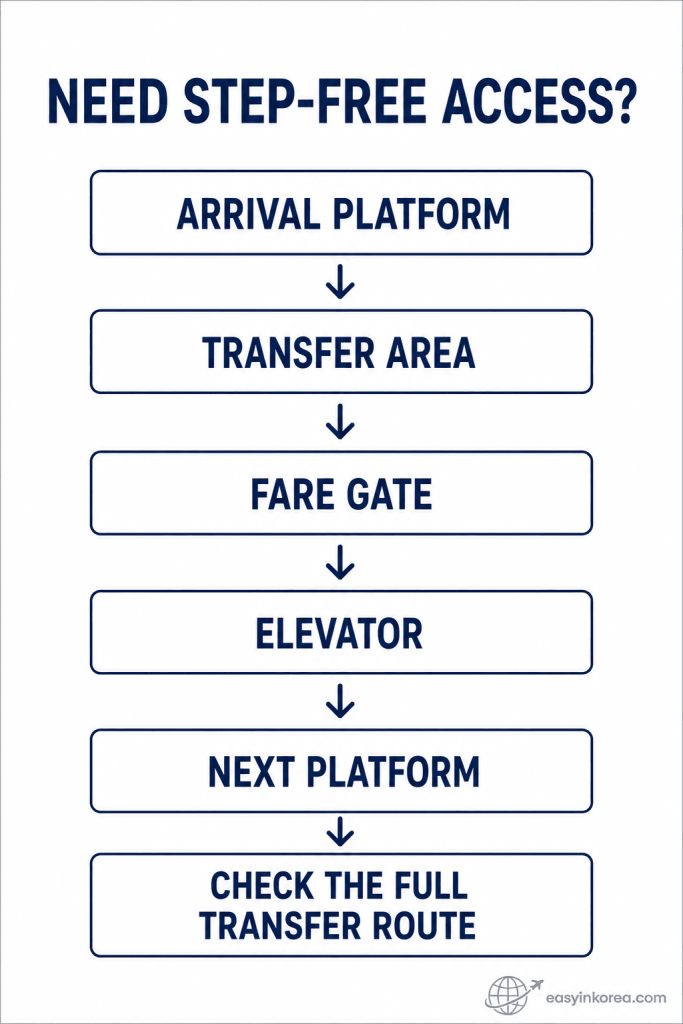
This accessibility section of the Seoul Station Transfer Guide focuses on route continuity. A step-free transfer is not confirmed just because one elevator appears along the way.
Check the connection from your arrival platform through the transfer area, any fare-gate access, the elevator route, and the next platform. The exact order and station elements can vary depending on whether you are connecting to AREX, KTX, or a Seoul subway service.
If you use a wheelchair, stroller, or have limited mobility, follow current station accessibility signs and check the full transfer route before moving. Elevator availability or temporary access conditions can change.
Do not check only one elevator.
A useful step-free transfer needs continuity from your arrival point to your next train or destination.
Check the full journey:
- Arrival platform
- Route into the transfer area
- Fare-gate access
- Elevator between required levels
- Access to the next platform
If you are leaving Seoul Station, continue the check to street level and the final destination entrance.
One elevator does not prove that the whole transfer is step-free.
Elevator availability, temporary restrictions, construction, and station operating conditions can change. Follow current station accessibility information and ask staff if the step-free connection is unclear.
Going from Seoul Station to the Street
Your train trip is finished. Which way should you leave?
If Seoul Station is your final rail stop, switch from thinking about trains to thinking about your destination.
Use this order:
DESTINATION → DIRECTION → EXIT
Do not choose an exit only because its number looks familiar from a map or an old travel guide.
First check where you are going:
- hotel
- bus stop
- taxi area
- shopping
- nearby attraction
- another meeting point
Then choose the exit or street direction that matches that destination.
If you use a wheelchair, stroller, or large luggage, check whether the route to street level has the elevator access you need. Reaching the correct station exit area does not automatically mean the final outdoor route is step-free.
What If You Go the Wrong Way?
Took the wrong corridor or passed the wrong gate?
A wrong turn at Seoul Station does not mean you need to keep walking until you find another route.
Use this recovery sequence:
STOP → CHECK NEXT CONNECTION → CHECK CURRENT SIGN → RETURN IF NEEDED → ASK STAFF
If the sign no longer shows your next train
Stop before going farther. Look back for the last transfer sign you clearly understood.
If you passed through the wrong fare gate
Do not try to create your own way around the gate. Ask station staff how to return to the correct area.
If you cannot find an elevator
Check the current station signs or ask staff for the step-free route. An elevator in another part of the station may not connect to the platform you need.
Recovery is usually easier when you stop early instead of continuing in the wrong direction.
Common Mistakes at Seoul Station
A small check before walking can save a long return trip.
1. Following “Seoul Station” instead of the next connection
Once you are already inside the station, look for AREX, KTX, subway, or your destination rather than the station name alone.
2. Assuming every airport train works the same way
Check the service you plan to use, its current departure information, and your airport terminal before boarding.
3. Choosing an exit before checking the destination
Use destination first, direction second, and exit third.
4. Following stairs first with large luggage
Check the elevator and floor changes before choosing the quickest-looking path.
5. Assuming one elevator means a full step-free route
Check continuity from your current platform to the next platform or street level.
6. Relying on an old screenshot
Station signs, services, elevator conditions, and operating information can change. Use the current signs when they differ from an older guide.
What Travelers Wish They Knew
Seoul Station feels simpler once you stop trying to understand the whole station at once.
You do not need a perfect mental map of Seoul Station before your first transfer.
What helps more is knowing one thing clearly:
What am I taking next?
Once you know that, look for the matching sign. When the sign changes, check again. If you reach a fare gate or floor change, confirm that you are still following the same connection.
With a suitcase, stroller, wheelchair, or tired legs after a long trip, it is also fine to choose the route that gives you more time to check the elevator and walking distance.
The goal is not to move through Seoul Station without ever stopping. The goal is to keep knowing what your next action is.
FAQ: Seoul Station Transfers
These are the practical questions to check before your next connection.
Can I transfer from AREX to KTX at Seoul Station?
Yes. After arriving at Seoul Station, follow the current signs for KTX or railway trains. Allow enough time for the walk, floor changes, and your boarding steps.
Can I transfer from KTX to the Seoul subway?
Yes. Check the subway line and direction you need, then follow the current subway signs from the railway area.
Can I transfer from the subway to AREX?
Yes. Follow the Airport Railroad or AREX signs, then check the airport train service, departure information, ticket requirements, and airport terminal before boarding.
Is the whole Seoul Station transfer step-free?
Do not assume that one elevator makes every transfer route fully step-free. Check the full route from your arrival platform through the transfer area and fare gate to the next platform or street level.
Should I use a specific train car for the elevator?
A specific car position may sometimes reduce walking, but it should not be treated as a permanent transfer rule. Follow current station signs and accessibility information for the route you need.
How much time should I allow for a Seoul Station transfer?
There is no single transfer time that works for every traveler. Your route, luggage, walking speed, elevator use, crowds, ticket steps, and departure platform can all affect the time you need.
What should I do if the signs do not match an old travel guide?
Follow the current station information. If the route is still unclear, ask station staff before continuing farther into the wrong area.
Check Current Official Information
Check current railway, airport railroad, and subway information before relying on a specific platform, timetable, elevator, or station service.
Some Seoul Station information can change. Check current official information when your trip depends on a specific service or station condition.
Check again for:
- train departure times
- platform information
- AREX operations
- airport-related services at Seoul Station
- subway operating information
- elevator or accessibility conditions
- temporary construction or route changes
Official information:
If an old screenshot, blog post, or saved map conflicts with current station signs or official information, use the current information for your trip.
AREX’s official site currently provides Seoul Station–airport route and ticket information, while Incheon Airport separately directs travelers to Airport Railroad information for current fares, schedules, and services. Seoul Metro also provides current train-operation information and notes that actual operation can vary.
Conclusion
A Seoul Station transfer starts with one simple question: what are you taking next?
You do not need to memorize every floor, corridor, or train-car position at Seoul Station.
Start with your next connection. Then follow the current signs and check the fare gate, floor changes, and next platform as you move.
If you have large luggage, check the elevator and walking distance before choosing your route.
If you need step-free access, check the full transfer from your arrival platform to your next platform or street-level destination.
CHECK YOUR NEXT CONNECTION → FOLLOW CURRENT SIGNS → CHECK ELEVATOR OR DISTANCE IF NEEDED → GO TO YOUR NEXT PLATFORM.
Before travel, confirm any timetable, platform, service, or accessibility information that could affect your connection.
Related Guides
Continue with the guide that matches your next practical step before or after transferring at Seoul Station.
Continue with the guide that matches your next practical step before or after transferring at Seoul Station.